The end of the year is often a reflective time. Dr. Frank Sells, one of my favorite Bible teachers, used to warn us of becoming “morbidly introspective.” If our reflection concentrates on us, it is likely to become pretty discouraging! Our failures. Our burdens. Our disappointments. The right reflection will cause us to look to the Lord, to consider His goodness and His faithfulness.
A few days ago, God directed my attention to a lesser-known passage written by Moses. (There was a man who knew something by experience about transitions!) The children of Israel stood at the brink of a new season, on the verge of all God had for them, when he said,
“But the land, whither ye go to possess it, is a land of hills and valleys, and drinketh water of the rain of heaven: A land which the Lord thy God careth for: the eyes of the Lord thy God are always upon it, from the beginning of the year even unto the end of the year.”
Deuteronomy 11:11-12
There are several wonderful truths in this description of the promised land:
1. God has more for us to possess.
Notice that the place of blessing has “hills and valleys.” God meets us in both. Lester Roloff said, “The most fertile ground is found in the valley. The greatest fruit grows in the valley. If you’re going to be in the valley, you might as well go ahead and farm it!” Take the time to read the verses that follow in Deuteronomy 11:13-17, and you will see God’s conditions. Listen to the Lord, love the Lord, serve the Lord…and you will have all that the Lord has for you.
2. God sees and God cares.
He has His eye on us, and He always provides for His own. This is the meaning of the name Jehovah-jireh, and it is the message we must remember at every season of life. Psalm 65:11 says, “Thou crownest the year with thy goodness; and thy paths drop fatness.”
3. God works from start to finish
In the words of Scripture, “from the beginning of the year even unto the end of the year.” The Lord IS the beginning and the end (Revelation 1:8), and He sees the end from the beginning (Isaiah 46:10). He is in our past, in our future – and, yes, in our present!
The same God who worked before the pandemic started at the beginning of this year is caring for us now at the end of the year. In the words of Amy Carmichael‘s mother to her at a difficult moment in life:
He loveth always,
faileth never,
So rest on Him today - forever.
These are truths to remember, not only at the end of this year, but at the beginning of a new one! Only God knows what the coming year will hold, but we know that He holds all of it, and all of us, in the palm of His hand. Reflect on this now and remember it all year long.
WATCH: New Attitudes for the New Year
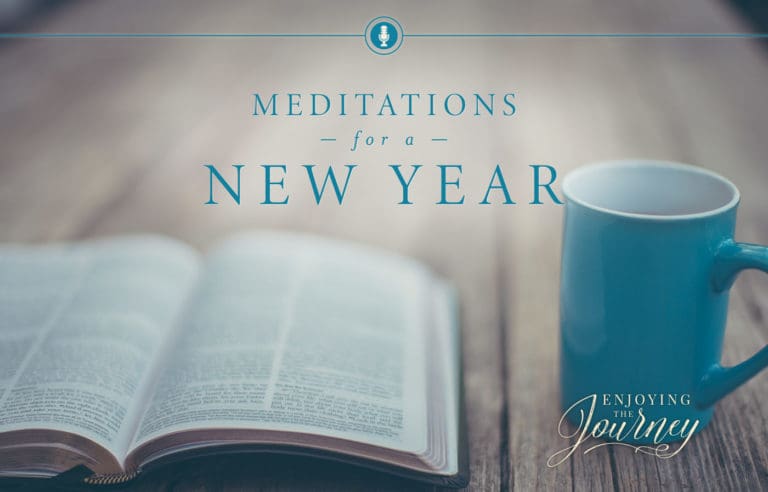
Be sure to listen to Scott’s series “Meditations for a New Year.” Find it on the Bible App or HERE on our website.
About Scott Pauley
Discover more from Enjoying the Journey
Subscribe to get the latest posts sent to your email.