“At the Gate of the New Year” Scott Pauley

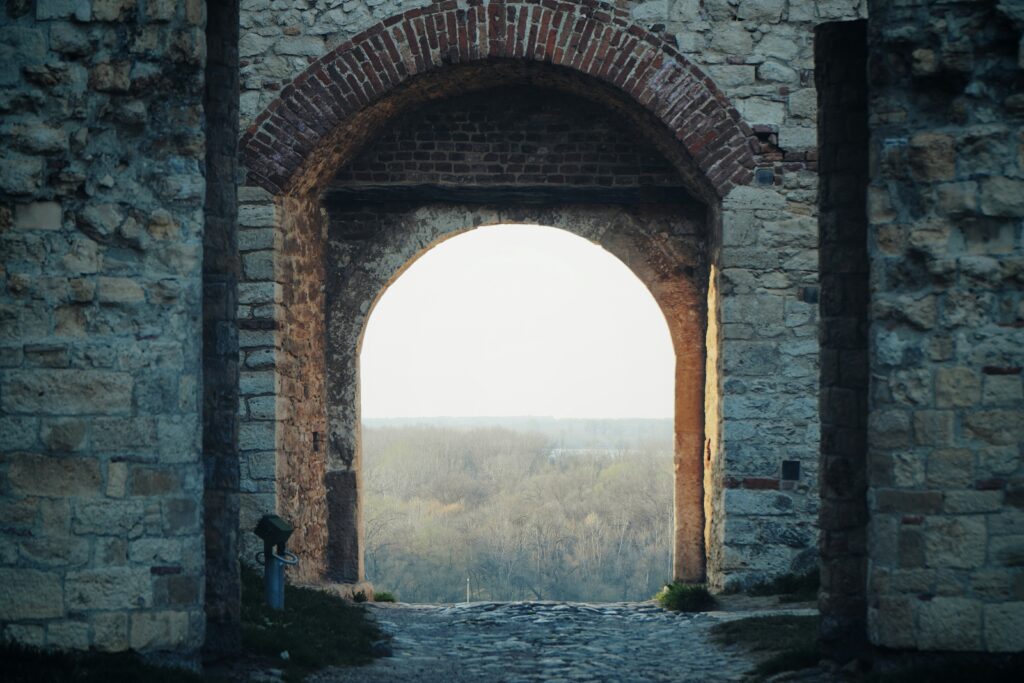
It is Christmas, 1939, in London, England.  King George VI addresses the British Empire as he does every year at this time.  In his speech he quotes a beautiful poem that his daughter has just given him.  The powerful words would continue to be connected to the Royal Family for years to come.  They are inscribed on the gates of the chapel at Windsor Castle:

And I said to the man who stood at the gate of the year:  “Give me a light that I may tread safely into the unknown.”

And he replied, “Go out into the darkness and put your hand into the Hand of God.  That shall be to you better than light and safer than a known way.”

So I went forth, and finding the Hand of God, trod gladly into the night.  And He led me towards the hills and the breaking of day in the lone East.

So heart be still:
What need our little life
Our human life to know,
If God hath comprehension?
In all the dizzy strife
Of things both high and low,
God hideth His intention.

God knows. His will
Is best. The stretch of years
Which wind ahead, so dim
To our imperfect vision,
Are clear to God. Our fears
Are premature; In Him,
All time hath full provision.

Then rest: until
God moves to lift the veil
From our impatient eyes,
When, as the sweeter features
Of Life’s stern face we hail,
Fair beyond all surmise
God’s thought around His creatures
Our mind shall fill.

swing-gate-in-snowThe words, now known as At the Gate of the Year, were written by Minnie Louise Harkins.  Her original title was: God Knows.

We too stand at the gate of a new year.  The unknown lies ahead.  But God knows.  He is there already.  He will be with us when we arrive.  He will never leave us nor forsake us!  And “that shall be to you better than light and safer than a known way.”

“When thou passest through the water, I will be with thee; and through the rivers, they shall not overflow thee: when thou walkest through the fire, thou shalt not be burned; neither shall the flame kindle upon thee” (Isaiah 43:2).

Put your hand in the Hand of God and walk through the gate of the new year in faith.


Discover more from Enjoying the Journey

Subscribe to get the latest posts sent to your email.
Post Author

More from similar topics

Subscribe to Blog via Email

Recent Posts

A journey through 1 John reveals our place in the family of God, how we can have assurance, and that our joy is rooted in Christ.

Journey through 1 John

“Jesus saw Nathanael coming to him, and saith of him, Behold an Israelite indeed, in whom is no guile! Nathanael saith unto him, Whence knowest thou me? Jesus answered and said unto him, Before that Philip called thee, when thou wast under the fig tree, I saw thee.” (John 1:47-48)

Why the Story of Nathanael Sitting Under the Fig Tree Matters

It also discusses the Four Sermons in Haggai It is in that context that God raises up the prophet Haggai with four sermons in four months. The Word of the Lord comes to Haggai, and he preaches four sermons. Each one of them is dated for us. Each sermon targets a different problem. You can read them in Haggai chapters one and two. In his first sermon (Haggai 1:1-15), Haggai preached on the danger of waiting when we should be working. They were waiting for a sign to build. He said, You don't need a sign, you need to obey God. Haggai's second sermon (Haggai 2:1-9) explained the danger of lamenting the past and missing the present. They were sorrowing over the destruction of the past temple. God said, Build a new one. It was G. Campbell Morgan who said, “It is impossible to unlock the present with the rusty key of the past." Many people are bogged down in their past and miss the present. Keep in mind what is at hand and what is ahead. The third sermon he preached (Haggai 2:10-19) described the danger of seeing only the material and neglecting the supernatural. They could see the work that needed to be done, but they missed the fact that God had resources that would help them get it done. The Lord was behind all of this. The fourth sermon (Haggai 2:20-23) warned against the danger of recognizing who is against us and forgetting who is for us. They were concentrating on the opposition and forgetting that “greater is he that is in you, than he that is in the world” (1 John 4:4). A journey through Haggai shows us the importance of performing the work that God has told us to do, and His glory in our obedience. Image leads to an overview of Haggai

Journey through Haggai

How Social Media Shapes Our Heart

How Social Media Shapes Our Hearts

2 Comments

  1. Jonathan VandenHurk on December 31, 2013 at 7:53 AM

    Very good – Thank you for sharing this with us. I think we will need to share this poem tonight at our church’s New Year’s Eve service. By the way, you can listen to the last part of that Christmas speech here: http://youtu.be/8GryNdlz2Xg?t=1m20s

  2. Grace Manning on December 31, 2013 at 10:48 PM

    Thank you, Bro. Pauley! This was a blessing!

Leave a Reply