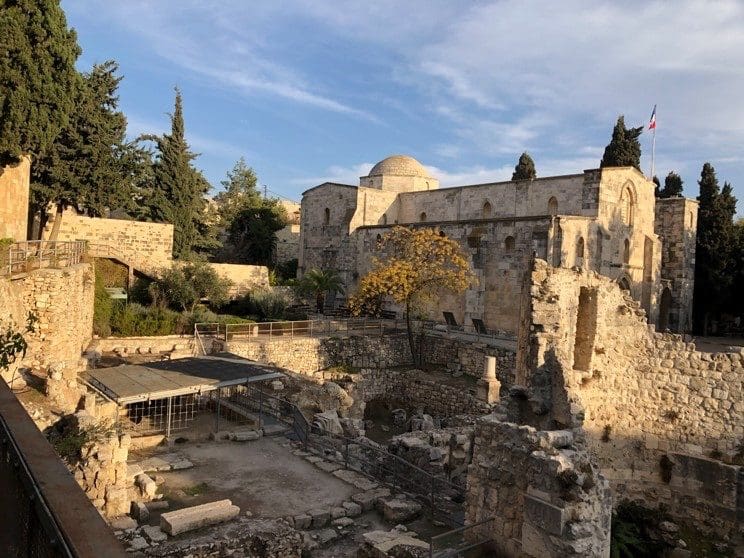
The Pool of Bethesda John Buckner

The Pool of Bethesda
is a mishmash
archaeologically.
At various points in
history it has housed Byzantine and
Crusader churches, as well as an
Islamic law school.
It has been built
over multiple times through the
centuries.
Photo by John Buckner

After this there was a feast of the Jews; and Jesus went up to Jerusalem. Now there is at Jerusalem by the sheep market a pool, which is called in the Hebrew tongue Bethesda, having five porches. In these lay a great multitude of impotent folk, of blind, halt, withered, waiting for the moving of the water” (John 5:1-3). 

On the Via Dolorosa, just inside the Lion’s Gate in Jerusalem’s Old City, is the site of Bethesda. This is where Jesus famously found the man who had been waiting for the stirring of the waters. For thirty-eight years, this mad had been unable to enter the waters for healing. Jesus famously asked him, “Wilt thou be made whole?” When the man answered that he was unable to enter the pool, Jesus said, “Rise, take up thy bed, and walk.”

What is fascinating about this story is that the ancient pool itself sat in a pagan temple. The temple was a dedication to the Roman god of healing, Asclepius, and possibly also to Fortuna, the goddess of good luck. In the Bible, it was full of people presumably waiting for some angel to stir the waters. In reality, like most pagan revelations, there is a prosaic explanation. The spring that fed the pools sometimes inexplicably surged in flow, causing pools in the city to bubble and stir.

Jesus, in His mission to seek out the lost sheep of the house of Israel, entered this pagan temple, and on the Sabbath day, no less. He came there to find a lost Jewish man who was seeking healing where he should not even be, much less stay for thirty-eight years. The man did not know it was Jesus who healed him until he spoke with his Healer in God’s Temple, which was perhaps a ten-minute walk away from the pool of Bethesda.

Are you seeking healing in the wrong places? Are you uselessly waiting for a natural phenomenon that the lost world mistakes for an angel? Just as the man in the book of John found no healing outside of Jesus, you too need Him alone. If you are a believer, meditate on the fact that our Savior was willing to go to an unclean place dedicated to vile gods on the Sabbath day just to find those who needed Him.

Excavation pursuits have removed part of the pool system. Much remains buried under the city of Jerusalem, which surrounds the pool. Photo by John Buckner


Discover more from Enjoying the Journey

Subscribe to get the latest posts sent to your email.
Post Author

More from similar topics

Subscribe to Blog via Email

Recent Posts

A journey through 1 John reveals our place in the family of God, how we can have assurance, and that our joy is rooted in Christ.

Journey through 1 John

“Jesus saw Nathanael coming to him, and saith of him, Behold an Israelite indeed, in whom is no guile! Nathanael saith unto him, Whence knowest thou me? Jesus answered and said unto him, Before that Philip called thee, when thou wast under the fig tree, I saw thee.” (John 1:47-48)

Why the Story of Nathanael Sitting Under the Fig Tree Matters

It also discusses the Four Sermons in Haggai It is in that context that God raises up the prophet Haggai with four sermons in four months. The Word of the Lord comes to Haggai, and he preaches four sermons. Each one of them is dated for us. Each sermon targets a different problem. You can read them in Haggai chapters one and two. In his first sermon (Haggai 1:1-15), Haggai preached on the danger of waiting when we should be working. They were waiting for a sign to build. He said, You don't need a sign, you need to obey God. Haggai's second sermon (Haggai 2:1-9) explained the danger of lamenting the past and missing the present. They were sorrowing over the destruction of the past temple. God said, Build a new one. It was G. Campbell Morgan who said, “It is impossible to unlock the present with the rusty key of the past." Many people are bogged down in their past and miss the present. Keep in mind what is at hand and what is ahead. The third sermon he preached (Haggai 2:10-19) described the danger of seeing only the material and neglecting the supernatural. They could see the work that needed to be done, but they missed the fact that God had resources that would help them get it done. The Lord was behind all of this. The fourth sermon (Haggai 2:20-23) warned against the danger of recognizing who is against us and forgetting who is for us. They were concentrating on the opposition and forgetting that “greater is he that is in you, than he that is in the world” (1 John 4:4). A journey through Haggai shows us the importance of performing the work that God has told us to do, and His glory in our obedience. Image leads to an overview of Haggai

Journey through Haggai

How Social Media Shapes Our Heart

How Social Media Shapes Our Hearts

Leave a Reply