Journey Through Judges
The Lord Jesus said to His followers that the spirit indeed is willing, but the flesh is weak (Matthew 26:41). Are you ever surprised at how spiritual you can be one moment, and how fleshly you can be the next? How you can walk in victory and sense the presence of God and then in the very next moment have the most awful faults, or say the most awful things? How is that possible? This is not new. As a matter of fact, you see that sad cycle repeated over and over again in the example of the children of Israel. We’ve come in our steady journey through Scripture to the Book of Judges.
Listen: Journeying through Judges
Overview of Judges
The Book of Joshua is full of victory, but our journey through Judges is full of defeat. In Joshua, there is progress, but in Judges, decline; in Joshua, faith, but in Judges, unbelief; in Joshua, joy, but in Judges, sorrow; in Joshua, freedom, but in Judges, bondage. Does that sound familiar? Does it sound like the great struggle between the flesh and spirit in your own life? At one moment we’re heavenly-minded, it seems, and the next moment we’re earthly-minded.
Why do we move from Joshua to Judges? Why do we go from such victory and blessing in the land of Canaan, following the Lord, to such defeat and such conflict in the book of Judges? The answer is given twice in the book of Judges.
Key Passages in Judges
The key verse is actually given in two different places, both near the end of the book.
The first is in Judges 17:6 where the Bible says, “In those days there was no king in Israel, but every man did that which was right in his own eyes.” And then, interestingly enough, that is repeated almost verbatim at the very last verse of the book, Judges 21:25, which says, “In those days there was no king in Israel.”
Key Phrase
Every man did that which was right in his own eyes. After the death of Joshua, the people quit obeying God. They had had one king, and that King was the Lord. They had been a Theocracy. God was the one ruling and reigning over them. But now, suddenly, they’ve chosen not to obey that King. God was still the King — He was still on the throne — but the people were not committed to their King.
They were not yielded to their King. And so, because of this, God had to raise up what he called Judges. This book actually gets its name from thirteen Judges — twelve of them were chosen by God, and one of them was a usurper — who ruled over the land during this very difficult period of Israel’s history.
Cycles of Judgment and Mercy
Some people have called this the Dark Ages in Israel’s history. Indeed, it was a very dark period. Any time you’re not under God’s ruling presence, it is a very dark period. The Lord is still there. As a matter of fact, the name Lord is found 178 times in this book.
But how often we call Him Lord, and yet do not allow Him to rule and reign over us. Remember, Jesus talked about those who called him Lord, Lord, but did not do the things that He said. That is a picture of Israel at this particular time. So God sends judgment. There are seven oppressions. There’s an oppression from Mesopotamia, from Moab, from the Canaanites, from Midian, from Abimelech, from the Ammonites, from the Philistines.
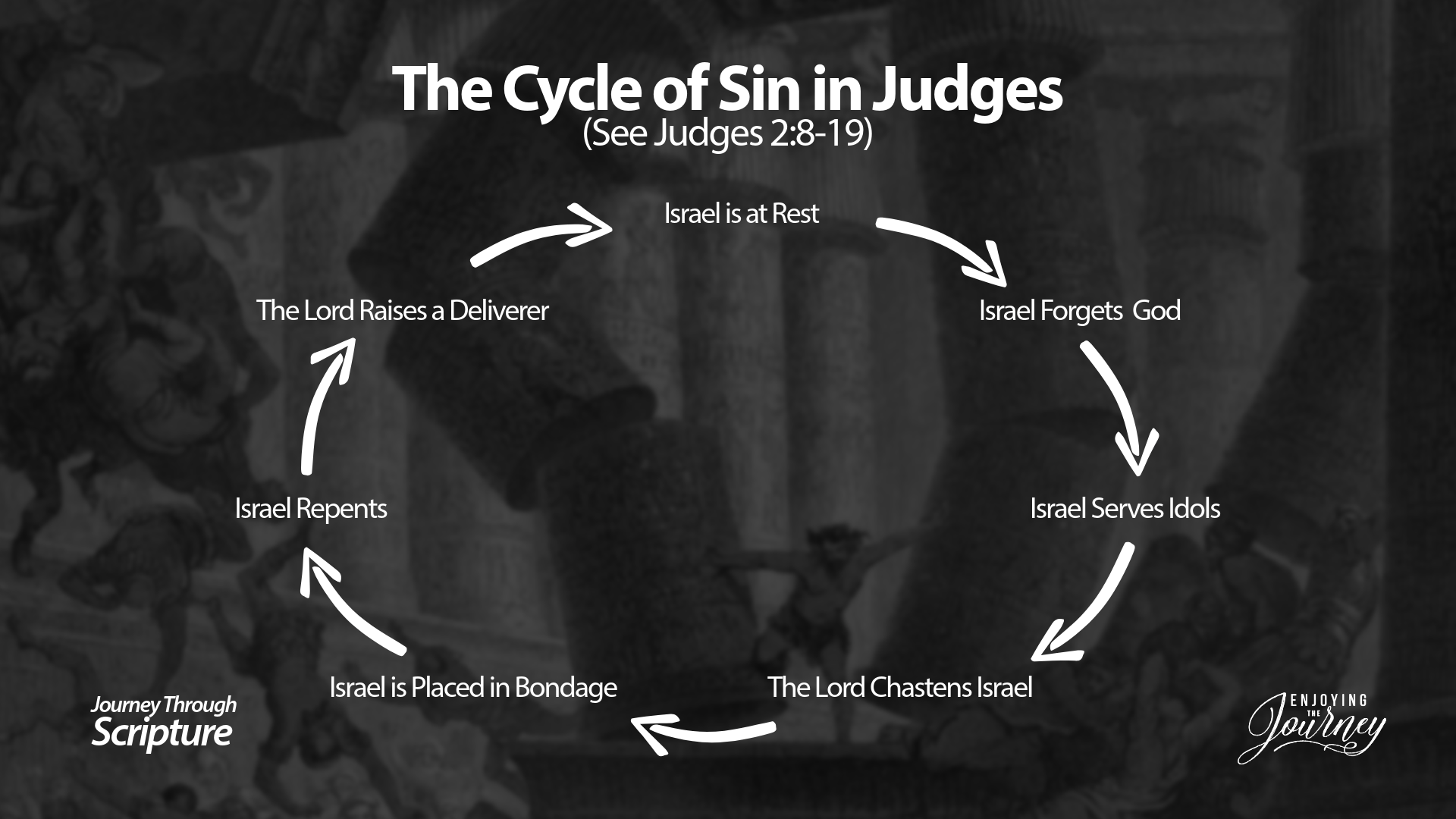
This motion graphic illustrates the cycle of sin and judgment in the nation of Israel, described in the Book of Judges.

Watch this motion graphic that illustrates the cycle of sin and judgment in the nation of Israel described in the Book of Judges. This is a free teaching tool. You may download and use this slide HERE.
Wave after wave of judgment. What is God doing? God is trying to get their attention. May I ask you, is God trying to get your attention today? If so, what does he have to do to get your attention? Are you willing to hear His word? And He does caution in his chastening, or will it take something more severe, like it did in the nation of Israel?
The amazing thing is, as you journey through Judges, not only do you see His judgment, but you also see His mercy. You see, there were seven oppressions. But interestingly enough, there were twelve God-appointed judges.
The Judges
We know more about some of the judges than others. The judges are:
- Othniel
- Ehud
- Shamgar
- Deborah, teamed together with a military leader named Barak
- Gideon
- Tola
- Jair
- Jephthah
- Ibsen
- Elon
- Abdon
- Samson (the one that is spoken of more than any other, because he was the judge during the longest oppression, the oppression of the Philistines)
It is interesting. We call these men and women Judges. The book actually never calls them that. But the word ‘judge’ is used in relation to God himself. These men and women were representatives of the true Judge. God was using them to judge Israel at this particular period. One of the things that stands out to me in the book of Judges is, though there are seven judgments now, there are 12 judges.
Can I remind you that though God is a God of judgment, and He is always a God of mercy? Where sin abounds, grace does much more abound. And whatever sin is in your life today, God’s mercy is abundant for that. If you look to Him, then whatever struggle you’re dealing with today, know that God’s mercy is sufficient for that if you’ll trust Him. (If you do not know Christ, CLICK HERE.)
The Theme of Judges: Anarchy and Apostasy
You see, the sad story of the Book of Judges is a story of anarchy. There was no rule. There was no boundary. In the words of Scripture, “every man did that which was right in his own eyes.” I’m thinking now of the Scripture that says, “There is a way which seemeth right into a man, but the end thereof are the ways of death.” (Proverbs 14:12)
You see, a journey through Judges demonstrates that apostasy is always connected to anarchy. When people start doing their own thing, when they fail to obey God, it brings such a departure from light and from truth. This book opens on a note of advancement. They’re conquering enemies. And yet it ends with such confusion. Why? Because the children of Israel were content to live with their enemies, to allow them to stay, to not drive them out.
And because of their disobedience to God, they enter into a period of such darkness. We must obey God completely, which means we must deal with every sin and drive out every enemy. We must not rest content to simply say we know God. No, we must say we want the Lord to have all there is of us.
Breaking the Cycle of Sin in Our Lives
We want him to rule and reign, to sit on the throne of our hearts. This cycle is repeated again and again in the nation of Israel. There are seven cycles in this one book alone. But would you pause for a moment and think about your own life? You see the same cycles in your own life where you begin with just a little compromise, a little allowance of some sin. We tell ourselves, “It’s not too bad.” We begin to excuse it, and pretty soon that thing has taken over our lives. The thing which we thought we controlled suddenly becomes our master. We become its slave. And so then what do we do? God has to do something to get our attention. We cry out to God for mercy. The Lord sends a deliverance.
There’s a period of peace and blessing. And then, for whatever reason, we go right back to the same fleshly way. Wherever you are in this cycle today, stop it. Stop right where you are, and look to the Lord.
Christ is Our True Judge
These judges were a picture of the true Judge, of the true deliverer, which is the Lord Jesus Christ. He is our deliverer. Christ alone can set you free. (Watch: Ryan’s Journey to Freedom.) Christ alone can cause the victory to continue. As long as we live by faith, we continue in victory. And the moment we begin to live in unbelief and disobedience, we enter into a period of defeat. I don’t know about you, but I would much rather live in Joshua than in Judges.
By the grace of God, let’s seek to walk in the spirit, not the flesh today. Pause right now and say to the Lord, “Lord, I don’t want to live in Judges today. I don’t want to be earthly-minded. Rather, I want to ‘set my affection on things above and not on things on the earth.’ I want to walk with Christ and live in faith and victory.”
Make this day a Joshua Day and not a Judges Day. We’ve all had our own journey through Judges, haven’t we? Let’s not enter into that again. Instead, let’s determine today by faith and obedience, to live the life of victory that God has for all of us. And then, my friend, you will enjoy the journey.
Related Article: 5 Ways to Get More Out of Your Bible Reading
Discover more from Enjoying the Journey
Subscribe to get the latest posts sent to your email.