
“And let us not be weary in well doing: for in due season we shall reap, if we faint not.” – Galatians 6:9
Listen to the story of William Wilberforce on Traveler’s Tales
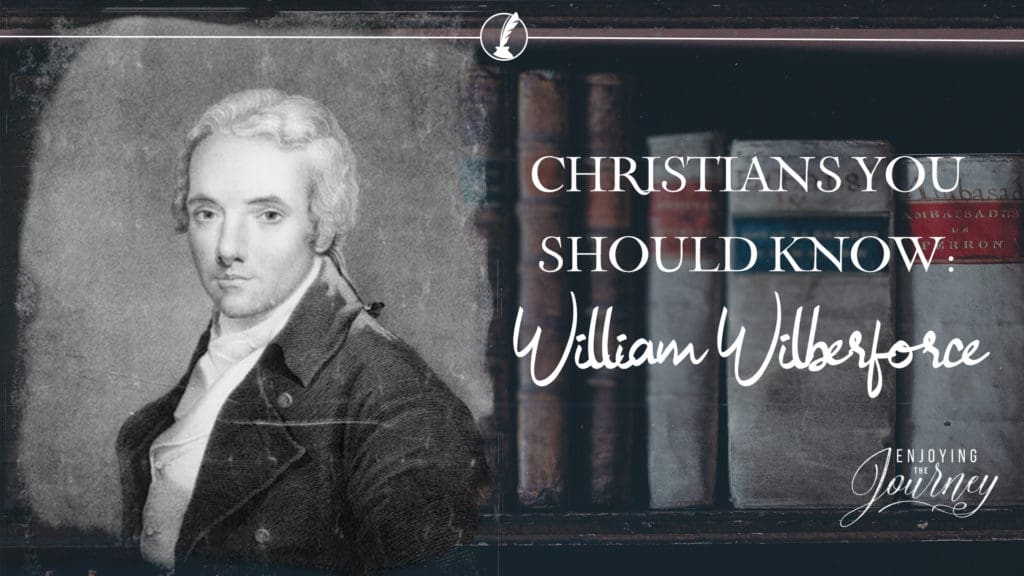
A Snapshot of the Life of William Wilberforce:
Born: Aug. 24, 1759, Hull, England
Died: July 29, 1833, London, England
Politician, philanthropist, and promoter of the abolition of slave trading. Wilberforce began his political career by founding the Proclamation Society to combat vice. He was converted (1784) and took up the abolition cause (1786), proposing his first motion for the abolition of the slave trade (1789), which did not carry until 1791.
As a Parliament member for Hull (1780), Yorkshire (1784), and Bramber, Sussex, 1812-25, he aggressively pursued the passage of bills to end slavery. Wilberforce married Barbara Spooner. He helped found the Church Missionary Society (1799) and the British and Foreign Bible Society (1804). In 1807, an act of Parliament ended the slave trade. In 1823, he founded the Anti-Slavery Society. He wrote Practical View of Christianity (1797). He published Appeal…on Behalf of Negro Slaves in the West Indies, which moved for the abolition of slavery and the emancipation of slaves.
In 1825, he retired from the House of Commons. He was able to curb the powerful East India Company and was instrumental in having its charter revoked, after his death, in 1859. He was a key figure of the Clapham sect (a group of wealthy Anglican Evangelicals who lived in the Clapham area, northwest of London). One month after* his death, slavery was abolished throughout the British Empire. His favorite Bible verses were Luke 18:13 and Galatians 6:9. “Christianity condensed: admit, submit, commit, transmit”. – (Excerpt taken from the Reese Chronological Encyclopedia of Christian Biographies. Used by permission.)
*The Slavery Abolition Act of 1833 was passed in the House of Commons just two days before his death. It became law on August 28, 1833.
A Spiritual Application for Our Lives:
There have been many wicked scourges throughout history. One of the darkest was the abhorrent slave trade. Few today understand the dark and dreadful realities of slavery. William Wilberforce dedicated his life to abolishing it. Sadly, few have heard of the strong faith that brought Wilberforce to this mission. He was doing what he believed God had created him to do.
The faith of Wilberforce was no political tactic or public display. Faith in Christ was foundational to the work and causes to which Wilberforce dedicated his life. However, this faith was not always the center of Wilberforce’s life. Through the childhood influences of strong believers, the earnest witness of a Christian friend, the diligent search of Scripture, and the wise counsel of John Newton, William committed his life to Christ. The Holy Spirit’s convicting work had accomplished its purpose.
The “conscience of his nation.”
This is how William Wilberforce is described. Understandably so, William fought for the truths found in Scripture to be acknowledged by law. He understood that true morality is found in the Word of God, not the whims of culture or government. Sadly, many believers have bought the lie that we must allow the unbelievers to right every wrong and speak out against the evils around us. Many believe that error must be countered by anyone except those who are part of “the pillar and ground of truth…” (1 Timothy 3:15). Wilberforce is a glaring rebuke of this fallacy.
We desperately need a Wilberforce in our day who has the moral fortitude, unwavering integrity, and feverish determination to take on the evils surrounding us. Further, God’s people must be willing to proclaim the truth, suffer the attacks, and fight with all their might to stop the atrocities around us. Christians must remember that the Word of God is the foundation upon which we build our lives. As Wilberforce said of Scripture…
“…a due sense of its value would be assuredly impressed on us by the diligent study of the Word of God, that blessed repository of divine truth and consolation. Thence it is that we are to learn our obligations and our duty, what we are to believe and what to practice. And, surely, one would think it could not be required to press men to the perusal of the sacred volume. Reason dictates, Revelation commands;…Yet, is it not undeniable that with the Bible in our houses, we are ignorant of its contents; and that hence, in a great measure, it arises, that the bulk of the Christian world know so little, and mistake so greatly, in what regards the religion which they profess?”
A bill to abolish slavery in Great Britain was passed in the House of Commons on a Friday. Wilberforce was told the joyful news on Saturday. Then, William Wilberforce died on Sunday. His faithful labor had not been in vain. Doubtless, the day he heard the news was one of great rejoicing. He spent his entire adult life for this cause, and God used him greatly. May God raise more godly leaders who will persevere for God’s glory, the gospel’s sake, and the love of others.
A Suggestion for Further Reading…
A Practical View of Christianity – William Wilberforce, 1797
READ: 21 Bible Prayers for Government Leaders
Discover more from Enjoying the Journey
Subscribe to get the latest posts sent to your email.
Post Author
More from similar topics
1 Timothy 3 | Bible | Biography | Galatians 6 | John Newton | Scripture | William Wilberforce | government | leaders | politics | slave trade