
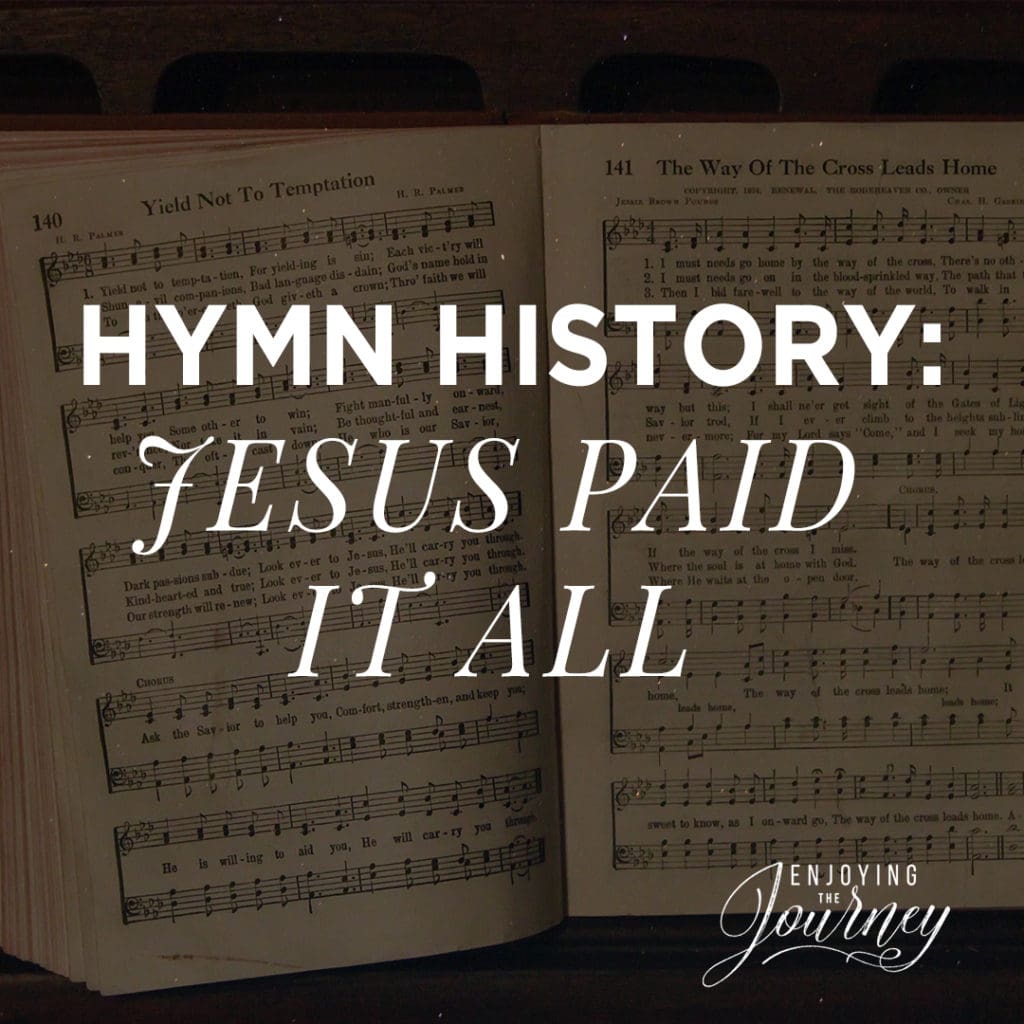
“Forasmuch as ye know that ye were not redeemed with corruptible things, as silver and gold, from your vain conversation received by tradition from your fathers; But with the precious blood of Christ, as of a lamb without blemish and without spot:” – 1 Peter 1:18-19
We are thrilled to share a series of brief accounts of how some of the great hymns of our faith were written. Each synopsis has been compiled through the research of Jerry Vargo and is shared by permission. It is our hope that these stories will be a help and encouragement to your Christian walk. This week we read the story behind the stirring hymn, “Jesus Paid It All.”
_______________________________________________________________________________________
It’s 1865, Elvina Hall sits in the Monument Street Methodist Church choir, in Baltimore, Maryland.
Pastor George Shrick is preaching on the subject of the crucifixion. During the sermon, Elvina is wrapped up in the message and becomes inspired to write some words about the crucifixion in the flyleaf of her hymnal. All of the stanzas come quickly to her as she writes while her pastor preaches. After church, she approaches her pastor timidly, with the hymnal in hand, and has the following conversation:
“Pastor, I did not hear your entire sermon this morning.”
“That’s alright Elvina, I put a lot of people to sleep on Sunday morning with my sermons,” he said jokingly.
“Oh no, Pastor. I did not fall asleep. I was thinking about the crucifixion and all that Jesus did for us and while you preached I was inspired to write these words in my hymnal. The words came quickly and smoothly as I wrote them down. I made a copy for you to see.”
Pastor Shrick takes the words to his office where he remembers that the church’s choir director, John Grape, had written a tune the previous week. John gave a copy of the music to Pastor Shrick and told the pastor that he had no words for the tune. John did choose a title for his tune, but that’s as far as it went. He had titled his new tune All to Christ I Owe. John was a successful coal merchant in Baltimore, who, as he once stated, “dabbled in music for my own amusement.” For many years he was an active layman in the Monument Street Church, working in the Sunday school as well as serving as the organist and choir director.
Pastor Shrick looks at Elvina’s words and John’s tune and it looks like they match. Pastor Shrick then calls John to his office and asks him to look at the words that Elvina wrote, to see if they matched the tune he had written. John goes to a piano and begins to play his tune and sing Elvina’s words.
To the amazement of both, neither one word of Elvina’s poem nor one note of John’s tune has to be altered! The words and the music fit together perfectly. Thus, on that Sunday morning in 1865 the hymn Jesus Paid It All was composed because of a dedicated choir member, a talented choir director, and a pastor who put them together. The tune needed a refrain, which Elvina and the pastor wrote together. It was soon sung in several churches in Baltimore, and well received.
Hardly anyone knows the names of Elvina Hall and John Grape, but millions of Christians have sung their hymn for these many years. Since its first published appearance, this hymn has been widely used in churches, especially for the Lord’s Supper service.
1. I hear the Savior say,
“Thy strength indeed is small,
Child of weakness, watch and pray,
Find in Me thine all in all.”
[Refrain] Jesus paid it all,
All to Him I owe;
Sin had left a crimson stain,
He washed it white as snow.
2. Lord, now indeed I find
Thy pow’r and Thine alone,
Can change the leper’s spots
And melt the heart of stone.
[Refrain]
3. For nothing good have I
Where-by Thy grace to claim;
I’ll wash my garments white
In the blood of Calv’ry’s Lamb.
[Refrain]
4. And when, before the throne,
I stand in Him complete,
“Jesus died my soul to save,”
My lips shall still repeat.
[Refrain]
Discover more from Enjoying the Journey
Subscribe to get the latest posts sent to your email.

Praise the Lord!! Thank you for this wonderful testimony.
Thanks for reading the articles!
Wow I am so blessed
One of my favorite hymns plus Blessed Assurance. Both can make my heart soar with thankfulness for what Jesus did for me.
Great songs!
How God has been gracious to our soul by giving us those wonderful hymns of remembrance.
That hymn cannot grow old because of it content, that it why at 73 I love to sing it for His glory.
Amen!
These hymn histories have been so wonderful! I teach piano to my two older grandsons, and I have used these hymns and their accompanying histories as part of their week assignments. Many younger people are not familiar with some of the “older” hymns, sadly. Thank you so much for posting these!!
So glad you are able to pass them on! Thank you.