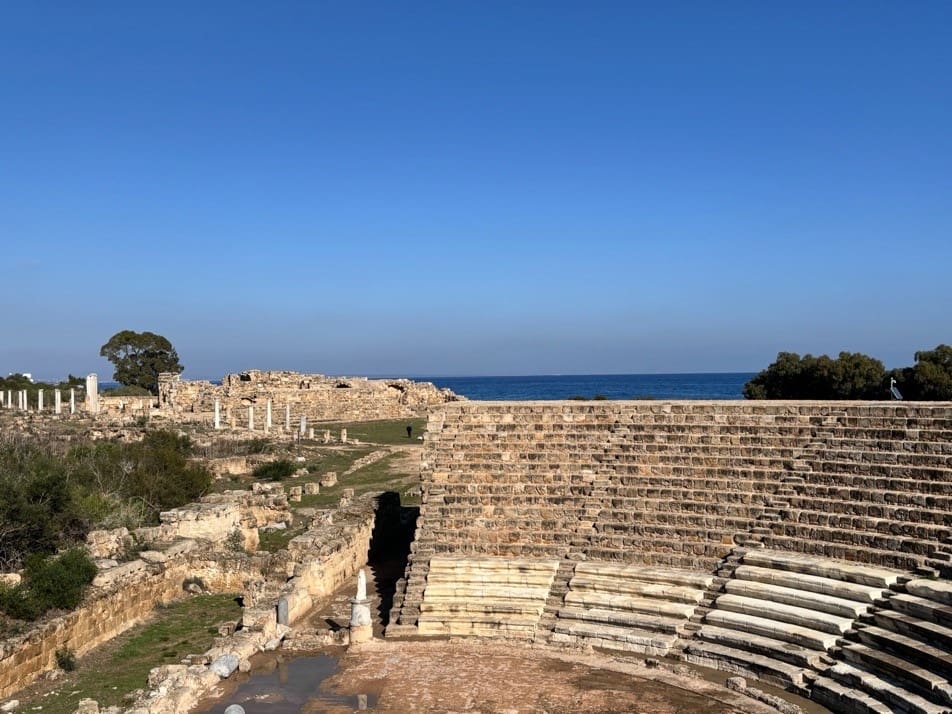
Salamis
“So they, being sent forth by the Holy Ghost, departed unto Seleucia; and from thence they sailed to Cyprus. And when they were at Salamis, they preached the word of God in the synagogues of the Jews: and they had also John to their minister” (Acts 13:4-5).
The Biblical Significance of Salamis
Salamis was the first stop for the evangelists Barnabas and Saul on their first missionary journey. This was a journey that would take them across modern Cyprus from east to west, and then up into Anatolia in modern Turkey. The ancient city of Salamis is located on the east coast of Cyprus, not far from the medieval city of Famagusta. It is believed to be the hometown of Barnabas, but that is not stated in Scripture. However, we do know from Scripture that he was from Cyprus, and it makes sense that he would travel to an area that he knew well to begin their missionary journey. (Click HERE to Study Acts).
After Paul and Barnabas split up due to their disagreement over John Mark, Acts tells us that Barnabas returned to the island with John Mark. (Acts 15:39) A local tradition states that Barnabas later returned to Salamis with John Mark, who had previously abandoned the work in Perga, in the nearby Pamphylia in modern Turkey. Barnabas’ grave is located in a cave near Salamis and can be visited.
The book of Acts does not give us many details about Barnabas and Saul’s time in Salamis, just that they preached in the synagogue. It is interesting to walk the ruined streets of Salamis and meditate on what God did here. When he was in Salamis, Paul was still an unknown young Christian named Saul. A short time later, just across the island of Cyprus in Paphos, Saul would reach his first Gentile, the Roman Sergius Paulus. It was there that he began to go by the name of Paul, and took the lead in the ministry. The preaching duo was originally known as Barnabas and Saul, but after Cyprus they were known as Paul and Barnabas. Everything that Paul later did, both in person and through his writings, had its beginning in the city of Salamis.
The Practical Significance of Salamis
If you are in Christ, you have a place to remember. We should appreciate our beginnings in Christ. It is a good thing to occasionally return to our Salamis, the place where God put His hand on us and began to use us for His glory. You may or may not be able to return physically, but you should remember it often. Every person who has been mightily used of God began somewhere.
Salamis also reminds us that every one of us has a Barnabas to remember. That godly man sought out the young Saul when he was a new convert and introduced him to other believers. They were understandably afraid of the man who had recently done them so much harm, but Barnabas showed him kindness. On Cyprus, the mentor was happy to step into the background and let his protégée lead. Again on Cyprus, this preacher took John Mark under his wing after he quit the ministry. I encourage you to remember the people whom God has used in your life to bring you to where you are, or to restore you. If they are still alive, I encourage you to reach out to that person and tell them what they mean to you.
Modern Travel Note:
The ancient city of Salamis is reachable by bus or taxi from Nicosia, the divided capital of Cyprus. However, you do need to bring your passport. To reach it, I crossed from the Republic of Cyprus into the internationally unrecognized Turkish Republic of Northern Cyprus.
- To do this, you walk up the main shopping street in Nicosia, when you get to the crossing you first present your passport to the Cypriot authorities, then you cross the militarized zone, then the Turkish authorities scan your passport. While the Republic of Cyprus uses the Euro, the north uses Turkish lira, and you will need some for the bus. I found the ATM on the right directly after the checkpoint did not charge any fees.
- If you continue walking straight after the crossing, you will eventually come to a medieval customs gate. Intercity buses stop to the right, and you need to find one that is headed to Magusa, the Turkish name of Famagusta. The bus charged approximately $5, and took about an hour to reach Famagusta.
The city is well worth a visit in its own right. From the walled city, you can take a taxi to Salamis. This was about $15, although I met some people who walked or took local buses. From ancient Salamis, I walked out to Barnabas’ grave, which took about an hour, but you can take a taxi. To return to the capital, you can just reverse this process.
Discover more from Enjoying the Journey
Subscribe to get the latest posts sent to your email.