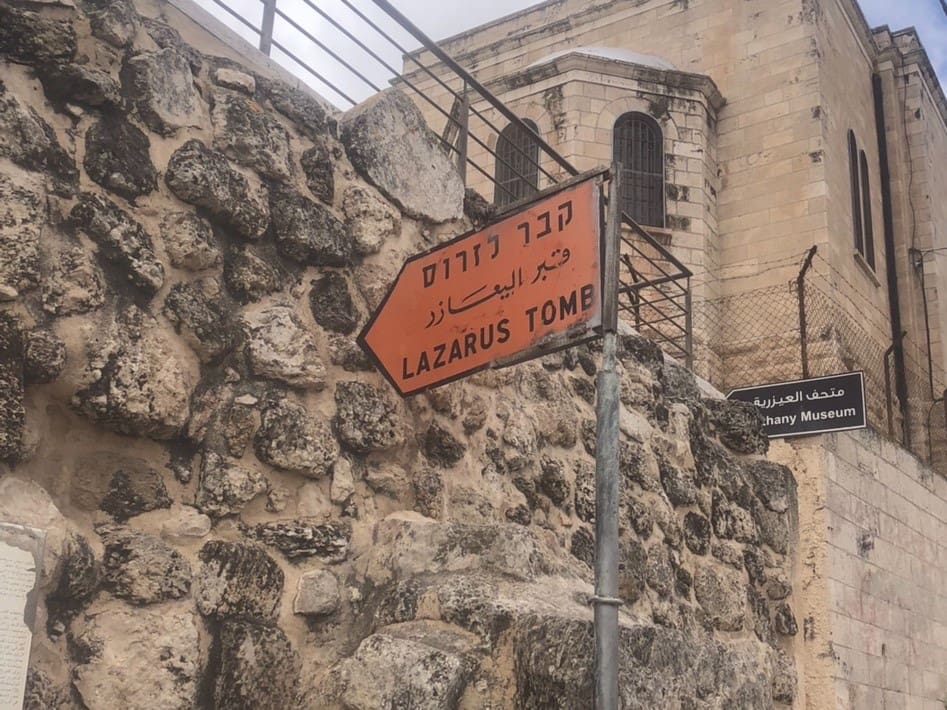
“Now a certain man was sick, named Lazarus, of Bethany, the town of Mary and her sister Martha….And when he thus had spoken, he cried with a loud voice, Lazarus, come forth” (John 11:1, 43).
The biblical town of Bethany is located just east of the city of Jerusalem on the Mount of Olives. It is the setting for many famous stories from the Gospels. For example it is here that Mary chose to sit at Jesus’ feet and hear His teachings instead of helping Martha prepare the meal. Bethany was also where Mary took the spikenard and anointed Jesus in preparation for His burial.
However, one of the best known and well-loved stories that happened in Bethany is the resurrection of Jesus’ friend Lazarus. Jesus was in danger for His life from the authorities in Judea, so He crossed the Jordan River to another jurisdiction. While He was there, He received news that Lazarus was sick. He waited two days and then returned to Judea.
In one of the most memorable and dramatic moments in Scripture, Jesus stood before the opened tomb of Lazarus and shouted, “Lazarus, come forth!” He issued an impossible order, but crucially, He enabled His friend Lazarus to obey. Lazarus, who had been dead a moment before, came walking out of His tomb. Without Jesus’ power, the decomposing corpse of Lazarus was unable to hear, much less fulfill His command. What a testimony to the power of the incarnate Word of God!
After Jesus was crucified, buried, and won His victory over death and the grave, He visited Bethany again. The Bible says in Luke 24 that He told the disciples that repentance and the remission of sins should be preached in His name to all nations, beginning at Jerusalem. They were to wait at Jerusalem until the Holy Spirit came, empowering them. Then He led them out of Jerusalem to the town of Bethany, on the Mount of Olives. There He blessed them and ascended into Heaven in their sight.
Once again, He issued an impossible command. He told the disciples to “Go ye into all the world and preach the Gospel.” Just as with Lazarus’ resurrection from the dead, He is who gave the commission, and He is who enables the fulfillment of it. The town of Bethany shows us that God does not give commands in vain. Just as Lazarus could not “come forth” without the power of Christ, we cannot “go forth” without utter reliance on Him.
“And Jesus came and spake unto them, saying, All power is given unto me in heaven and in earth.Go ye therefore, and teach all nations, baptizing them in the name of the Father, and of the Son, and of the Holy Ghost” (Matthew 28:18, 19).
Discover more from Enjoying the Journey
Subscribe to get the latest posts sent to your email.