Rebekah and the Camels John Buckner

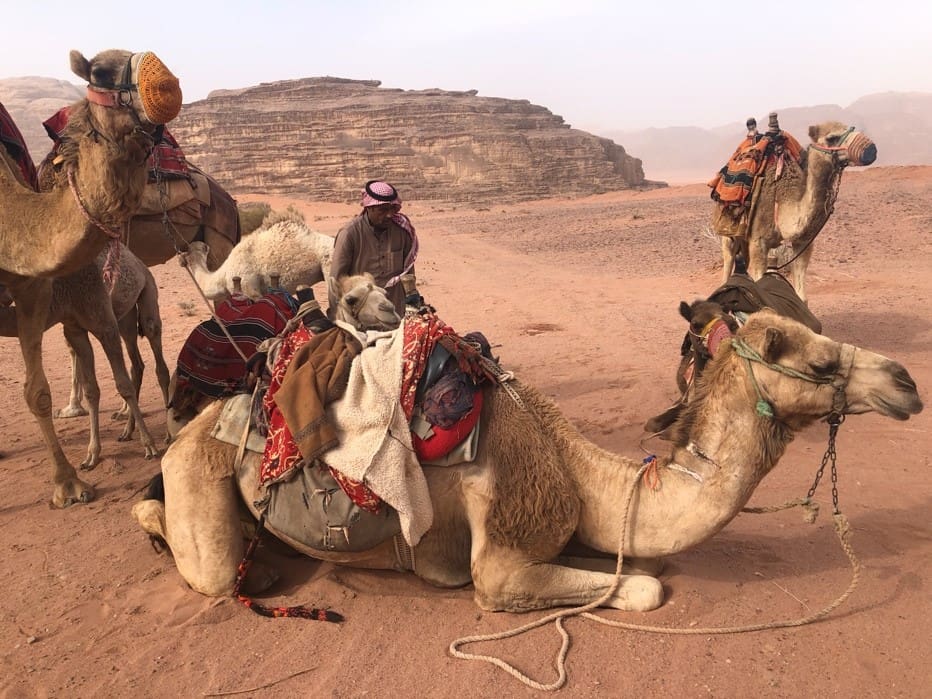
The camel in the foreground in southern Jordan, biblical Midian, is kneeling like Genesis 24:11 says that Eliezer's camels did by the well. The camels on the far left and far right have muzzles, which lets you know that they can either spit or bite. The Bedouin man in the background is readying them for a trip into the wilderness. Photo by John Buckner

Rebekah and the Camels

And the servant ran to meet her, and said, Let me, I pray thee, drink a little water of thy pitcher. And she said, Drink, my lord: and she hasted, and let down her pitcher upon her hand, and gave him drink. And when she had done giving him drink, she said, I will draw water for thy camels also, until they have done drinking. And she hasted, and emptied her pitcher into the trough, and ran again unto the well to draw water, and drew for all his camels. And the man wondering at her held his peace, to wit whether the Lord had made his journey prosperous or not” (Genesis 24:17-21).

When Abraham was old, he called his servant Eliezer and sent him to find a wife for Isaac. The servant prayed for God to send his master’s son a wife who was willing to serve others. He did not pray for her to be beautiful, though it turns out that she was. Instead, he asked God to send a woman who was happy to work hard to water his ten camels.

It was late in the afternoon when the Eliezer asked her for a drink of water. Rebekah did not hesitate in giving him a drink, and drew water for his camels as well. Many wells in the Middle East are deep, with a bucket on a line. Others have a rope to which your pitcher can be attached. She would have had to drop the bucket or pitcher many times and pull it up while Eliezer and his camels watched and waited. An average camel can drink between 20 to 40 gallons in one sitting, so she had her work cut out for her. She would have had to pull up between 1,600 and 3,200 pounds of water, one pitcher at a time. Nevertheless, she drew water for all of the ten camels, and was no doubt exhausted with aching back muscles when Eliezer revealed who he was, and who he worked for.

Rebekah could have politely told the rich stranger to draw his own water, or to only give him water but not his camels. However, due to her servant’s heart, she was showered with jewels and soon riding one of those very camels in honor back to the holy land. She married Isaac, and became one of the revered matriarchs of the Israelites.

This story teaches us to always ask God for guidance when faced with a difficult task. Eliezer knew that he needed God’s help to choose the right wife for Isaac. He was in an unfamiliar land, so he relied wholly on the God of Abraham to lead him. The story also teaches us that our greatest opportunity may show up in our lives unexpectedly, and disguised as tiring, menial work. What was probably an otherwise normal day changed her destiny at nightfall because she was willing to draw water for a thirsty man and his ten camels.
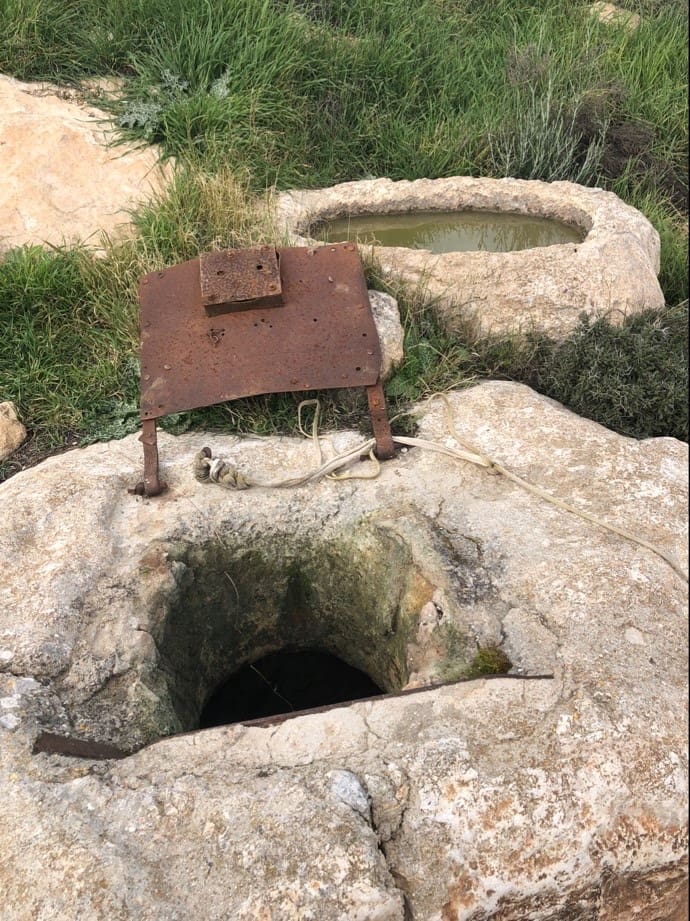
Rock well in the mountains nearJerusalem. Beside it is the stone trough that the local shepherds still use to water their flocks. Even though it has a rusty iron lid now, in ancient times it would have been covered by a rock. Photo by John Buckner

Rock well in the mountains near Jerusalem. Beside it is the stone trough that the local shepherds still use to water their flocks. Even though it has a rusty iron lid now, in ancient times it would have been covered by a rock. Photo by John Buckner


Discover more from Enjoying the Journey

Subscribe to get the latest posts sent to your email.
Post Author

More from similar topics

Subscribe to Blog via Email

Recent Posts

A journey through 1 John reveals our place in the family of God, how we can have assurance, and that our joy is rooted in Christ.

Journey through 1 John

“Jesus saw Nathanael coming to him, and saith of him, Behold an Israelite indeed, in whom is no guile! Nathanael saith unto him, Whence knowest thou me? Jesus answered and said unto him, Before that Philip called thee, when thou wast under the fig tree, I saw thee.” (John 1:47-48)

Why the Story of Nathanael Sitting Under the Fig Tree Matters

It also discusses the Four Sermons in Haggai It is in that context that God raises up the prophet Haggai with four sermons in four months. The Word of the Lord comes to Haggai, and he preaches four sermons. Each one of them is dated for us. Each sermon targets a different problem. You can read them in Haggai chapters one and two. In his first sermon (Haggai 1:1-15), Haggai preached on the danger of waiting when we should be working. They were waiting for a sign to build. He said, You don't need a sign, you need to obey God. Haggai's second sermon (Haggai 2:1-9) explained the danger of lamenting the past and missing the present. They were sorrowing over the destruction of the past temple. God said, Build a new one. It was G. Campbell Morgan who said, “It is impossible to unlock the present with the rusty key of the past." Many people are bogged down in their past and miss the present. Keep in mind what is at hand and what is ahead. The third sermon he preached (Haggai 2:10-19) described the danger of seeing only the material and neglecting the supernatural. They could see the work that needed to be done, but they missed the fact that God had resources that would help them get it done. The Lord was behind all of this. The fourth sermon (Haggai 2:20-23) warned against the danger of recognizing who is against us and forgetting who is for us. They were concentrating on the opposition and forgetting that “greater is he that is in you, than he that is in the world” (1 John 4:4). A journey through Haggai shows us the importance of performing the work that God has told us to do, and His glory in our obedience. Image leads to an overview of Haggai

Journey through Haggai

How Social Media Shapes Our Heart

How Social Media Shapes Our Hearts

Leave a Reply