Journey Through Amos
I grew up in the hill country, in the mountains, and so I am partial to them. If I had to identify with an Old Testament prophet, it would be Amos – he was from the hill country. Let’s begin our journey and see what God has for us from the pen of a country prophet named Amos.
Listen: Journeying through Amos
Overview of Amos
Who was Amos? Amos was from a place called Toccoa. That was wild country. It was the wilderness of Judea, the same wilderness where David watched his flocks 300 years previously. But in this wild country, this man named Amos was not a preacher. He was not trained in the school of the prophets. He was just a regular, ordinary fellow.
In fact, the Bible says that he was a herdsman. This is a man who was a farmer, or a rancher if you will. He was a man that was keeping flocks and herds. I imagine him as a man’s man, a tough mountain type man. Maybe a little rough around the edges. Isn’t it wonderful that God uses all different kinds of people from so many different places? He will use anybody who will yield to Him and obey Him. Amos was such a man.
The Burden of Amos
Amos was a native of Judah, but he prophesied in Israel, so he became a foreign missionary. Essentially, his name means “burden.” And he was burdened. And what was his burden? It is interesting that so many of these prophets are literally preaching right on the edge of their judgment.
But not Amos. Amos was sent with a message he preached for about ten years, and the period of time in which he preached to Israel was Israel’s zenith. They are in the midst of power. They are in the midst of prosperity and popularity. Life is good. As a matter of fact, it will be another 30 years before judgment comes.
Oftentimes, it is in our fullness where we most forget God, and sometimes we wait too late, and God, early on, sends us messages of mercy. It is in moments of prosperity that we most need to give God our undivided attention. And Israel failed to do that when the preacher Amos came along with God’s message.
Key Verse of Amos
Consider Amos 4:12. The Bible says, “Therefore thus will I do unto thee, O Israel: and because I will do this unto thee, prepare to meet thy God, O Israel.”
We have probably heard that phrase at some point. It is repeated in other places in Scripture. “Prepare to meet thy God.” But perhaps you did not know that that phrase was not reserved for the heathen people. It was actually reserved for the nation of Israel. Think on that for just a moment.
Outline of the Book of Amos
In the opening two chapters of the Book of Amos, there are eight burdens, and God deals with lots of these Palestinian nations. And then he launches into three sermons, a series of sermons in chapters three through six. He gives three 11th-hour appeals. “Seek ye me and ye shall live,” he says.
Then he goes into five visions, and he gives five promises, “I wills.” In the midst of it all, the emphasis remains on God’s people. May the Holy Spirit drive this home to your heart as He has to my own. God judges and deals with sin, especially in His own people. Not including His people, but especially His people. That’s why a believer cannot sin and get by with it. It is why a Christian can commit some sin, a lost man may go right on and have no thought about it, but a believer is absolutely miserable.
God is chastening. God is dealing. Why is that? Because you belong to Him, and He is not going to let you go your own way. And so, when God pronounces judgment, it is not just on all these nations surrounding Israel. No, God judges His own people in a special way. You see, they are privileged. To whom much is given, much is required.
The Plumbline
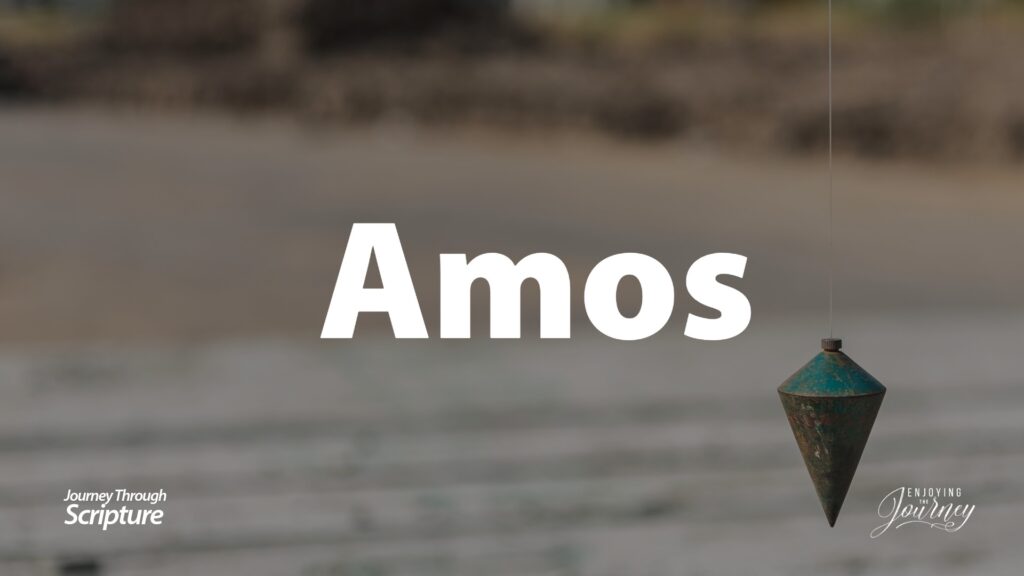
There is one vision in the book of Amos that is a good summary of this truth. We see it in Amos 7:7-9. The Bible says: “Thus he shewed me: and, behold, the Lord stood upon a wall made by a plumbline, with a plumbline in his hand.” How? We don’t use a plumb line very much anymore. But a builder would understand this. It is a line that would be stretched to make sure things are level and they are straight. It is a measuring rod.
“And the Lord said unto me, Amos, what seest thou? And I said, A plumbline. Then said the Lord, Behold, I will set a plumbline in the midst of my people Israel: I will not again pass by them any more: And the high places of Isaac shall be desolate, and the sanctuaries of Israel shall be laid waste; and I will rise against the house of Jeroboam with the sword.”
Usually, you use a plumb line for construction. Here, God says, “I am going to use a plumb line. And because you are not going to measure up, I am going to destroy, I am not going to build up. I am going to tear down.
The Privilege, the Plumbline, and the Promise
Notice the privilege. He says, “I am doing it to my people.” Friend, if you are a Christian today, you are a privileged person. You are in the family of God. You cannot sin and get by.
Notice the plumb line. What is that? God’s holy standard. His perfect standard for us. That is the very nature and character of God, I believe, revealed in God’s Word. God’s Word is our plumbline. Measure yourself not by someone else, not by so-called ‘good’ friends, not by how you think you are doing. Measure yourself by the infallible Word of God.
Notice the promise of judgment. He says, I will pass over them no more. There are moments when God passes over, when He gives time to repent, when He lets it alone to see what we will do. But there comes a moment, a deadline, a line crossed, and God says, “No more, no more.”
The Message of Amos
Friend, the great message of Amos to my heart and to yours is this. Let us not get to that point. Let us not do despite to the grace of God. Paul said, “Shall we continue in sin that grace may abound? God forbid. How are we that are dead to sin, to live any longer?” There again, you see, it is not to live every day “turning the grace of God to lasciviousness,” saying, “well, I think I can get by with this. God will forgive me. I can get by with this. God will show me mercy.” Friend, God is going to chasten you. God is going to deal with you at some point. Judgment and punishment are coming. If you are lost, eternal punishment is coming. And so, what must we do? We must turn to the Lord. And we must say to God, “I want to be right with you.”
I love the fact that in this book, when you come to the end of the book, the closing verses of chapter nine, God gives five “I wills,” positive promises. And it is beautiful. Just as many promises as He gave visions of judgment. Aren’t you glad that “where sin abounds, grace does much more abound”?
The Troubler from Toccoa
Amos was not a popular guy, and some have referred to him as the troubler from Toccoa. He was the fellow who came into town and stirred up trouble. But friend, what he was trying to do is stir them up to turn them to the Lord.
If someone or something today is being used by God to reprove you, to stop you, to get your attention, do not spurn that. That is God’s mercy. He is trying to speak in soft tones so He does not have to speak later in harsh tones. Measure yourself by God’s plumbline. Measure yourself by God’s Holy standard. And where you do not measure up, say to the Lord, “Lord, I want to be right with you.”
I love the fact that at the end of the book, God is viewed not just as a Judge, but as a Restorer. Friend, He will deal with your sin, but He does not just want to bring the consequences and chastening. He wants to restore you. He wants you to be everything that he saved you and called you to be.
Listen to this country preacher today, this troubler from Toccoa. Listen to the message of Amos and turn to the Lord.
Related Article: 5 Ways to Get More Out of Your Bible Reading
Discover more from Enjoying the Journey
Subscribe to get the latest posts sent to your email.