
“And David girded his sword upon his armour, and he assayed to go; for he had not proved it. And David said unto Saul, I cannot go with these; for I have not proved them. And David put them off him. And he took his staff in his hand, and chose him five smooth stones out of the brook, and put them in a shepherd’s bag which he had, even in a scrip; and his sling was in his hand: and he drew near to the Philistine” I Samuel 17:39-40.
Understanding the Slings in Bible Times
Slings are not a child’s toy, as is sometimes portrayed. Slingers were an integral part of ancient armies. We are told in Scripture that King Uzziah of Judah prepared slings as part of his army’s arsenal (2 Chronicles 26:14). We also learn that slingers from the combined armies of Israel, Judah and Edom were capable of destroying a Moabite city. “…only in Kirharaseth left they the stones thereof; howbeit the slingers went about it, and smote it” (2 Kings 3:25).
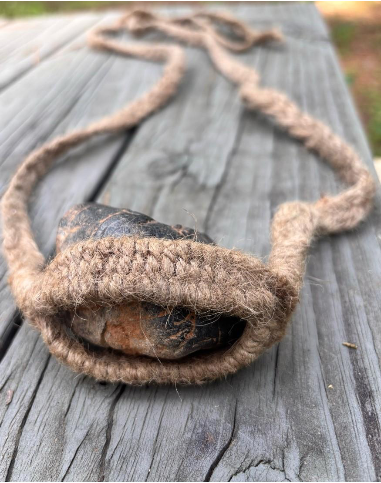
A replica of a common style of sling in antiquity. In modern trials, they are accurate at around 400 yards. That is beyond the effective distance of ancient javelin throwers or archers. Slings were made of braided ropes and could be wrapped around a hand or waist when not being used. The slings could hurl stones, which on average weighed half a pound, at speeds in excess of 120 miles per hour. Israel is very rocky, so slingers did not worry about running out of ammo. Photo by John Buckner
Slingers were capable of amazing accuracy, such as that of some men from the tribe of Benjamin, “Among all this people there were seven hundred chosen men lefthanded; every one could sling stones at an hair breadth, and not miss” (Judges 20:16). This latter statement is extraordinary when you consider that each stone that a slinger uses will vary in weight, shape, and texture from every other stone he has ever fired. Nevertheless, ancient slingers were prized by generals such as Hannibal Barca, who famously invaded Italy with elephants, and Julius Caesar. The historian Diodorus Siculus, writing in the first century BC, said that Greek and Spanish slingers “hurled their missiles with such force and accuracy that they often disabled or killed enemies before they could close the distance.”
The Account of David and Goliath
When David went into battle against Goliath, we are told that he selected five smooth stones from the brook. Despite how this is often depicted, he would not have chosen flat stones. Anyone who has ever used a modern slingshot, or even thrown a flat stone, can understand why. They simply do not fly straight. Instead, the stones would ideally have been smooth and round. Rocks from rivers and streams are perfect for the job. David probably spent quite some time choosing his stones. He was going into a life-or-death battle, not just for himself but for his nation. It is likely that he chose five stones because he was effectively going into battle against two men: Goliath and his shield-bearer.
Our Spiritual Weapons
Christian, the Bible says that Goliath disdained David, and we presume his sling as well. However, David had a weapon that Goliath could not see: the God of Israel. In modern times, it is common to meet with disdain when you speak of your faith. However, we do battle with the help of David’s God. To the untrained eye, a sling seems to be nothing but a bit of rope, yet it is a powerful and effective weapon. To the world, our Bible and our faith seem to be silly, small things, yet they are changing lives and shaking the world.
Before his battle with Goliath, David spent time in the desert getting to know his sling. I urge you to emulate him and get to know your Bible and practice with it every day. Spend time in prayer and alone with God. Then, when the battle comes, be like David and run toward the enemy, confident both in your God and in your weapons.
“For though we walk in the flesh, we do not war after the flesh: (For the weapons of our warfare are not carnal, but mighty through God to the pulling down of strong holds;)” 2 Corinthians 10:3-4
Related Resource: Study 1 Samuel
Discover more from Enjoying the Journey
Subscribe to get the latest posts sent to your email.