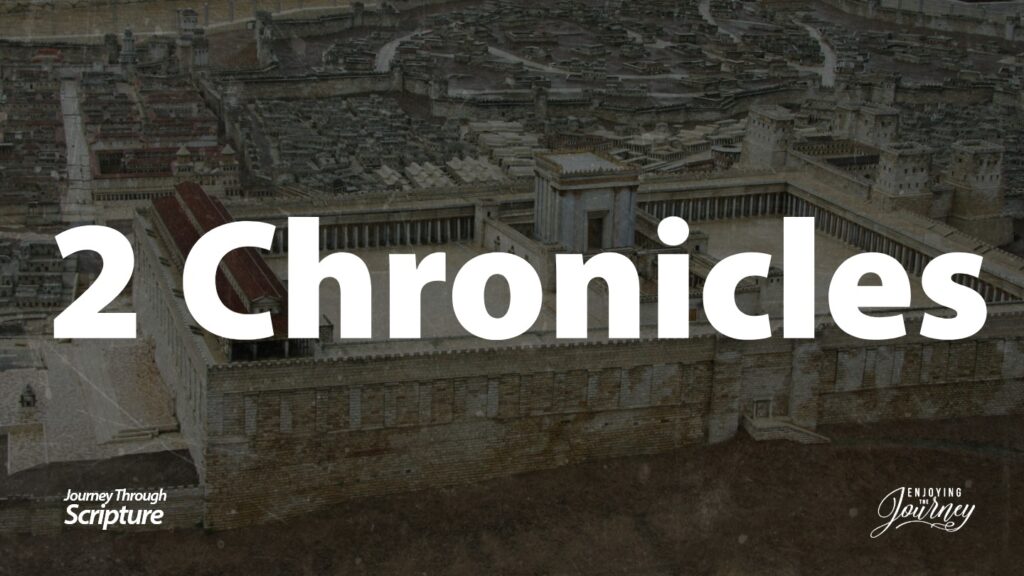
Journey Through 2 Chronicles
Our journey now takes us through 2 Chronicles. We view life in terms ofthe past, the present, and the future. With God, there is no past, present, or future. He transcends time. God is the I AM. The Lord is the Great Eternal. While we are bound by time, He is not. The beautiful truth for us is that God is the God of the past, the God of the present, and the God of the future.
Listen: Journeying through 2 Chronicles
Overview of 2 Chronicles
The Book of 2 Chronicles picks up where the last book left off. Ezra is writing to those who are emerging from the Babylonian captivity. They have been exiled for 70 years, far from their homes and from everything that is familiar; their temple and throne are gone. God repeats so many lessons in Chronicles that they knew, had heard, and that were written in other places, because He wanted to remind them that He does not change. God is still on the throne, still at work, and His promises are still true.
In 2 Chronicles, we see the rest of the story. 1 Chronicles ended with the prosperous reign of David.
- 2 Chronicles 1-9 opens by turning the focus to the reign of Solomon, his son.
- 2 Chronicles 10 describes the rebellion of the ten tribes, leading to the division of the kingdom into Israel and Judah.
- 2 Chronicles 11-36:16 reheases the the reign of the kings of Judah. While a few kings were righteous, most of these kings followed their own desires, and the priests, kings, and people all sinned against God, until, as the Bible says, “there was no remedy” (2 Chronicles 36:16).
There comes a point where God gives people up to what they want, and judgment follows. That is exactly what you find in this story of the kings of Judah in 2 Chronicles. But why does he rehash all of that? The reason is that two threads are woven through the journey through 1 and 2 Chronicles like an unbroken chain.
Man’s Failure and God’s Faithfulness
Those threads, the recurring truth is man’s failure and God’s faithfulness. Man is constantly sinning against the Lord, and God is constantly showing mercy. The central theme of 2 Chronicles is this: what you do with God will determine what God does with you. It is as if in 1 Chronicles, God cries out, “I am for you!”, and in 2 Chronicles God asks, “Are you with me?” God has never changed. He loves you with an everlasting love and wants the best for you. God has great thoughts and plans for you, but we must determine whether we want that or not. We must learn from history and decide today that we desire what God desires for us. The great exhortation of Chronicles is this: determine what you will do with the Lord.
Key Verses
2 Chronicles 15:1-2
There are two key verses that we find in our journey through 2 Chronicles. One is famous, while the other is not quite as well known, but if you compare them to each other, they share the same message. The first is given to an individual king. In 2 Chronicles 15:1-2, the Bible says, “And the Spirit of God came upon Azariah the son of Oded: And he went out to meet Asa, and said unto him, hear ye me, Asa, and all Judah and Benjamin; The Lord is with you, while ye be with him; and if ye seek him, he will be found of you; but if ye forsake him, he will forsake you.”
What is the message? What you do with God determines what God does with you. God responds to your response to Him. He is not going to force Himself on you. God is not going to make you, because He does not violate human will. He may work to draw and convict, sending messengers like this prophet Azariah. The Spirit of the Lord will move on your heart, and the Word of God will speak, but you must choose. You must make your own decision, and then you must live with the consequences of that decision
2 Chronicles 7:14
The other key verse is a famous verse written to the entire nation. We love to quote it, but have you applied it? 2 Chronicles 7:14: “If my people, which are called by my name, shall humble themselves, and pray, and seek my face, and turn from their wicked ways; then will I hear from heaven, and will forgive their sin, and will heal their land.”
God always fulfills His part. The question is, will we fulfill ours? God always keeps His word. Will we obey His Word and do what He calls on us to do? Will we humble ourselves, pray, and seek his face? (Click HERE to read Scott’s book, The Need of Our Nation.)
Reminders from God
As you study this book, you realize that 2 Chronicles 36:16 is not the end of the story. God continues in verses 17 through 21 and tells us about the ravaging of the people. He tells us how they lost their families, their fortune, and their freedom. He reminds them of their Babylonian captivity.
The people have just returned from the Babylonian captivity. It is fresh in their minds, and yet He is reviewing it again. Why? He is reminding them that returning does not mean that they cannot wander again. Robert Robinson wrote that famous hymn, “Come Thou Fount of Every Blessing.” In it, we hear that powerful phrase, “Prone to wander, Lord, I feel it. Prone to leave the God I love. Here’s my heart, O take and seal it, seal it for Thy courts above.” (Listen to the true story behind this hymn HERE.)
2 Chronicles ends with the people returning to Jerusalem, sent back by Cyrus, king of Persia. Cyrus was a wicked, pagan king, referred to as God’s anointed friend. God can use anybody, anytime, to fulfill His purpose. The Bible says, “Surely the wrath of man shall praise thee: the remainder of wrath shalt thou restrain.” (Psalm 76:10). God used Cyrus to bring them back into the land of promise.
At the end of the book, they stand amid the ruins, reflecting on their past and examining their present. Why? Because God is getting them ready for their future. Chronicles is not merely a chronicle of the past; it provides an examination of their present condition. Ultimately, it establishes a bridge to their future.
Conclusion
1 and 2 Chronicles are sometimes referred to as the book of Chronicles, which is the first of four books known as the Post-Exile books. These books were written after the exile, once the people returned. Those books are: Chronicles, Ezra, Nehemiah, and Esther. It is interesting to see how they build on each other. Chronicles looks back in retrospect on the history of God and His people. Ezra restores the temple. Nehemiah reconstructs the walls of Jerusalem. Esther details the rescue of God’s people from ruin and destruction. What is God saying to his people? “You have had quite a history, but now you have a new beginning. You are standing on the threshold of everything I have for you.”
As someone very profoundly said, “Today is the first day of the rest of your life.” Indeed, it is! You cannot go back and change the past, but you can learn from it. This present moment where you stand shapes your future. My friend, God has great things planned for all of us, including Israel. God has not finished with Israel. And though the church is not Israel, God has great things in store for us as well. “But as it is written, Eye hath not seen, nor ear heard, neither have entered into the heart of man, the things which God hath prepared for them that love him.” (1 Corinthians 2:9).
The great lesson of 1 and 2 Chronicles is this: God loves you, and God is for you. He has a glorious future planned for you, but you must decide for yourself what you will do with the Lord.
Related Article: 5 Ways to Get More Out of Your Bible Reading
Discover more from Enjoying the Journey
Subscribe to get the latest posts sent to your email.