

Everybody Loves a Good Story!
Life is a story. Moses said, “We spend our years as a tale that is told.” Perhaps that is why people around the world love to hear a good story (Listen to a full-length Bible Message on “The Rest of the Story”) – in some way, we can all identify. We weep at tragedies, laugh at comedies, and thrill at adventures.
The ancients passed along truth through storytelling. Scripture is full of narrative accounts which are given as examples of God’s truth. When Christ came teaching the Word of God He regularly employed the use of parables. Indeed, the Lord Jesus was the Master Teacher and the Master Storyteller. (Read more about the power of story here.) Next week we begin a brand new Enjoying the Journey series on the parables of Jesus, and I look forward to looking at these spiritual stories with you in the weeks ahead.
From the time I was a child I have heard a parable defined as “an earthly story with a heavenly meaning.” The word parable, which means “to cast alongside,” is found about 50 times in the gospel records. Parables are simply a means of comparing spiritual truth to things in natural life – a means of connecting God’s Word to our world.
In each study we identify three things:
- The Interpretation. It is a basic principle of Bible study that every Scripture has one primary interpretation. We must begin by uncovering the story, the setting, and the significance of each text.
- The Revelation. The Word is more than information, it is God’s revelation of Himself. Each parable reveals something about the nature of God and His perfect attributes.
- The Application. Though every story is not about us, there is an application to us. Parables may speak primarily of Israel, of Gentiles, or of the church (1 Corinthians 10:32). Many of the parables are prophetic in nature, but all of them have a present-tense message for us. We must find the personal and practical “takeaway” for our lives.
Why Did Jesus Use Parables?
Jesus was very plain about why He used parables: to reveal the truth to those who wanted to understand it and to conceal the truth from those who would not receive it (Matthew 13:10-15). We must approach these passages humbly, with total dependence on the Spirit to guide us. There is some disagreement among good Bible students on some of the meaning in the parables and I do not suppose to have all of the answers. Here are a few principles that must be followed in any parabolic study:
- Parables are not all true stories, but they are stories that always convey truth. There is some debate over whether stories such as the prodigal son may have come from real-life situations. It is possible. But, as a general rule, the parables were simply object lessons of truth.
- Each parable has one primary point. It is dangerous to begin to read into every detail some symbolic meaning. Every parable has one big idea and we must seek nothing more and settle for nothing less than our Lord’s intent.
- Interpreting parables requires examining both the context of ancient culture and the context of the rest of Scripture. The customs and culture of Jesus’ day help to understand the story itself. The larger treatment of the subject throughout the Word helps us to understand the spiritual significance.
There are differing lists of parables depending on whether you include minor parabolic language, along with the well-known parables of Jesus. We have developed an accompanying ETJ resource for this series. You may download a companion study guide which will show the parables of Jesus and their parallel passages in each gospel record.
Join me for the next stage of our journey as we study the parables Jesus told and their application to us!
(Listen to the Bible studies below, in the Archive, on our ETJ web app, YouTube channel, or any podcast platform.)
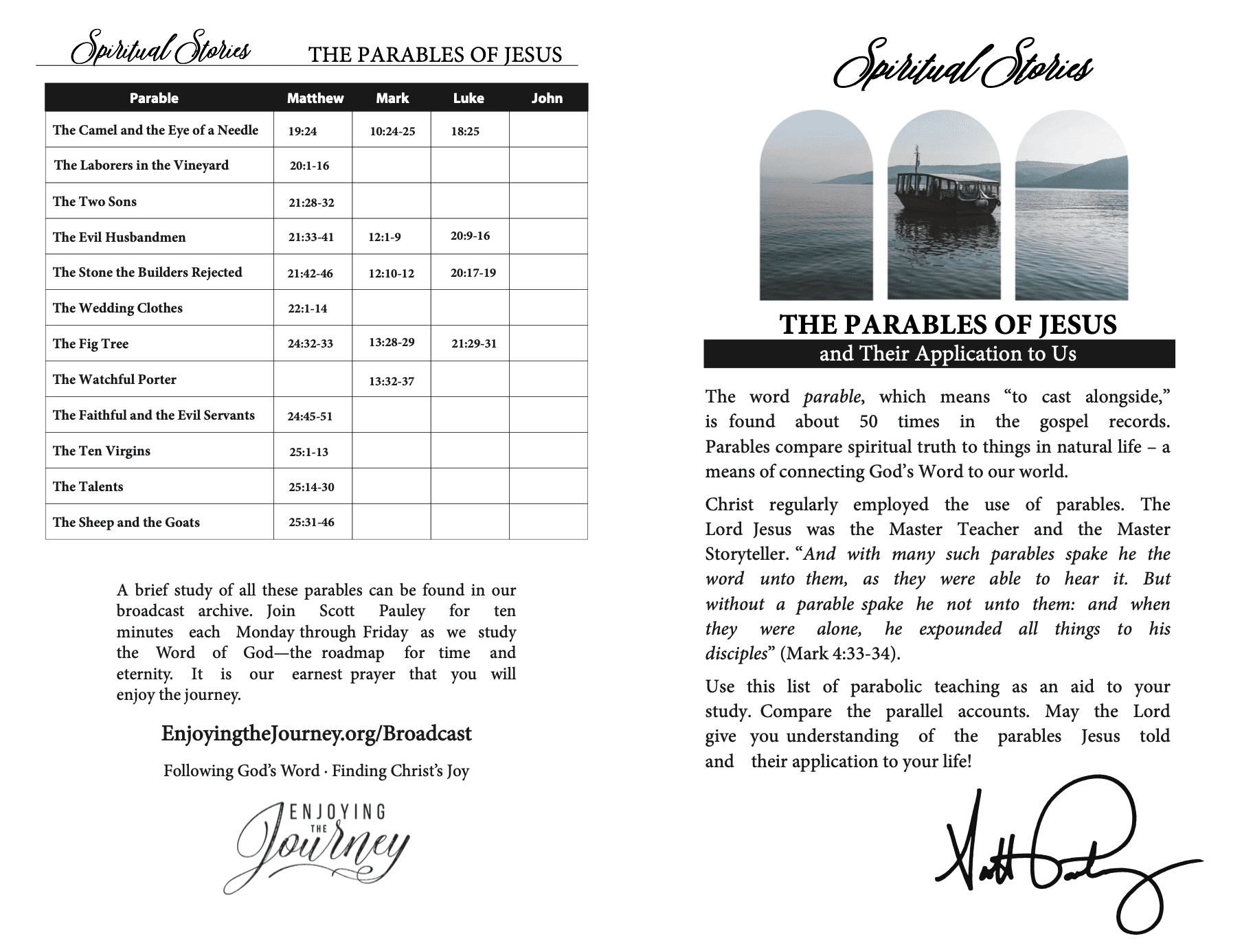

This is a guide to the parables of Jesus. Use it to compare Scripture with Scripture. Seek to discover what God’s message is to you in these parables.
Discover more from Enjoying the Journey
Subscribe to get the latest posts sent to your email.
Post Author
More from similar topics
Bible | Church | Gentiles | God's Word | Israel | Jesus Christ | Scripture | application | narrative | parables | prophecy | spiritual stories | story | teaching