
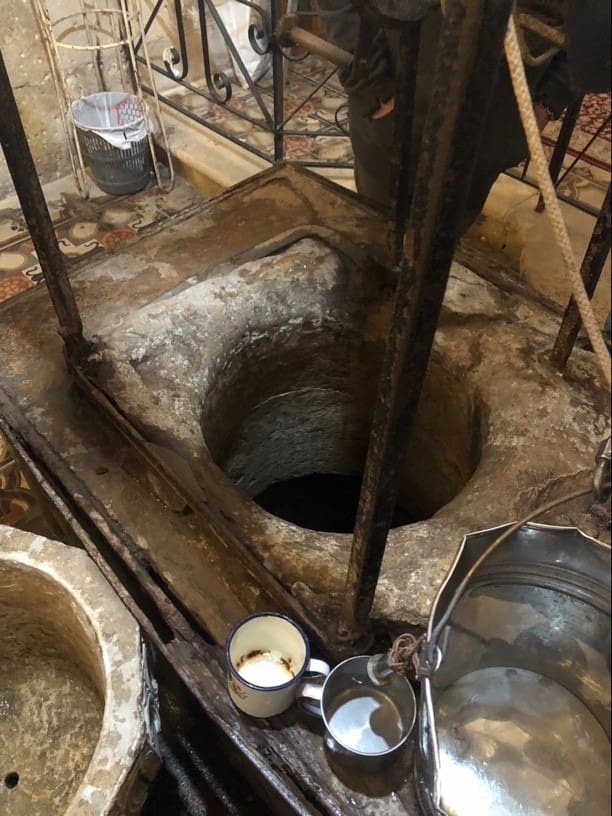
Jacob’s Well
“And he must needs go through Samaria. Then cometh he to a city of Samaria, which is called Sychar, near to the parcel of ground that Jacob gave to his son Joseph. Now Jacob’s well was there. Jesus therefore, being wearied with his journey, sat thus on the well: and it was about the sixth hour. There cometh a woman of Samaria to draw water: Jesus saith unto her, Give me to drink” (John 4:4-7).
Jacob’s well is located in the neighborhood of Balata near the city of Nablus, known as Neapolis during Roman times. The well is 250 feet from historic Shechem, which the book of John calls Sychar. Today the well is inside of a Greek Orthodox Church. The well is quite deep at 135 feet, which concords with the words of the Samaritan woman, and it is has a narrow mouth. The custodians of the church will sometimes draw water from the well in a bucket, which they then pour back. If you listen quietly, you can hear the water splash far below you. The water is cold, and tastes fresh.
The Lord at Jacob’s Well
In John 3, Jesus preached a personal sermon to Nicodemus, a high-ranking Jewish man, and told him that he needed to be born again. In the next chapter, Jesus preached to a broken Samaritan woman and told her the same message. He shocked the unnamed woman at the beginning by asking her to give Him some water to drink. The ancient rabbis of Israel despised the Samaritans as a whole, but particularly the women. They wrote some shocking things about the presumed nature of Samaritan women in the Talmud. Samaritan women were seen, among other things, as imparting impurity to any food or drink that they touched.
In John 4, Jesus violated a manmade tradition, not a biblical one, when He asked the woman for a drink. She was surprised that He did this, since she no doubt knew her Jewish neighbor’s extreme views on her people. However, as God Himself later exhorted the apostle Peter, “What God hath cleansed, that call not thou common.” (Acts 10:15) Jesus did not see her as a Samaritan, or as an enemy, but instead He saw her for who she was, a sinner who needed His salvation.
When the disciples returned with food, they were surprised to see that Jesus was talking with a Samaritan, and a woman at that! They tried to get Him to eat, but He refused. Instead, He urged them to lift up their eyes and look on the fields for they were white already to harvest. He wanted them to see that the harvest was ripe among the religious, like Nicodemus, and that it was also ripe even among the despised Samaritans. Jesus chose to travel through Samaria on purpose to meet this woman, and the others in the city. After she told the residents of the city what Jesus had done, they heard His words, and then they too believed on Him. He ended up staying with them a couple of days, during which He no doubt violated many more bigoted, manmade rules.
The Lesson at Jacob’s Well
We can speculate that Jesus did this, not just for the benefit of the lost Samaritans, but also for His disciples. Just before He ascended into Heaven, He told His disciples that they would receive the Holy Ghost, and would be witnesses in Jerusalem, and Judea, the home of people like Nicodemus. But they would also go to Samaria, and the uttermost parts of the earth to reach people like the Samaritan woman, and those of us who are Gentile believers. (Acts 1:8)
Christian, are you allowing a manmade rule to impede your witnessing? Jesus urged His followers to see the hated Samaritans, and even Samaritan women as part of His Gospel harvest. Is there a people group that you refuse to see as part of the harvest, to lift up your eyes and look upon? Some people that you despise and see as excluded from God’s love? If so, I urge you to repent today, and follow in the steps of Jesus the Messiah. He chose to travel to Samaria to preach the Gospel, even in the face of misunderstanding and ethnic hatred. Why? Because the Samaritans needed Christ too.
Discover more from Enjoying the Journey
Subscribe to get the latest posts sent to your email.