Journey Through Micah
In the 1950s, the Quakers coined an expression. Maybe you have heard it: “speaking truth to power.” We sometimes hear this phrase in different contexts, such as in the news. Perhaps you have heard that phrase recently. It is interesting how things come back around. There is a resurgence of certain ideas and expressions, such as speaking truth to power.
Sometimes that must be done in the spiritual realm. That is exactly what the prophet Micah was called on to do. Journey through Micah and see what an examination of this book reveals.
Listen: Journeying through Micah
Overview of Micah
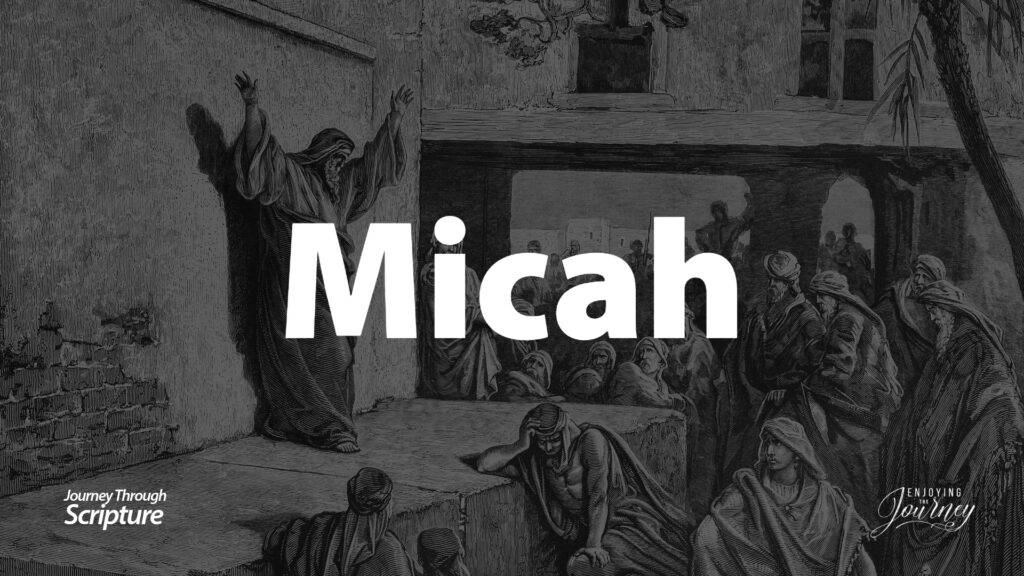
Micah was a commoner. He was not an aristocratic type of person — he has even been referred to as “the prophet of the poor.” Micah was a contemporary of Isaiah. He was called on to prophesy to the two capitals. Micah 1:1 records, “The word of the LORD that came to Micah the Morasthite in the days of Jotham, Ahaz, and Hezekiah, kings of Judah, which he saw concerning Samaria and Jerusalem.”
Notice it was Samaria and Jerusalem. What are those two places? They were the two capitals. Samaria was the capital of the Northern Kingdom (Israel). Jerusalem was the capital of the Southern Kingdom (Judah).
Here God commissioned a poor man, a commoner, an everyday fellow to speak God’s truth to powerful people. It took courage and faith. Most people, when they talk about speaking truth to power, are thinking: “I’m going to give you a piece of my mind. I’m going to tell you what I think. No matter how powerful you are.”
That is not at all what we are dealing with in this book. Micah was called on to speak God’s truth, not his own. That is what this world needs today. It needs God’s eternal truth. Even in powerful places, like Washington, D.C., and London, England. In the great cities and capitals of the world, among powerful people, among the wealthy and world leaders, do you know what is needed? A return to truth. The prophet Micah is an illustration of that.
The King of Kings
His name means “who is like unto Jehovah?” Interestingly enough, he used that phrase in his writings. In Micah 7:18, he wrote, “Who is a God like unto thee, that pardoneth iniquity, and passeth by the transgression of the remnant of his heritage? he retaineth not his anger for ever, because he delighteth in mercy.”
How could he look the politicians in the face without fear? How could he speak in Samaria and Jerusalem, to their kings, and unflinchingly tell them the hard truth? Because he had a greater King. He was serving one more powerful than them. He knew Who he represented. In our day, we need to return to that mentality — that every man is just a man. God is always far greater.
Theme of the Book of Micah
Micah’s ministry spanned over 40 years. Take the time to read through this entire little book of the Bible. You will find that the theme of the book is very simple. It is this: the Failure of rulers and the Faithful Ruler. And it is Ruler with a capital R, because it is a reference to Christ, to the Messiah.
Micah breaks down how every class of rulers had failed.
- The princes (civil leaders) crumbled into sin (Micah 3:1).
- The prophets (moral leaders) were compromised (Micah 3:5).
- The priests (spiritual leaders) were corrupt (Micah 3:11).
Every type of ruler that God had put in place, the princes, the prophets, and the priests, all of them had miserably failed. Micah reminds us that men often fail, but Christ never does.
Micah describes how Jesus is always faithful
What are the three eternal officers of the Lord Jesus Christ? Jesus is the greatest Prophet, He is Priest, and He is King. In every way that the rulers failed, the Ruler is always faithful. Don’t you love that truth? Choose to let Christ be your King today! Allow Christ to rule freely over your heart and life. That doesn’t mean that you should not listen to authorities or submit to rulers; called to submit (Romans 13) and to pray for them (1 Timothy 2:2). (DOWNLOAD: 21 Bible Prayers for Government Leaders.) They need the same thing we need – the truth of the King of Kings and the Lord of Lords.
Key Verses of Micah
The key to this book is found in Micah 6 in the form of two verses. One gives us the situation, and the other gives us the solution.
The Controversy with Man
First, the situation. Micah 6:2 declares: “Hear ye, O mountains, the LORD ‘s controversy, and ye strong foundations of the earth: for the LORD hath a controversy with his people, and he will plead with Israel.”
Here’s the keyword: controversy. We have all been in controversies. It is one thing to have a controversy with man; it is quite another thing to have a controversy with God. And here God says, “I have a controversy with you.” The LORD did not fail; man did. The problem is on our end. Almighty God has a controversy with us. If that is the situation, what is the solution?
The Divine Solution
In the same chapter, Micah 6, we read this beautiful verse. “He hath shewed thee, O man, what is good; and what doth the LORD require of thee, but to do justly, and to love mercy, and to walk humbly with thy God?” (Micah 6:8).
Don’t you love it that God shows us what He wants? People say, “What does God want for me anyhow?” Here is the answer. He wants you to do justly — do right. He wants you to love mercy, and he wants you to walk humbly with your God. If we obeyed this command, so many of the problems and struggles we deal with right now would fade away.
With so many controversies around us, we often miss the spiritual conflict. There is a constant battle with the world, the flesh, and the devil. It will continue as long as we are in this world. Much conflict and so much controversy come with God and with one another because we are not doing justly, we are not loving mercy, and we are not walking humbly before our God.
Outline of Micah
As you walk through the little book of Micah, there are 3 or 4 natural divisions, and they’re all marked by the word “Hear“. You can mark them for yourself as you walk through the Word of God.
Micah 1:2 – “Hear, all ye people; hearken, O earth, and all that therein is: and let the Lord God be witness against you, the Lord from his holy temple.“
Micah 3:1 – “And I said, Hear, I pray you, O heads of Jacob, and ye princes of the house of Israel; Is it not for you to know judgment?“
Micah 6:1 – “Hear ye now what the Lord saith; Arise, contend thou before the mountains, and let the hills hear thy voice.”
You know what the Lord is looking for today? He is looking for somebody who will get in tune with Heaven and hear His Word. We are so in tune to Samaria and Jerusalem. That is to say, we are so in tune with Washington, D.C., or Hollywood that we fail to hear what God is saying.
What is the remedy? We need someone to remind us that it is not about man. It is always about God. It is not about princes, prophets, and priests — it is about Jesus Christ. We must listen to Him and do what He wills.
A Prophecy of the Messiah
We close this overview of Micah by sharing one of the most famous prophecies in the whole Bible. Several hundred years before the Messiah came, it was prophesied where he would be born. Micah 5:1 says, “Now gather thyself in troops, O daughter of troops: he hath laid siege against us: they shall smite the judge of Israel with a rod upon the cheek.” That happened at Calvary. But notice Micah 5:2. “But thou, Beth-lehem Ephratah, though thou be little among the thousands of Judah, yet out of thee shall he come forth unto me that is to be ruler in Israel; whose goings forth have been from of old, from everlasting.”
You can be sure that this poor prophet delighted in telling rulers that a strong King, the Messiah, would come in a little place called Bethlehem. It is a reminder to us that another Commoner came; His name was Christ. He became a man without ceasing to be God, to bring us to Himself.
It is not about our power, it is about who He is. It is not about man’s rule, it is about God’s rule. Would you choose to let the Lord rule over you today? He is the only Faithful King.
Related Article: 55 Prophecies Jesus Fulfilled
Discover more from Enjoying the Journey
Subscribe to get the latest posts sent to your email.