
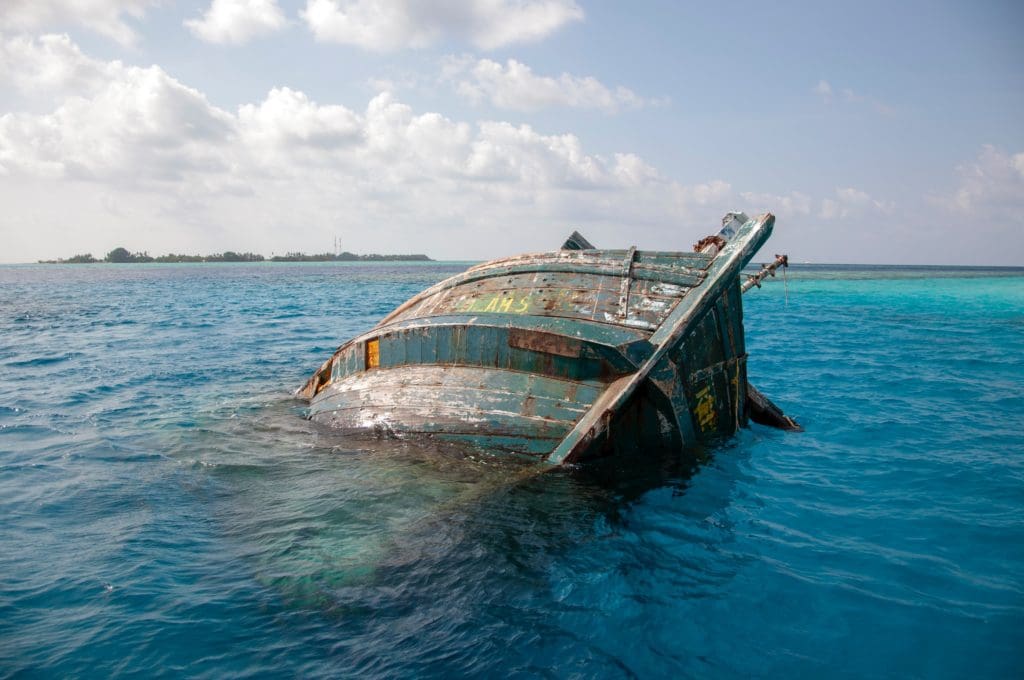
As I ran along the coast in a Florida community some time ago I saw one of the most vivid reminders of the dangers of life. The sun was shining bright and the skies were clear. People around me mingled in the park, walking their dogs and talking to one another. Expensive private boats floated along the pier. And there in the middle of all that beauty was the wreckage…
No doubt, the boat had served some useful purpose. Perhaps a family had enjoyed wonderful days onboard. Now it sat at the bottom of the harbor. The only evidence that it existed was the mast still sticking out of the water.
A severe storm had revealed some weakness in the vessel, and now it is useless. Worse than useless, it is in the way. Others must maneuver around it.
As I stood looking the Holy Spirit brought His truth to my mind:
“Holding faith, and a good conscience; which some having put away concerning faith have made shipwreck” (1 Timothy 1:19). There are so many shipwrecks in our world! Rarely is it because of someone rejecting truth. Usually it is the result of neglecting the application of truth. Faith. A good conscience.
The Apostle Paul thought this danger very real, not only for others, but for himself:
“But I keep under my body, and bring it into subjection: lest that by any means, when I have preached to others, I myself should be a castaway” (1 Corinthians 9:27). My body like that boat can very easily become useless to God. It can be set aside, no longer able to be used for the purpose for which He created it.
How do we keep from becoming castaways…shipwrecked?
Paul said that he fought to “keep under” his body. The affections and appetites of the body want to rule over every other part. They must be kept under. But, under what? Not my control, but His. My vessel is only useful as it is under the watchful eye and perfect wisdom of the Captain.
The Apostle’s words are strong. Literally, he says he works to “beat down” his body. Flesh is our greatest enemy. In the previous verse Paul said, “…so fight I, not as one that beateth the air” (2 Corinthians 9:26). To beat the air around us is pointless. To beat down the sin within us is purposeful.
What is true for the athlete, is true for the boatman, and true for the Christian. Wise people address issues of character. Appearances do not guarantee safety. We spend a great deal of time polishing our vessels, but one small crack beneath the surface can lead to disaster.
There is something worse than a sea disaster – a sin disaster. Storms will come, but the other shore is in sight. You won’t always have fair winds and smooth seas, but your Captain will guide you safely home as long as you keep the vessel in His hands.
Let’s determine by God’s grace to finish our voyage without a shipwreck.
Discover more from Enjoying the Journey
Subscribe to get the latest posts sent to your email.





Oh! So true brother Scott; it is a constant battle between the flesh and the Spirit. This is one of my greatest fears and struggles, and like a good soldier we must fight this battle constantly.
Appreciate your faithfulness. Pray for me.
Thank you for your article. What a sobering reminder that “this arm of flesh will fail you, ye dare not trust your own.”
God bless you my friend. Look forward to being with you all soon!