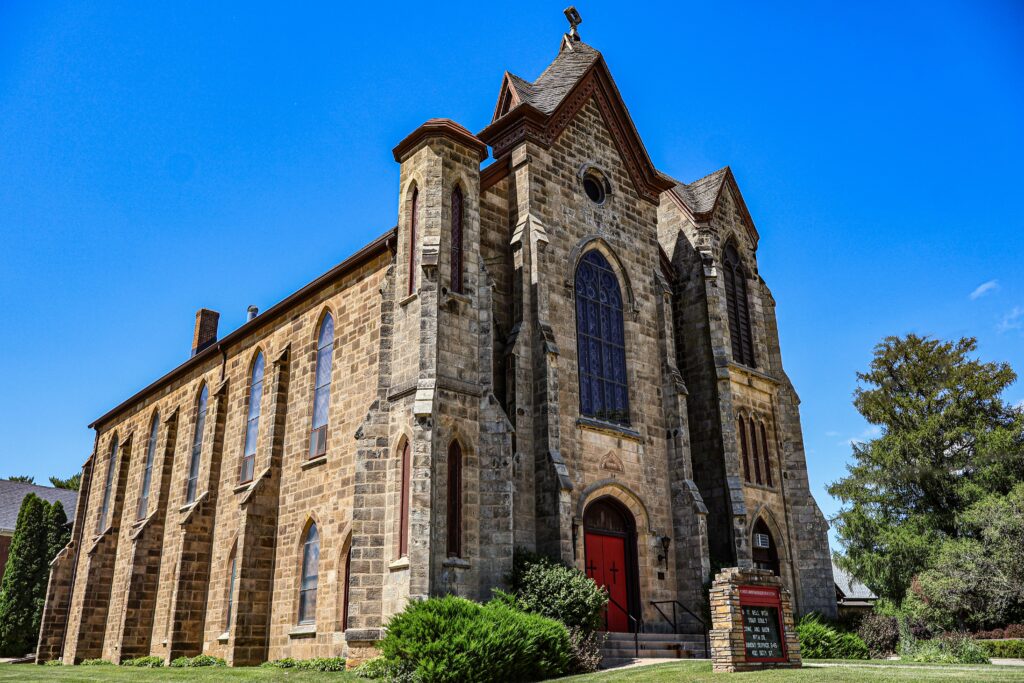
CBS News has reported several times in recent months on the rise of nondenominational churches. They cite professor and researcher Ryan Burge, who records that more American adults than ever now identify as non-denominational, more than all mainline denominations together. There are more people connected to nondenominational churches than the two largest Protestant denominations – the Southern Baptist Convention and the United Methodist Church – combined! Less than 3% of Americans attended nondenominational churches in 1972. Today it is 14%.
Thom Rainer, a Southern Baptist, similarly observed that behind the “nones” (those who claim no religious belief), the second largest group in today’s culture are the “nons” (those who identify with nondenominational churches). Many believe that, on this trajectory, nondenominational churches will surpass Roman Catholics in the years ahead. How should we view this shift, and how can we help people who are seeking?
Denominations are not in the Bible.
Pastor Clarence Sexton often said to me, “Beware of any ‘ism’ – it takes the place that only Jesus should have.” Indeed, man-made organizational structures can never accomplish what the God-ordained organic growth of local churches can. This is not to suggest that individual and independent churches cannot work together. They should! The partnership of the Jerusalem church and the Antioch church in the Book of Acts is a classic example.
In recent days, it has been my privilege to work with a number of churches that labored together to impact their region for Christ. “Behold, how good and how pleasant it is for brethren to dwell together in unity!” (Psalm 133:1) Oneness among like-minded believers for the advancement of the gospel is a beautiful thing to see. But there is a delicate balance that must be maintained. Doctrinal purity and church autonomy matter.
Issues arise when one church, group of churches, individual, or group of individuals claims authority over another autonomous congregation. The church, as a local body of believers, may be influenced by other believers and partner with other believers, but it is not to be dominated by believers outside of that local church.
The local church is to be independent.
Read the letters of Paul, and you will find that local assemblies in the New Testament connected in prayer, cooperated in gospel endeavors, and communicated with one another when needs arose. But they did not presume to control one another. We have Christ in common and belong to “the whole family in heaven and earth” (Ephesians 3:15). It must please the Father when His children act like brothers and sisters, but we must remember that the children are not twins.
The “whole family” has never assembled. Not yet. Soon we will all meet at the Father’s house, but Christ has designed it that local assemblies would be a microcosm of the whole now. A denomination, like a universal church or “invisible” church, cannot baptize converts, observe the ordinances, comfort the bereaved, assemble together, exercise discipline, or send out laborers. Every Christian needs a local church, and each church body is independent by its very nature.
Doctrine is essential.
This is important: you may go to a nondenominational church, but you do not go to a non-doctrine church. There is no such thing! (Read more on this: “Yes, Doctrine Matters!“) Every church believes and teaches something. One of the dangers in the meteoric rise of nondenominational congregations is the blurring of lines of truth. While seeking to remove division, many have removed distinction.
I frequently meet people who attend churches that have no idea what their church believes in areas of vital Bible doctrine. This has also contributed to an increase in unregenerate church members. The goal of Christ’s church is not to see how many people it can get in the seats on Sunday morning; it is to help people know Christ and the truth of the Word of God.
- Do you know what your church teaches?
- Does it line up with the Scripture?
- Do you know what you believe and why?
This is a day for clarity.
God’s people have always been known for what they believe and who they represent. Beware of replacing “ism” with “non.” It would be much better to be identified by what you are than what you are not. In a world of questions, chaos, and confusion, the church should be one place where people can come and know exactly what will be taught. The church is “the pillar and ground of the truth” and this requires certainty.
In the words of J.C. Ryle:
“A religion without doctrine or dogma is a thing which many are fond of talking of in the present day. It sounds very fine at first. It looks very pretty at a distance. But the moment we sit down to examine and consider it, we shall find it a simple impossibility.
We might as well talk of a body without bones and sinews. No man will ever be anything or do anything in religion, unless he believes something!”
Pop Christianity promotes a type of generic message and general faith. Our God is always specific. We must not go beyond Scripture, but we must not fall short of it either. The Lord’s people should be as plain as their Master when it comes to revealed truth. This is the difference between cultural Christianity and biblical Christianity.
Permit me to close with a personal word. I am a Baptist by doctrinal conviction. I am a member of a local New Testament church that is independent in its governance. As an evangelist, I believe that cooperative efforts among like-minded churches in prayer and evangelism are essential if we are going to reach the world. And I am burdened that so many Americans attend churches of any kind without ever getting rooted in the truth of Scripture.
Let us be Bible Christians, committed church members, and unashamed advocates for right doctrine. Trends come and go. Truth is here to stay.
Discover more from Enjoying the Journey
Subscribe to get the latest posts sent to your email.