Journey Through Nahum
Two books of the Bible deal with Nineveh. The first is famous: The Book of Jonah. Two books later, a second prophet deals with the same city and the very same sins. The record is found in the little book of Nahum. Let us journey through Nahum, discover what was happening in Nineveh, and the eternal truths God is teaching through this book.
Listen: Journeying through Nahum
Overview of Nahum
Nahum was from Judah. His name is a shortened form of Nehemiah. It means comfort. What was Nahum’s comfort? His comfort was in knowing that in the end, God always does right. In the end, evildoers will be repaid. Nahum dealt with Nineveh, but about 100 years after Jonah preached.
Think about this: Jonah preaches (begrudgingly), and the people of Nineveh repent. They got right with God. The greatest revival in history, arguably, was the salvation of an entire city. A nation turns to God from the top down. It was an amazing thing. And yet, 100 years later, they are right back to the same sins; they are in even worse shape.
When you go back to sin, it is always worse every time you go back to it. And so, finally, they get to a place where there is no more hope. And the city of Nineveh fell in 612 BC.
Nahum 1:1 says: “The burden of Nineveh,…”. You see, the truth of the matter is that sin may be repented of. We can be restored to fellowship, but sin is still serious business. If we take iniquity lightly, if we treat it flippantly, if we think we can go back and forth, back and forth, back and forth, at some point, we cross a line with God and judgment. Restraint is actually a judgment reserved.
God is Slow to Anger, but God is also Jealous
You remember back in Jonah 4:2, one of the things that Jonah observed about God was that the Lord was slow to anger. Jonah said, “I knew that you were going to be slow to anger.” Well, it is interesting that Nahum actually repeats that, but he adds something here. Remember, the Bible is a progressive revelation because God is progressively unveiling Himself to man. In Nahum 1:2, the Bible not only says that God is slow to anger, but it also says He is jealous.
Nahum 1:2 says, “God is jealous, and the LORD revengeth; the LORD revengeth, and is furious;…” The Lord will take vengeance on His adversaries, and He reserves His wrath for His enemies. Yet, verse three says, “The LORD is slow to anger…” God is slow to anger, but that does not mean He will reserve His anger forever.
We read in the New Testament, “Behold therefore the goodness and severity of God…” (Romans 11:22). Some may ask, “Is He good or is He severe?” The answer is both. God is good. But at some point, God brings judgment.
In Jonah, we see God’s goodness toward Nineveh. In Nahum, we see God’s severity toward Nineveh. He brings judgment upon those who despise His goodness.
The inhabitants of Nineveh at this particular time saw God angry. The prophet Nahum saw God angry. It is a fearful thing to fall into the hands of a living God. You do not want to witness the anger of a holy God. And what is this? This message about Nineveh, in the second book, 100 years later, serves as an object lesson to the whole world. It is an example to us.
The Fall of Nineveh
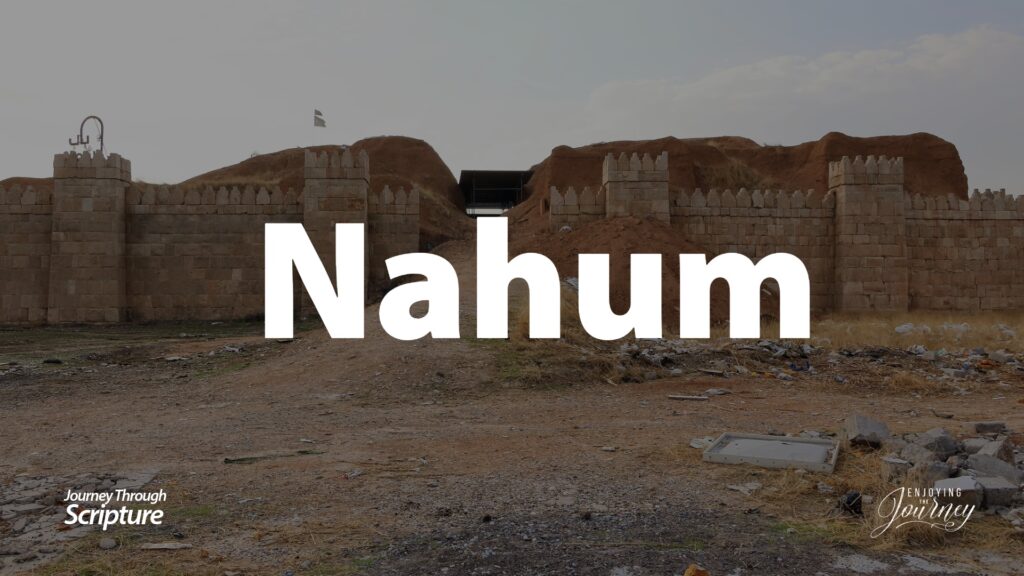
Nineveh was the most powerful city in the world. It was actually four cities in one. It was about 60 miles around. Its walls were 100 feet high. Historians believe that the walls were broad enough for three chariots to be driven side by side on them. There were 1500 towers along those walls. Each of them was 200 feet high.
This was an imposing fortress. It rose like a castle that could not be penetrated. Yet, one of the phrases used in the Book of Nahum is this: “I will make an utter end of it.” Nothing left. Total destruction.
Today, there is nothing left of the ancient city of Nineveh. There is nothing left of these people. Why? Because when God says He is going to make an utter end of something, He makes an utter end of it.
- In chapter one, their doom is declared.
- In chapter two, it is described.
- In chapter three, God points out that it was deserved.
This message was not for Nahum. It was from God, and it was for God. Nahum barely mentions his own nation. Remember, Jonah was such a patriot. He was so concerned about his own nation. Nahum barely mentions his own nation. He was not seeking revenge for them. No, this is holy wrath. This is righteous indignation. This is not retaliation that man brings; this is retribution that God brings.
When people have wrath in them, that wrath becomes their master. But God is always master of His own wrath, His own anger. And God finally shows it to Nineveh. And in showing it to Nineveh, He shows it to all of us.
Key Verses of Nahum
The key verses of the book are found in Nahum 1:8-9. The Bible says, “But with an overrunning flood he will make an utter end of the place thereof, and darkness shall pursue his enemies. What do ye imagine against the LORD? he will make an utter end: affliction shall not rise up the second time.”
Remember, they have been given a chance already. God says there will be no more chances. And He repeats this phrase “utter.” God does not repeat Himself because He forgot He said it the first time. He says it again because He does not want us to forget what He said: “an utter end.”
By the way, did you catch the way that He was going to do it — with an overrunning flood? Based on the description of Nineveh I just gave, you might think, “Well, no army could get through there.” One city ruler once said, “The only way for Nineveh to fall is if her river turns against her.” Did you know that is exactly what happened? During one of the sieges, the river swept in upon her in such a way that it made a huge gap in the mighty walls of Nineveh, a gap large enough for the enemy to come through.
In Nahum, we are reading prophecy – when written, judgment was still in the future. Now we are looking back on it. In retrospect, it is much clearer. But this is definitely prophecy.
The Judgment of God
Nahum says God is going to use a flood to bring judgment. By the way, there was a time earlier in history when He used a flood to judge the whole world. You remember that? There is another flood coming, not a flood of water; God promised He would not do that. But there is a flood of fire coming. There is judgment coming to this world. And if this world thinks, and the nations of the world think they have escaped God’s judgment, friend, it is judgment restrained. But it is also a judgment reserved.
This should sober us. I love reading Scripture, and it brings me great joy. But the same Scriptures that comfort also convict. Remember that Nahum’s name means comfort. We find our comfort in God. There is conviction here. Let us examine ourselves; let us look at our own hearts, our homes, our churches, and our nation. Let us say to God, “Lord, we want to be right with you because we do not want you to have to bring judgment on our generation.”
The Attributes of Christ
One of the things I love about the book of Nahum that you might miss if you are not careful is that chapter one is full of the attributes of Christ. “He rebuketh the sea.” (Nahum 1:4) He is good (Nahum 1:7) He is a stronghold (Nahum 1:7) in the midst of judgment. The Bible says, “He knoweth them, that trust in him” (Nahum 1:7). Don’t you love that? You are not going to stop judgment from coming, but you can trust the Lord Jesus. You can come to know Him as your personal Savior.
As a Christian, you can be as close to Him as is possible, and in the midst of judgment, like Nahum, you too can find comfort. May God help us today not just to get a glimpse of some civilization or city long removed from the earth, but may we have a fresh glimpse of the God of heaven, a God who will rule and reign for all eternity. Trust Him today.
Related Study: 2348 B.C. All Over Again?
Discover more from Enjoying the Journey
Subscribe to get the latest posts sent to your email.