Hierapolis in the Bible
“Epaphras, who is one of you, a servant of Christ, saluteth you, always labouring fervently for you in prayers, that ye may stand perfect and complete in all the will of God. For I bear him record, that he hath a great zeal for you, and them that are in Laodicea, and them in Hierapolis.” Colossians 4:12-13
Hierapolis and Paganism
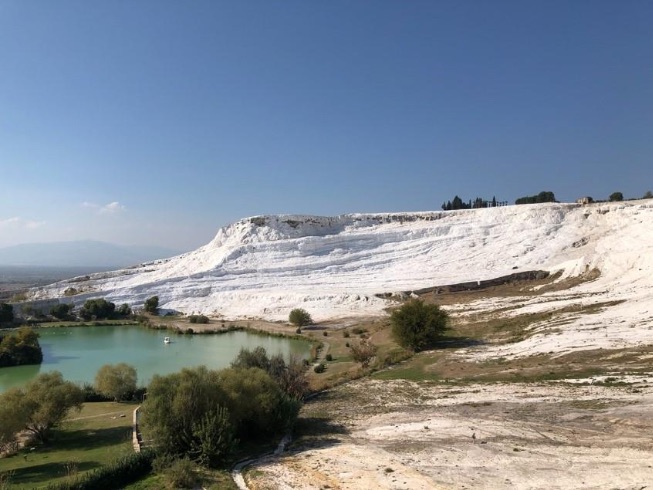
Hierapolis was well-known in antiquity for its temple built over “the gate to the underworld.” The temple was originally built to honor Cybele, the eastern mother goddess. Later, after the Greeks colonized the area, the temple became associated with Hades, also known as Pluto, the god of the underworld. The temple was built over a fault line, from which toxic gases still emerge from deep in the earth. Ancient writers such as Strabo and Cassius Dio wrote of the ceremonies. People would gather on the benches around the “gate to the underworld,” and eunuch priests known as the Galli would drive bulls into the arena. Poisonous gases leaking from deep in the earth and emanating from the sacred cave, would kill the bulls.
It is still unknown how the priests managed to avoid succumbing to the gas. The fact that they could descend to the cave and return was seen as proof of Hades’ protection. In modern times, the cave still emits poisonous gas and is still dangerous to enter. Pilgrims would come from around the Greek and Roman worlds to gather in small rooms around the temple. After a time of fasting, they would consume drugs such as opium, as well as small amounts of the gas from the temple. This would send them into a trance where they hoped to be visited by the Great Mother Goddess or by Hades, the king of the underworld.
Hierapolis and the Early Church
Hierapolis is not as famous as Colosse, nor as infamous as Laodicea. Nevertheless, we can learn some important lessons from Hierapolis. The founding of the church in Hierapolis is traditionally credited to the influence of the Apostle Paul, who was living nearby in Ephesus. Even though the city housed “the mouth to hell and crucified Philip, one of Christ’s companions, we know from this lone verse in Colossians that faithful believers resided in the city.
Our world needs believers who are ready and willing to preach Christ at the very mouth of hell, just like in Hierapolis. Even when surrounded by vile paganism, persecution, and the judicial murder of Philip, the church there remained. If they can stand for Christ in such circumstances, we should take courage and do so too. God wants His followers to live for Him in the midst of our own deteriorating culture! Does God want you to go to a literal temple of hell to preach His Son? If so, I urge you to follow His calling. In any case, Hierapolis shows modern believers that we can faithfully serve God, wherever we happen to live.
“And I say also unto thee, That thou art Peter, and upon this rock I will build my church; and the gates of hell shall not prevail against it.” Matthew 16:18
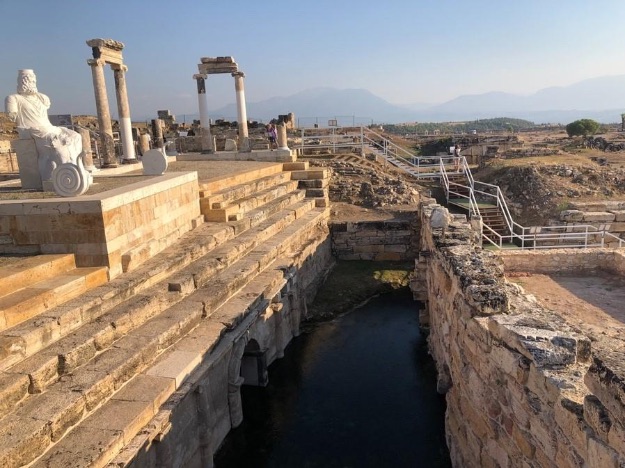
The Plutonium. The vaulted door on the lower left leads to a cave that was known as the entrance to the underworld. Even today, entry is forbidden due to how dangerous the gases are. People could safely sit on the bleachers and watch the ceremonies down below. Overlooking it all is a recreation of a statue of Hades that stood here in antiquity.
Photo by John Buckner
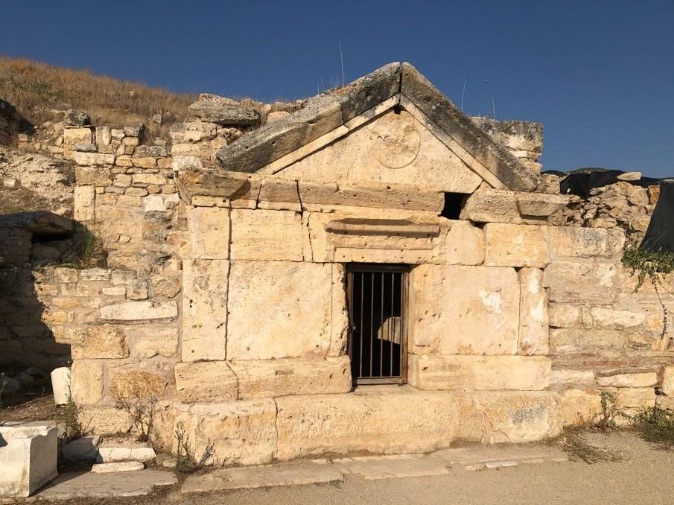
The tomb of Philip the Apostle. This is located very close to the traditional site where Philip was crucified. The tomb and the surrounding area are still being excavated and studied. It was rediscovered in 2011 by Italian archaeologists.
Photo by John Buckner
Discover more from Enjoying the Journey
Subscribe to get the latest posts sent to your email.