King David’s Blessing at En Gedi
“And it came to pass, when Saul was returned from following the Philistines, that it was told him, saying, Behold, David is in the wilderness of Engedi. Then Saul took three thousand chosen men out of all Israel, and went to seek David and his men upon the rocks of the wild goats. And he came to the sheepcotes by the way, where was a cave; and Saul went in to cover his feet: and David and his men remained in the sides of the cave.” – 1 Samuel 24:1-3
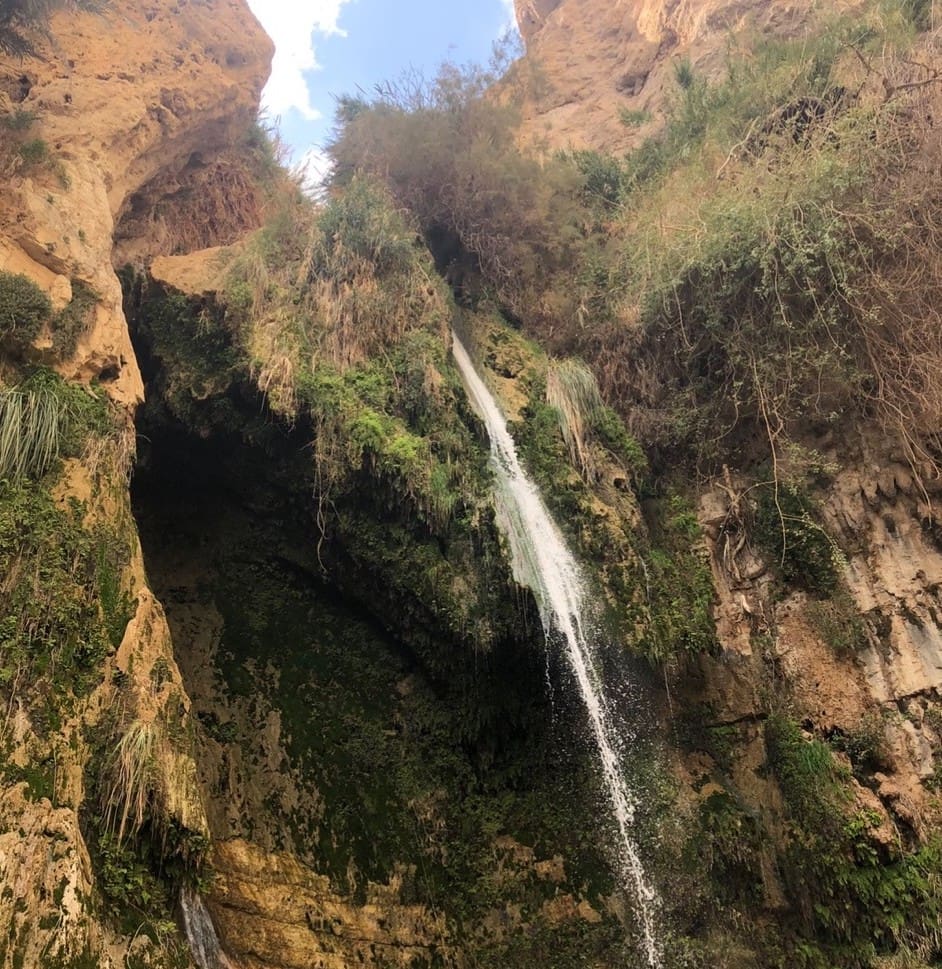
I crouched by the pool of water that forms below a small waterfall at the oasis of En Gedi. I dipped my fingers in the water, carefully avoiding getting my shoes wet. Then I took some pictures before I stood and meditated on the story of David. Suddenly, a man’s voice startled me.
“Excuse me sir, are you done with your photographs?” I looked around and saw a middle-aged Orthodox Jewish couple standing beside me. I responded that I was finished.
“Good. We don’t want to spoil your pictures.”
The well-dressed couple joined hands and, to my consternation, ran laughing into the water and began playing underneath the waterfall like children. The man fell over backwards, and his wife was convulsed with laughter as she chased his hat downstream. She barely caught it before it went out of sight. Soon they left and headed deeper into the park but their place was taken by a group of Jewish high schoolers from Jerusalem. They too began to cavort in the water and sing, along with their teacher.
As I climbed higher into the park, I passed more pools of water and more waterfalls. All of the pools had groups singing and playing in the water. I stepped aside to allow hikers coming down the mountain to pass. Some were children with their parents, while some were elderly. Most dressed themselves head to toe in suits or dresses. Additionally, all of them were soaking-wet and smiling.
Along the way I marveled at the lush strip of vegetation on either side of the small stream rushing down through the barren desert toward the Dead Sea. Around the oasis life of all kinds thrives. Coneys whistle from the rocks and birds sing, while just a few feet away is the hot, menacing desert of the Judean Wilderness.
When I reached the end of the trail, I stared in awe at David’s Falls.
The falls start at a spring high up on the rimrock, before plunging over and forming a pool of water below. The pool was full of Orthodox Jews happily ignoring both the sign saying Keep Out, and the harried-looking park ranger who was yelling the same thing.
Even in the heat of the desert, the waterfall acted like an air conditioner and the end of the canyon was surprisingly cool. I was hot from my climb through the desert so I sat and watched the scene for a while, before resolving to find out what was going on. I saw a rabbi with a friendly face leave the water and sit on a rock near me so I made my way over.
To my surprise, he was an American. I asked why everyone was jumping into the water.
He scooted over and patted the rock beside him. “Sit. I am happy to explain. Let me get my Bible first,” he said. So I sat in the puddle he left on the rock as he rummaged through a backpack that he retrieved from behind a nearby bush.
He pulled out a well-used Hebrew Bible that he protected by a Ziploc bag. He showed me a few passages where the Bible refers to a pool of water, בְּרֵכָה (brekha) In addition, he showed me a few of the many passages where the Bible uses the nearly identical word for blessing, בְּרָכָה (brakha). My favorite example was in Judges 1. In this passage, Caleb’s daughter made playful use of the word blessing, while seemingly implying pool:
“and Caleb said unto her, What wilt thou? And she said unto him, Give me a blessing: for thou hast given me a south land; give me also springs of water. And Caleb gave her the upper springs and the nether springs.”
The rabbi waved his hand toward the pool in front of us. “That brekha (pool) in front of us was a brakha (blessing) to David when he hid here from Saul. Praise God it is still here! We Jews do not want to dabble around the edges of God’s blessings to our father David and just wet our fingertips. Instead, we want to jump in these pools of blessing and dance for joy. God used this spring in the desert to bless our greatest king. Imagine that? We get to experience God’s own blessing to David! Who knows? Maybe David sat on this very rock where we are now!”
I thanked him for the Bible study and shook his hand, then prepared to leave. He smiled and raised his hand in farewell. “You are welcome my friend. May you too experience the blessings of Israel’s God.”
I made my way back down the mountain deep in thought, while stopping at each little pool as I descended. As I left the oasis, the trail wound through a piece of the desert toward the parking lot. Occasionally, I glanced back and smiled at the sight of my wet footprints. I was dripping water, but smiling like all the other soggy people walking near me.
How about you Christian? Are you merely dabbling around the edges of the blessings of God? Or are you all in? Are you joyfully standing in the blessings of our God?
May we all cry out with Caleb’s daughter “Give me a blessing!”
Discover more from Enjoying the Journey
Subscribe to get the latest posts sent to your email.