The Tombs of the Prophets John Buckner

The Tombs of the Prophets

“And his feet shall stand in that day upon the mount of Olives, which is before Jerusalem on the east, and the mount of Olives shall cleave in the midst thereof toward the east and toward the west, and there shall be a very great valley; and half of the mountain shall remove toward the north, and half of it toward the south.” 
Zechariah 14:4

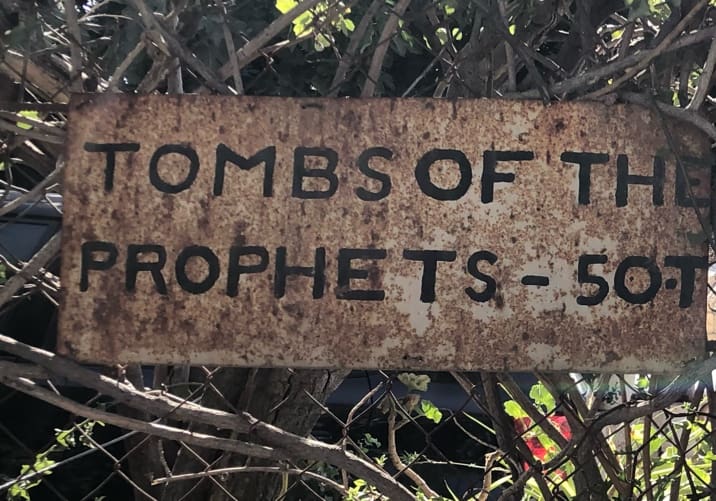
	One of the most overlooked gems in Jerusalem is the Tombs of the Prophets on the Mount of Olives. Every day, thousands of pilgrims on their way up or down the mountain troop past the weatherbeaten sign pointing toward the tombs. Only a few turn in to see it. 
Photos by John Buckner 

	The tombs are believed to belong to Haggai, Zechariah, Malachi, and their disciples. They are located in an enormous man-made cavern in the side of the Mount of Olives. The ancients carved this place near the summit of the Mount of Olives to bury the prophets because of Zechariah’s prophecy about the coming of the Messiah. 
	Once you descend the stairs into the cavern, there is no electricity or signs of modernity. A little light leaks in from the entrance and illuminates the cathedral-like antechamber where the guard will light a candle, hand it to you, and then show you the map of the tombs. He will smile and exhort you to sing, preach, or pray if you feel like it. Believe me, you will!
From there you can wander carefully by candlelight through the corridors and tunnels until you come to the tombs of the great men deep in the mountain. You can find their tombs by the feeble light from a single candle that always burns in front of each of the the three prophet’s graves. A local custom full of symbolism is to kneel, blow out your candle, then relight it from one of theirs. 
Photos from December, 2020.
John Buckner 

	Scholars are not certain if they are the tombs that Jesus mentioned, or if those tombs were elsewhere. Personally, I imagine Him pointing across the Kidron Valley to the tombs, since the entrance to the tombs was visible from the Temple Mount where He was teaching when He said:

“Woe unto you, scribes and Pharisees, hypocrites! because ye build the tombs of the prophets, and garnish the sepulchres of the righteous,” Matthew 23:29

What is known is that the cavern was built by ancient people to honor some great prophets of the Bible. The Tombs of the Prophets have amazing acoustics. I recommend standing somewhere in the dark, and when your meditations on the prophets, and on Jesus’ teachings, ascension, and second coming overcome you, burst into song! It is overwhelming to be near where Jesus will soon return and sing to Him. Whenever I descend the Mount of Olives toward Jerusalem, I always stop and glance back to see if He is there. Every time, I remember that right up there is where He said to “Go ye into all the world and preach the Gospel.” 
	When you go to Jerusalem, and I hope you do, please schedule an hour or two to visit this beautiful memorial to the prophets. Then go forth carrying the light that they preached to a dark world.  

“But unto you that fear my name shall the Sun of righteousness arise with healing in his wings;” Malachi 4:2

“For thus saith the Lord of hosts; Yet once, it is a little while, and I will shake the heavens, and the earth, and the sea, and the dry land; And I will shake all nations, and the desire of all nations shall come: and I will fill this house with glory, saith the Lord of hosts. Haggai 2:6-7

And his feet shall stand in that day upon the mount of Olives, which is before Jerusalem on the east, and the mount of Olives shall cleave in the midst thereof toward the east and toward the west, and there shall be a very great valley; and half of the mountain shall remove toward the north, and half of it toward the south” (Zechariah 14:4).

One of the most overlooked gems in Jerusalem is the Tombs of the Prophets on the Mount of Olives. Every day, thousands of pilgrims on their way up or down the mountain troop past the weatherbeaten sign pointing toward the tombs. Only a few turn in to see it. 

The tombs are believed to belong to Haggai, Zechariah, Malachi, and their disciples. They are located in an enormous man-made cavern in the side of the Mount of Olives. The ancients carved this place near the summit of the Mount of Olives to bury the prophets because of Zechariah’s prophecy about the coming of the Messiah. 

Once you descend the stairs into the cavern, there is no electricity or signs of modernity. A little light leaks in from the entrance and illuminates the cathedral-like antechamber where the guard will light a candle, hand it to you, and then show you the map of the tombs. He will smile and exhort you to sing, preach, or pray if you feel like it. Believe me, you will!

From there you can wander carefully by candlelight through the corridors and tunnels until you come to the tombs of the great men deep in the mountain. You can find their tombs by the feeble light from a single candle that always burns in front of each of the three prophet’s graves. A local custom full of symbolism is to kneel, blow out your candle, and then relight it from one of theirs. 

Scholars are not certain if they are the tombs that Jesus mentioned, or if those tombs were elsewhere. Personally, I imagine Him pointing across the Kidron Valley to the tombs, since the entrance to the tombs was visible from the Temple Mount where He was teaching when He said:

“Woe unto you, scribes and Pharisees, hypocrites! because ye build the tombs of the prophets, and garnish the sepulchres of the righteous” (Matthew 23:29).

What is known is that the cavern was built by ancient people to honor some great prophets of the Bible. The Tombs of the Prophets have amazing acoustics. I recommend standing somewhere in the dark, and when your meditations on the prophets, and on Jesus’ teachings, ascension, and second coming overcome you, burst into song! It is overwhelming to be near where Jesus will soon return and sing to Him. Whenever I descend the Mount of Olives toward Jerusalem, I always stop and glance back to see if He is there. Every time, I remember that right up there is where He said “Go ye into all the world and preach the Gospel.” 

When you go to Jerusalem, and I hope you do, please schedule an hour or two to visit this beautiful memorial to the prophets. Then go forth carrying the light that they preached to a dark world.  

“But unto you that fear my name shall the Sun of righteousness arise with healing in his wings” (Malachi 4:2).

For thus saith the Lord of hosts; Yet once, it is a little while, and I will shake the heavens, and the earth, and the sea, and the dry land; And I will shake all nations, and the desire of all nations shall come: and I will fill this house with glory, saith the Lord of hosts” (Haggai 2:6-7).

*Photos by John Buckner


Discover more from Enjoying the Journey

Subscribe to get the latest posts sent to your email.
Post Author

More from similar topics

Subscribe to Blog via Email

Recent Posts

A journey through 1 John reveals our place in the family of God, how we can have assurance, and that our joy is rooted in Christ.

Journey through 1 John

“Jesus saw Nathanael coming to him, and saith of him, Behold an Israelite indeed, in whom is no guile! Nathanael saith unto him, Whence knowest thou me? Jesus answered and said unto him, Before that Philip called thee, when thou wast under the fig tree, I saw thee.” (John 1:47-48)

Why the Story of Nathanael Sitting Under the Fig Tree Matters

It also discusses the Four Sermons in Haggai It is in that context that God raises up the prophet Haggai with four sermons in four months. The Word of the Lord comes to Haggai, and he preaches four sermons. Each one of them is dated for us. Each sermon targets a different problem. You can read them in Haggai chapters one and two. In his first sermon (Haggai 1:1-15), Haggai preached on the danger of waiting when we should be working. They were waiting for a sign to build. He said, You don't need a sign, you need to obey God. Haggai's second sermon (Haggai 2:1-9) explained the danger of lamenting the past and missing the present. They were sorrowing over the destruction of the past temple. God said, Build a new one. It was G. Campbell Morgan who said, “It is impossible to unlock the present with the rusty key of the past." Many people are bogged down in their past and miss the present. Keep in mind what is at hand and what is ahead. The third sermon he preached (Haggai 2:10-19) described the danger of seeing only the material and neglecting the supernatural. They could see the work that needed to be done, but they missed the fact that God had resources that would help them get it done. The Lord was behind all of this. The fourth sermon (Haggai 2:20-23) warned against the danger of recognizing who is against us and forgetting who is for us. They were concentrating on the opposition and forgetting that “greater is he that is in you, than he that is in the world” (1 John 4:4). A journey through Haggai shows us the importance of performing the work that God has told us to do, and His glory in our obedience. Image leads to an overview of Haggai

Journey through Haggai

How Social Media Shapes Our Heart

How Social Media Shapes Our Hearts

Leave a Reply