

Whose Image?
“And they send unto him certain of the Pharisees and of the Herodians, to catch him in his words. And when they were come, they say unto him, Master, we know that thou art true, and carest for no man: for thou regardest not the person of men, but teachest the way of God in truth: Is it lawful to give tribute to Caesar, or not? Shall we give, or shall we not give? But he, knowing their hypocrisy, said unto them, Why tempt ye me? bring me a penny, that I may see it. And they brought it. And he saith unto them, Whose is this image and superscription? And they said unto him, Caesar’s. And Jesus answering said unto them, Render to Caesar the things that are Caesar’s, and to God the things that are God’s. And they marvelled at him” (Mark 12:13-17).
When the Pharisees came to Jesus in the Temple to ask Him about paying tribute money, their question was not really about taxes. They were trying to trap Him so that they could accuse Him of either breaking Jewish law or Roman law. Jesus’ answer was not about paying taxes either. Instead, He asked them to bring a Roman coin. When He asked them about the image and words on the coin, the most religiously observant among His questioners would have turned their heads away. This was to avoid looking at the graven images on Caesar’s coin and the usual pagan symbolism and idolatrous words. As they so often did, they averted their gaze, not just from the coin, but also from the image and Word of God made flesh (Hebrews 1:3, John 1:1). Yet, Jesus demanded that they look at it, think about it, and answer some questions.
As was His custom, Jesus used the language of the Bible in His discussion with the Pharisees and the Herodians. When He asked them about the image on the coin, no doubt they remembered that according to Genesis they were made in the image of God. It is as if He is saying, “give this metal trinket to the man whose image it bears, but give yourselves to God.” He is telling us to submit ourselves completely to our Creator, the One whose image we bear. Once we consider that we are made in God’s image, we have to see the image of God in others as well.
It is easiest to see God’s likeness in the faces of the people whom we love, yet Jesus saw it in the very faces of those who came to trap Him in His words. As James wrote, “But the tongue can no man tame; it is an unruly evil, full of deadly poison. Therewith bless we God, even the Father; and therewith curse we men, which are made after the similitude of God. Out of the same mouth proceedeth blessing and cursing. My brethren, these things ought not so to be” James 3:8-10.
Ironically, they said that Jesus did not regard the person of men, meaning that He did not bend to the will of others, including the religious authorities. They were certainly right metaphorically, but Jesus literally looked at people and saw the image of God in them. He loved the outcasts of Israel, the blind, the lame, and the lepers. Contrary to His contemporaries in first-century Judea, He also saw the image of God in the faces of the hated Samaritans, the traditional enemy of the Jews.
As we follow in His footsteps, our hardest and holiest work is to see the image of God in others, even our enemies. Do you have someone, or a group of people, whom you refuse to see as bearing the image of God the Father? Are you blessing God while you curse those made in His image? I urge you to amend your ways before it is too late. Walk as He walked, and see God’s image even in your enemies.
“Then said Jesus, Father, forgive them; for they know not what they do. And they parted his raiment, and cast lots.” Luke 23:34
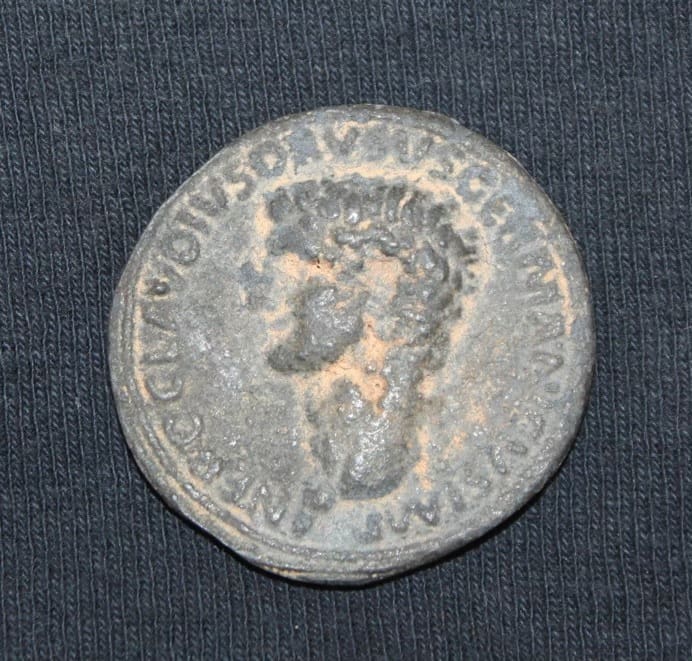
Sestertius from the time of the Emperor Nero, approximately 40-45 AD. Purchased by the author in Baalbek, Lebanon in 2014. This coin shows the emperor, as well as his names: Nero Claudius Drusus Germanicus Imperator. Photo by John Buckner.
Discover more from Enjoying the Journey
Subscribe to get the latest posts sent to your email.