

“And Samuel took a sucking lamb, and offered it for a burnt offering wholly unto the Lord: and Samuel cried unto the Lord for Israel; and the Lord heard him. And as Samuel was offering up the burnt offering, the Philistines drew near to battle against Israel: but the Lord thundered with a great thunder on that day upon the Philistines, and discomfited them; and they were smitten before Israel. And the men of Israel went out of Mizpeh, and pursued the Philistines, and smote them, until they came under Bethcar. Then Samuel took a stone, and set it between Mizpeh and Shen, and called the name of it Ebenezer, saying, Hitherto hath the Lord helped us” (1 Samuel 7:9-12).
Listen to this Account on Traveler’s Tales:
Ebenezer and the Ark of the Covenant
The Israelites were defeated in about the same place by the Philistines back in 1 Samuel 4, and the Ark of the Covenant was captured. The Israelites appear to have brought the Ark along as a type of talisman or good luck charm, much like their idolatrous neighbors would do. Needless to say, that did not work. Then, God showed the Philistines His divine displeasure. His heavy hand (5:6,9) drove the lords of the Philistines to return the Ark to Israel. (Click HERE for an overview of 1 Samuel.)
The Stone of Help
However, when we get to 1 Samuel 7, we learn that a long time has passed. For twenty years, the Ark was in Kiriathjearim, in the hills west of Jerusalem. The men of the city had taken custody of it when it was returned by the Philistines. Samuel told the people to stop serving idols and to return to the worship of Jehovah. The people obeyed. Then they all gathered to Mizpeh for a time of collective fasting and repentance. We are not told if the Ark is present as well, but from the context, it seems likely since even the enemy knew that it was where God dwelt (4:7).
While they were praying, the enemy heard and marched to attack them. In a dramatic scene, Samuel took a lamb and offered it to the Lord, and he prayed for Israel. As he was in the process of offering the lamb, the Philistine army approached the unprepared Israelites. At that moment, the God of Israel intervened and thundered on the Philistines. The divine counterattack was so strong that the enemy fled before Israel.
The God of Thunder
The story discredits and dismantles the false gods of the surrounding nations. The Israelites were unfaithful and served such gods as Baal and Ashtaroth before they repented (7:4). Baal was revered as the storm god, while his wife Ashtaroth was worshipped by the Philistines as a goddess of war. In this one moment, our God showed both the Philistines and the Israelites who was in charge of both storms and war.
The Hebrew here uses two different words for thunder in the same sentence. One of them, ra’am, tells us that God raged. The other word, kol, can mean either thunder or voice. For instance, the Philistines heard the kol, the shout of the Israelites when the Ark entered their camp in chapter 4. Psalm 116 begins with “I love the LORD, because he hath heard my kol, my voice.” The Hebrew Bible often plays with both possible meanings (Job 37:4,5; 40:9). In reverence, Samuel set up a stone called Ebenezer, the Stone of Help, to mark where God destroyed the enemy with a thundering roar.
The Philistines no doubt thought that they would win an easy victory during the lamb sacrifice. The ancient enemy of mankind made a similar mistake in the spring of 33 AD. Instead, the Lamb of God cried out with a loud kol, a loud voice, and died. He showed Himself to be the master of death, hell, and the grave. In the victory remembered by Ebenezer, the Israelites took back territory that the Philistines had conquered. On Calvary, Christ took back what mankind lost in Eden.
The Lord is Always Victorious
God won our victory at Ebenezer and at Calvary. However, it is good to do what Samuel did and mark the place. We as humans are prone to forgetting what God has done. Like the Israelites, we often turn aside and credit other forces and other voices instead of the kol of God. Do you remember what God has done for you? Or have you followed the gods of the world and forgotten His past victories? If so, I urge you to again do as the Israelites did and repent.
“The voice of the Lord is upon the waters: the God of glory thundereth: the Lord is upon many waters. The voice of the Lord is powerful; the voice of the Lord is full of majesty. The voice of the Lord breaketh the cedars; yea, the Lord breaketh the cedars of Lebanon.” (Psalm 29:3-5)
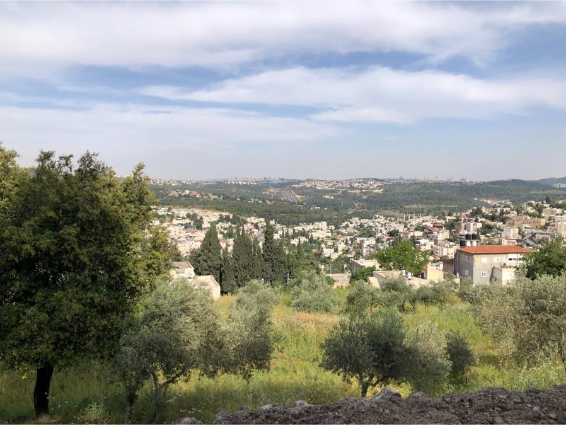
The view from Kiriathjearim. Jerusalem is visible in the distance. Today, the city is called Abu Ghosh. It is a weekend getaway spot. The Ark stayed in this pleasant spot for twenty years. After David’s ill-fated attempt to bring the ark to Jerusalem, he left it in the nearby house of Obededom for a further three months. Photo by John Buckner
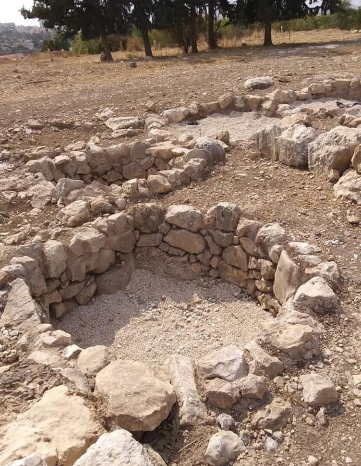
Izbet Sarta, near Tel Aviv, is believed to be the site of biblical Ebenezer. Besides appearing in the Bible, this was the site of an important discovery. Archeologists found a piece of pottery with the earliest list of the ABCs in the language of Israel. It dates from approximately the 11t century BC. What makes it interesting is that the list appears to have been written by a child. Photo by John Buckner
Discover more from Enjoying the Journey
Subscribe to get the latest posts sent to your email.