

The Tale of Three Servants
In 2 Kings 5, we read a tale of three servants. Naaman, the Little Maid, and Gehazi. Woven into the fabric of Scripture are dozens of servants who complete a tapestry of the power of God to work through human weakness. Amid the world’s chaos in that time period, God was at work in the lives of servants. This passage reminds us that as world events engulf others’ attention, God has His eye on those who are largely forgotten.
Second Kings records centuries of such turbulence. Chapter 5, amid a time of war, after the nation had been divided into the northern and southern kingdoms. Elijah, the great prophet, had passed off the scene; his mantle now rested on the shoulders of God’s faithful servant and his helper, Elisha. Elisha’s fame and the miracles God did through him were famous. In fact, even a little servant girl passed on the word of them to this first servant we meet: Naaman.
1. A Dying Servant: Naaman
“Now Naaman, captain of the host of the king of Syria, was a great man with his master, and honourable, because by him the LORD had given deliverance unto Syria: he was also a mighty man in valour, but he was a leper.” (2 Kings 5:1)
Notice the end of verse 1: “but he was a leper.” Naaman was an honorable man, a mighty man, and a victorious military leader. Yet, the emphasis in Scripture is not his position, but his sickness: he was a leper.
Naaman was a dying servant. The ancient disease of leprosy was a sickness with no known human cure. Occasionally, people recovered naturally, but by and large, leprosy was a terminal illness. It was characterized by great physical suffering and tremendous emotional strain. Lepers in that day were ostracized from society and separated from their families. Even those who did speak to you had to keep their distance lest they become infected. Naaman, for all his power, wealth, and favor, was still a leper.
His life paints an eternal picture of all of us from birth. All of us are born into this world with a sickness far more dreadful than leprosy: the deadly disease of sin. In our own strength, no matter how impressive or powerful we may seem, there is nothing we can do to rid ourselves of this sickness. At birth, we are already spiritually dead.
No Human Effort Can Wash Away Sin Sickness
- Your Power Cannot Save You: Naaman was the captain of the host of the king of Syria—the top general under one of the greatest leaders in the world. Whatever he said happened, yet his power could not overcome his leprosy. If you do not know the Lord Jesus Christ, no earthly power can remove the sickness of sin.
- Your Position Cannot Save You: Naaman was at the right hand of the leader of his nation. He had access to the greatest minds, physicians, and philosophers, yet none of them could take away his leprosy. The world is full of human ideas and solutions, but without Jesus Christ, nothing can truly take away sin.
- Your Own Plans Cannot Save You: Naaman had a specific, dramatic plan in his mind for how he ought to be healed. When Elisha simply sent a messenger saying, “Go and wash in Jordan seven times, and thy flesh shall come again to thee, and thou shalt be clean” (2 Kings 5:10), Naaman was angry. The Bible records, “But Naaman was wroth, and went away, and said, Behold, I thought, He will surely come out to me, and stand, and call on the name of the LORD his God, and strike his hand over the place, and recover the leper.” (2 Kings 5:11)
- Your Places Cannot Save You: In verse 12, Naaman declared in his rage: “Are not Abana and Pharpar, rivers of Damascus, better than all the waters of Israel? may I not wash in them, and be clean? So he turned and went away in a rage” (2 Kings 5:12). Many people mistakenly place their trust in a physical place, a church building, or the waters of baptism rather than in the Lord Jesus Christ. No physical place can bring spiritual regeneration.
Naaman is Cleansed
Naaman’s servants approached him in verse 13 and said, “My father, if the prophet had bid thee do some great thing, wouldest thou not have done it? how much rather then, when he saith to thee, Wash, and be clean?” (2 Kings 5:13). When Naaman humbled himself and followed God’s way: “Then went he down, and dipped himself seven times in Jordan, according to the saying of the man of God: and his flesh came again like unto the flesh of a little child, and he was clean.” (2 Kings 5:14)
It was not the Jordan River itself that cleansed him, but his obedience of faith to the word of the Lord. For us, salvation does not come through dipping in a river or doing a great work; it comes solely through faith in the shed blood of the Lord Jesus Christ. As Jesus declared, “I am the way, the truth, and the life: no man cometh unto the Father, but by me“(John 14:6). “Neither is there salvation in any other, for there is none other name under heaven given among men whereby we must be saved” (Acts 4:12). Naaman was cleansed when He put his faith in God’s way of Salvation. (If you need forgiveness, find God’s way of salvation HERE. )
A word must be said to Naaman’s servants who encouraged him to follow the commandment of Elisha. Thank God for those who point you toward the truth! That is a true friend!
Naaman was a leper, and God saved him!
2. A Diligent Servant: The Little Maid
“And the Syrians had gone out by companies, and had brought away captive out of the land of Israel a little maid; and she waited on Naaman’s wife.” (2 Kings 5:2)
God is a God of the ordinary. He works through ordinary circumstances and ordinary lives to accomplish extraordinary things by His power. We do not know the name of this Little Maid, but God knew her name. Syria had been at war with Israel, and this young girl was brought away captive—enslaved—out of her homeland. She had likely watched her city destroyed, and her family killed, and was now serving in the exact home of the Syrian general who oversaw the destruction. Naaman was remembered as a leper. Yet, the Little Maid is remembered as a faithful, diligent servant. God used her.
Spiritual Principles Exemplified by the Little Maid
- Overcome Bitterness: In verse 3, she said unto her mistress, “Would God my lord were with the prophet that is in Samaria! for he would recover him of his leprosy” (2 Kings 5:3). This was a cry of genuine compassion for a man who had caused her immense personal heartache. She had overcome bitterness because she recognized the spiritual need in others.
- Maintain a Good Testimony: Notice that when she spoke, her mistress and Naaman took her words so seriously that Naaman went to the king, gathered immense treasure, and traveled 130 miles on an excruciating journey to Samaria. If she had been groaning, complaining, or unfaithful, they would never have believed her word.
- Witness to Those Around You: Paul writes in Colossians regarding our conduct before the world: “Walk in wisdom toward them that are without, redeeming the time. Let your speech be alway with grace, seasoned with salt, that ye may know how ye ought to answer every man” (Colossians 4:5-6).
The Little Maid Illustrates that God’s Eye Is Upon You
Though she was hundreds of miles from home, alone in a godless environment, the little maid knew that the Lord was with her. There alone in the home of her captives, perhaps the truth of the Psalmist wrote itself through her mind: “If I take the wings of the morning, and dwell in the uttermost parts of the sea; Even there shall thy hand lead me, and thy right hand shall hold me” (Psalm 139:9-10).
Perhaps when the pangs of grief filled her young heart, the words of Psalm 27 comforted her: “Hide not thy face far from me; put not thy servant away in anger: thou hast been my help; leave me not, neither forsake me, O God of my salvation. When my father and my mother forsake me, then the Lord will take me up. Teach me thy way, O Lord, and lead me in a plain path, because of mine enemies.”
This maid had everything against her in her day (a slave, young, and a woman), yet God was for her! Trust God to give you victory today!
The Little Maid was a slave, yet God used her!
3. A Deceitful Servant: Gehazi
In stark contrast to the faithful Little Maid, we meet Gehazi, the longtime servant of the prophet Elisha. Gehazi was a man who had seen God perform incredible miracles. In the previous chapter, Gehazi witnessed a young boy raised from the dead. He just witnessed Naaman return from the Jordan fully cleansed, declaring: “Behold, now I know that there is no God in all the earth, but in Israel” (2 Kings 5:15).
Yet now, “Gehazi, the servant of Elisha the man of God, said, Behold, my master hath spared Naaman this Syrian, in not receiving at his hands that which he brought: but, as the LORD liveth, I will run after him, and take somewhat of him.” (2 Kings 5:20). Gehazi ran after Naaman, fabricated a story about two young sons of the prophets arriving in need, and accepted two talents of silver and two changes of garments. Gain by deceit. He hid the treasure in his house and lied directly to Elisha:
“And Elisha said unto him, Whence comest thou, Gehazi? And he said, Thy servant went no wither. And he said unto him, Went not mine heart with thee, when the man turned again from his chariot to meet thee? Is it a time to receive money, and to receive garments, and oliveyards, and vineyards, and sheep, and oxen, and menservants, and maidservants? The leprosy therefore of Naaman shall cleave unto thee, and unto thy seed for ever. And he went out from his presence a leper as white as snow.” (2 Kings 5:25-27)
How could Gehazi do such a thing? Notice these warning signs:
Warnings from the Fall of Gehazi
- The Danger of Living for the Temporal: Gehazi was not interested in what he could give. The eternal work God became of little interest to him. He was focused on what he could get for himself. He wanted to use God, instead of allowing God to use him. Scripture provides strong warnings to spiritual leadership about this matter (1 Timothy 3:8, 1 Peter 5:1-3). Paul warned his son in the faith, “For the love of money is the root of all evil: which while some coveted after, they have erred from the faith, and pierced themselves through with many sorrows.” Gehazi certainly felt the piercing sorrows of his own lust.
- The Warning of Spiritual Familiarity: Being close to the work of God, hearing truth daily, and even watching the miraculous will not automatically protect a heart from covetousness. Our affections can still be drawn toward worldly things. Never allow the amazing, eternal work of God to become stale or commonplace to you.
- The Law of Sowing and Reaping: Gehazi obtained the temporal wealth he lusted after, but it came with Naaman’s permanent leprosy. As Scripture warns: “Set your affection on things above, not on things on the earth” (Colossians 3:2). Why? Because “No man can serve two masters… Ye cannot serve God and mammon“ (Matthew 6:24). His own destruction was packaged in the temporal treasure he sought.
Gehazi was a deceiver, and God judged him.
No matter who you are today. No matter your past, you can find healing like Naaman. Regardless of your circumstance, like the maid, God can bless and use you for eternity. Even if you have experienced great victory, you can fall into sin, just like Gehazi. Let us be faithful!
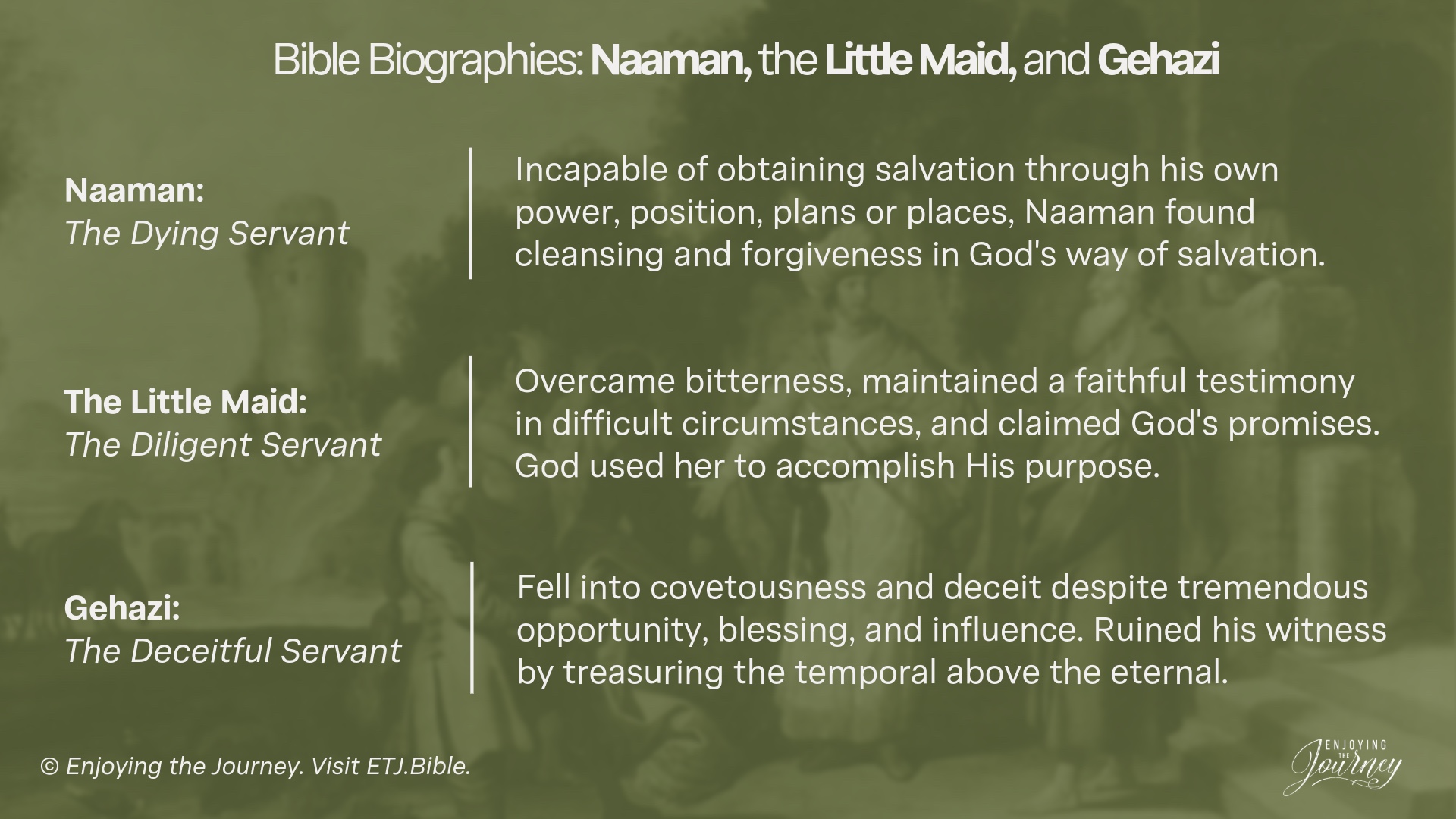
This slide provides a brief summary of each of the servants. Share it online, save it for later, or use it as a tool to teach these truths to others. © Enjoying the Journey 2026
Discover more from Enjoying the Journey
Subscribe to get the latest posts sent to your email.
Post Author
More from similar topics
2 Kings | Elisha | Gehazi | How can I be used by God? | Israel | Little Maid | Naaman | Old Testament | faithfulness | servants