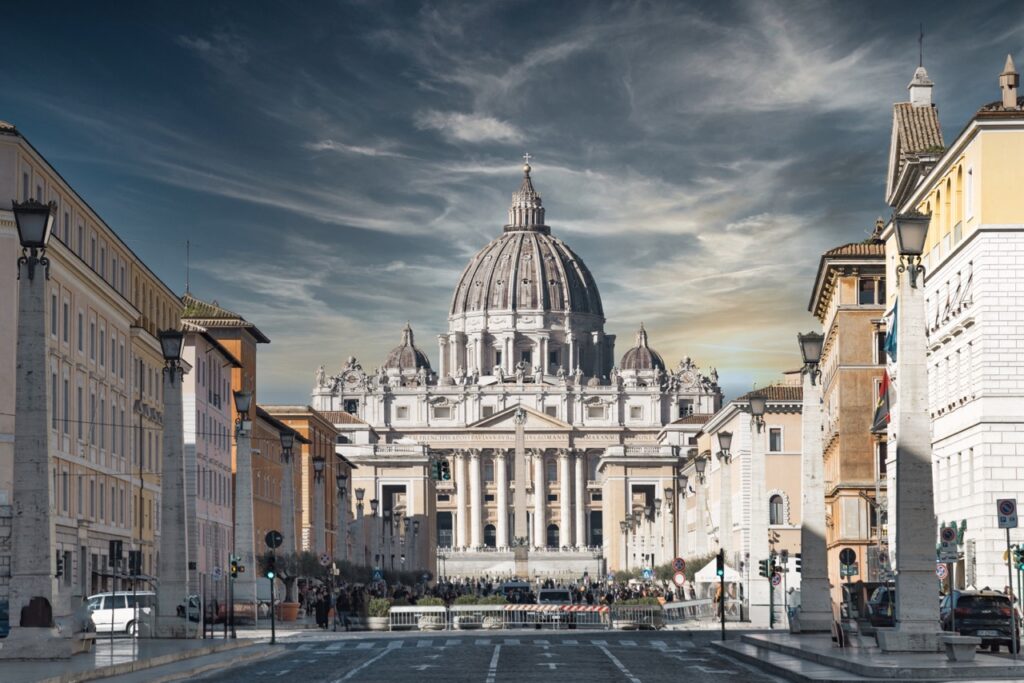
Over the last few days, all eyes have been on Rome. The Catholic church just chose its 267th Pope. Watching the ritualistic ceremony and intense media coverage highlights yet again the theological error of this religious system. In a word, that great error is idolatry. When all eyes are on men – a cardinal, a conclave, or a church – they are not on Christ. True worship always turns attention, affection, and adoration to the Lord alone.
Secret gatherings and smoke signals do not point us to Jesus. Only the Word of God and the Spirit of truth do that. It is idolatry when anything or any man takes the place of which only God is worthy.
The glorification of the Pope and the doctrine of the primacy of Peter is idolatry.
“And call no man your father upon the earth: for one is your Father, which is in heaven” (Matthew 23:9). On one occasion, Jesus called Peter “Satan,” and on another, Paul withstood Peter to his face because he was “to be blamed.” The best men are men at best, and good men are not God. The only Head of the church is the One who loved it so much He died for it, and His name is not Leo. It is Jesus.
The devotion to Mary and the “saints” is idolatry.
“And I fell at his feet to worship him. And he said unto me, See thou do it not: I am thy fellowservant, and of thy brethren that have the testimony of Jesus: worship God: for the testimony of Jesus is the spirit of prophecy” (Revelation 19:10). Mary testified herself that she was a sinner in need of a Savior (Luke 1:46-50). There is no mention of Mary’s name in all of the writings to the New Testament churches. Mary and the saints are not gatekeepers to grace – Christ is the way. Only He deserves our devotion.
The veneration of sacred images, statues, relics, and vestments is idolatry.
“Neither is worshipped with men’s hands, as though he needed any thing, seeing he giveth to all life, and breath, and all things” (Acts 17:25). While some will try to distinguish between veneration and adoration, the reality is that, whatever you call it, it violates the second commandment. “Thou shalt not make unto thee any graven image, or any likeness of any thing that is in heaven above, or that is in the earth beneath, or that is in the water under the earth. Thou shalt not bow down thyself to them, nor serve them: for I the Lord thy God am a jealous God…” (Exodus 20:4-5).
The elevation of tradition to authority alongside divine revelation is idolatry.
“Howbeit in vain do they worship me, teaching for doctrines the commandments of men” (Mark 7:7). The words of men and the wishes of councils must never “add” to or “take away” from Holy Scripture (Revelation 22:18-19). Christ is God’s final Word (John 1:1, 14; Hebrews 1:1-4), and the Word is enough.
The institution of a sacramental system to obtain forgiveness for sin and retain peace with God is idolatry.
“But this man, after he had offered one sacrifice for sins for ever, sat down on the right hand of God” (Hebrews 10:12). God gave Israel a sacrificial and priestly system. Some want to live by sacrifices and human priests. Yet, the perfect fulfillment of that system is in the sinless sacrifice and ultimate priesthood of Jesus. Redemption and forgiveness are found in Him alone.
All eyes should not be on Rome. All eyes should be on Christ. Everything else is idolatry.
WATCH: A Fresh Glimpse of Jesus

Click this picture to learn more about knowing Jesus Christ.
Discover more from Enjoying the Journey
Subscribe to get the latest posts sent to your email.