Journey Through Ezekiel
How much do you know about the Book of Ezekiel? That is one of the books of the Bible, and it is probably in the part of your Old Testament where the pages still stick together. When you even mention the name Ezekiel, people get a little scared because they think, “I am not that familiar with that book.”
If they are familiar with it, they often think, “Well, Ezekiel is that really hard book that has the wheel turning inside the wheel, and I do not understand all of that.” That can cause us to miss one of the truly great books of the Old Testament.
We are journeying through Ezekiel in this study. We are journeying with Ezekiel into the presence of God. Who is this man, this prophet named Ezekiel?
Listen to an Overview of Ezekiel:
Background of Ezekiel – Hope Amidst Captivity
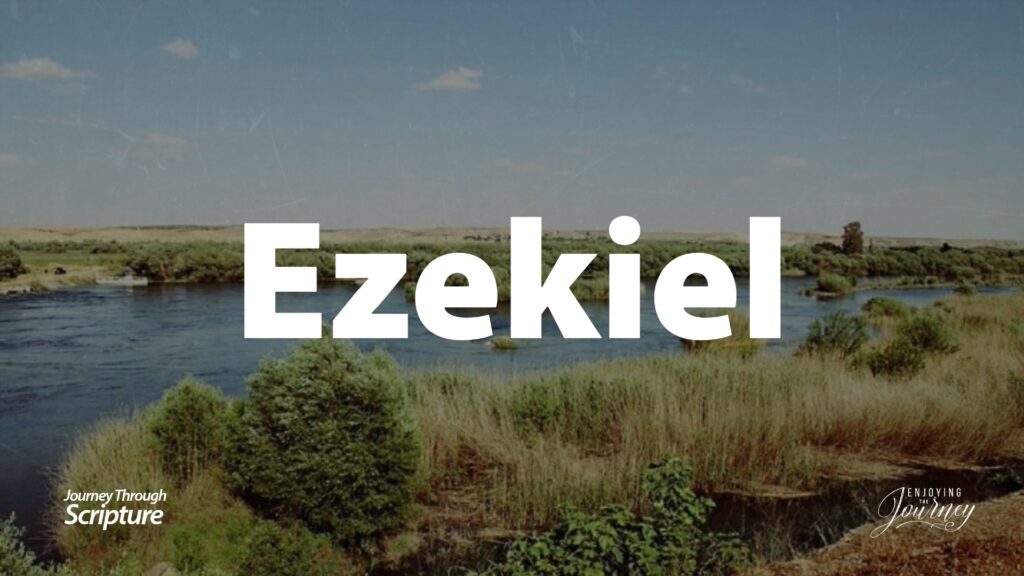
Ezekiel 1:1 says, “Now it came to pass in the thirtieth year, in the fourth month, in the fifth day of the month, as I was among the captives by the river of Chebar, that the heavens were opened, and I saw visions of God.”
There is a lot wrapped up in that one verse! Ezekiel is the prophet of the captivity. Recall that Jeremiah, the prophet of the broken heart, saw Jerusalem destroyed, and the people carried away captive. Ezekiel was a young man who had actually grown up in Judah. He was carried away captive when he was 25 years old. That means he spent the first 25 years of his life listening to Jeremiah, the weeping prophet.
How would you like to have that kind of heritage? It is no wonder that Ezekiel has been called the prolongation of the voice of Jeremiah. After a while, you start sounding like the people you have listened to. I hope that you are listening to people who are giving you the Word of God. Ezekiel did, and it helped him.
The Prophet Ezekiel
After Ezekiel was carried away captive, he lived down by the river with the other captives who were weeping under the burden of their captivity. However, this is a man who still finds hope. This is a man who refused to live in despair, who refused to say, “Everything is bad, and the future is now hopeless.” He gets a fresh glimpse of God. We all need that! He saw visions of God. Proverbs 29:18 says: “Where there is no vision, the people perish.” Friend, what our world needs, what I need today, and what you need is a fresh glimpse of the Lord God.
The thirtieth year referred to here in Ezekiel 1:1 is the thirtieth year of his life. They have been in captivity for about five years, when this 30-year-old man gets a glimpse of God. It is interesting that Ezekiel was a priest who became a prophet. While Daniel was serving God in the palace, Ezekiel was serving God among the people. It is beautiful that God always has His man, and God always has His man exactly where He wants him to be.
Ezekiel’s name means “God strengthens me.” Friend, you may feel like you are in captivity to a set of circumstances or difficulty that is out of your control. I want to remind you that there is a God who will strengthen you right where you are. He has promised to do it. And what you need is exactly what Ezekiel received. And that was a fresh vision of the Lord.
Theme of Ezekiel
The theme of the book is knowing God and His glory. I love the fact that Ezekiel did not spend his time looking around at the other captives and simply rehearsing their situation and circumstances. Anyone can do that. Instead, in the words of Helen Lemmel, the great hymn writer: “Turn your eyes upon Jesus. Look full in His wonderful face, and the things of earth will grow strangely dim in the light of His glory and grace.“ (Click HERE to read the fascinating history of this hymn.)
Ezekiel got his eyes on the glory of God. As a matter of fact, in the opening 11 chapters of the book, the phrase, the glory of the Lord appears 11 times. There is another phrase that is used repeatedly in Ezekiel. It is the phrase, “They shall know that I am the Lord,” which is found 70 times in this book. My friend, God wants you to know Him today. He wants you to know His glory. At every stage in life, at every age in history, in every circumstance, God wants you to see His glory. And whatsoever we do must be done for the glory of God.
The Glory of God
The entire book of Ezekiel revolves around the glory of God. In chapters one through thirty-two, the glory has departed. Jehovah is not there, the temple is gone, and the glory cloud has been removed. They are in captivity. It is a look at the past. But then, there is a very definite shift in chapter thirty-three through the end of the book. Here, Jehovah returns His glory. Returns to where? To the temple in the millennium. There is a look not at the past, but at the future.
We often spend so much of our time talking about the past and what did not go right. What we need is a fresh vision of the future, not just a recollection of the past. Ezekiel is given perhaps one of the most detailed visions of God found anywhere in Scripture.
The book of Ezekiel should be studied alongside the New Testament book of Revelation. It is often called the Revelation of the Old Testament. Why is that? Because Ezekiel saw visions of God, much like John did in the New Testament age. And when he saw those visions, he responded the very same way.
Ezekiel’s Glimpse of God’s Glory
Earlier in this journey through Ezekiel, we read Ezekiel 1:1. Then, in the last verse of Ezekiel 1:28, Ezekiel said he saw:
“As the appearance of the bow that is in the cloud and the day of rain, so was the appearance of the brightness round about. This was the appearance of the likeness of the glory of the LORD. And when I saw it, I fell upon my face, and I heard a voice of one that spake.”
Friend, when you get a fresh glimpse of God and all of His glory, you see Him as He is. Your response will be the same. You will humble yourself. You will fall on your face in the presence of a Holy God. And then, and only then, will you find your ears are open to truly hear what it is He wants to say to you.
Can I challenge you by whatever river you happen to be camping by today, and whatever captivity you may be living through, and whatever mourning you may hear in the people around you? Stop today and pray as Ezekiel did. Let us get a fresh glimpse of God. Let me see the Lord high and lifted up. When we hear from God, hope returns.
Prophet of Hope
It is noteworthy that Ezekiel is known not only as the prophet of captivity. He is known as the prophet of hope. How is that? Because, friend, when you get a fresh glimpse of God, you realize it is bigger. God is bigger than anything you are dealing with today. “…greater is he that is in you than he that is in the world.” (1 John 4:4)
Isaiah has been called the prophet of faith. Jeremiah has been called the prophet of love. Ezekiel has been called the prophet of hope. If you study these great prophets of the Old Testament, you will find that Isaiah emphasized the work of the Son, the Lord Jesus. Jeremiah emphasizes the work of the Father, the Father with a broken heart over His prodigal child. But Ezekiel’s vision emphasizes the work of the Holy Spirit. In an evil age, we need some people who understand that the Holy Spirit of God lives within them, and His power is not restrained by anything but our unbelief.
Friend, today the Holy Spirit of God wants to fill your life. He wants to lead you, guide you, and direct you in the midst of difficulty and struggle. He wants to give you a fresh glimpse of your good God, arrayed in all of His glory today.
Conclusion
I must give you this little footnote before we end our journey through Ezekiel. Ninety-one times, Ezekiel is referred to as the son of man. Did you know that this was actually Jesus Christ’s favorite term for Himself in the New Testament? Christ, rightly called the Son of God, actually referred to himself more frequently as the Son of Man. Seventy-nine times He did it, just like Ezekiel. Why is that? Every time He referred to Himself as the Son of Man, He was identifying with us in our plight, our struggle, and as the strength in our difficulty. He was saying, “I know you, and I love you. I have come to where you are.”
In the midst of your captivity today, there is hope because the Son of Man, the Son of God, has come to live with you in the person of His Holy Spirit. In His presence, there is joy. And in the midst of your difficulty, He brings hope.
STUDY – Revelation: The King is Coming
Discover more from Enjoying the Journey
Subscribe to get the latest posts sent to your email.