We take so many of the aspects of our existence for granted. The sun rises every morning. The rain and snow fall in their seasons. Plants, animals, and humans are born, mature, and die. The moon revolves around Earth, and Earth revolves around the Sun. We rarely take time to consider how everything got here, or how we got here. The creation of the universe is not a topic with which we concern ourselves.
The Bible makes it clear in the Book of Genesis that God created everything in the universe in six twenty-four-hour days. However, some doubt the reliability of God’s Word. In such cases, it is helpful to be prepared to answer these doubts with reasoned, scientific arguments that point to the truth of the Biblical account of creation.
Earth: The Goldilocks Planet
In the children’s story ‘Goldilocks and the Three Bears,’ a little girl named Goldilocks enters the house of the three bears and makes herself at home. She tests their porridge, and finds that one is too hot, another is too cold, and finally one is ‘just right.’ The same is true for the chairs (too hard, too soft, or just right), and even the beds (too high at the head, too high at the foot, or just right). Only one option seems to be perfectly made for her, meeting her needs.
When we consider our planet Earth, it is amazing how many things we see that demonstrate how God designed it to perfectly meet our needs.
Consider the distance from our planet to the Sun. Earth falls into what scientists refer to as the ‘habitable zone.’ This is the area that is favorable to life due to the ability of liquid water to exist on the surface of the planet. Scientists emphasize this due to their misguided belief that life spontaneously generated in liquid water. However, the importance of liquid water and its necessity for supporting and sustaining life is sufficient for our point. We are unaware of any other planet with an atmosphere or hydrosphere capable of supporting life.
The Moon
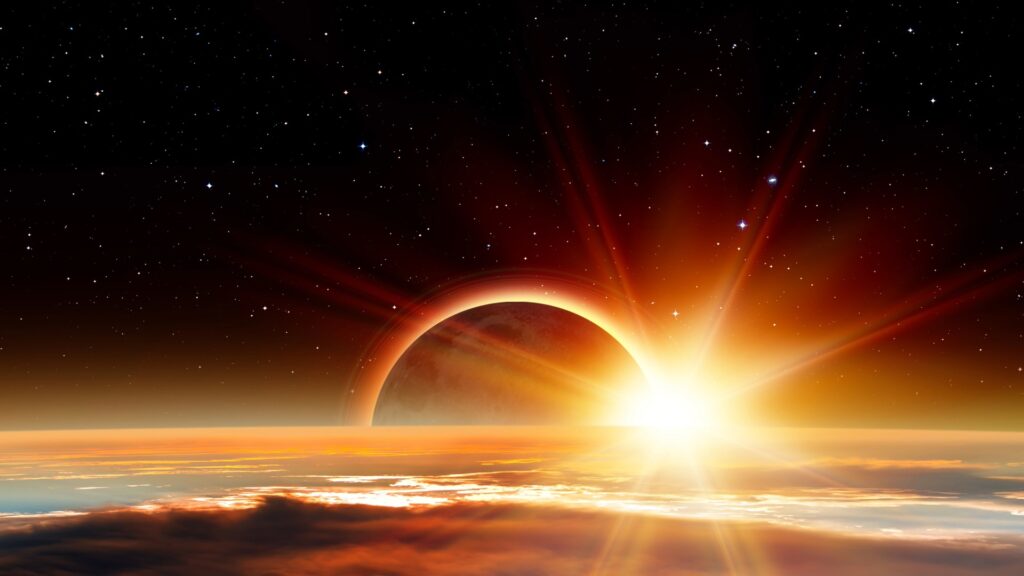
When we look into the sky on a clear night, we can often see the moon as it reflects the light of the sun. From our perspective, the moon appears to be approximately the same size as the sun. This is because although the sun is approximately 400 times larger than the moon, the moon is 400 times closer to Earth than the sun. Scientists, who we typically view as curious and seeking the answers to the mysteries of the universe, are strangely incurious about this fact. They typically characterize this as a mere coincidence, a cosmic fluke. Gene Weingarten, a former Washington Post writer, once observed, “I am a devout atheist but can’t explain why the moon is exactly the right size, and gets positioned so precisely between the Earth and the sun, that total solar eclipses are perfect. It bothers me.” In contrast, the Christian sees this as evidence of the marvelous precision and design of the Creator of the universe: God.
If this were not enough evidence, there is also the distance from the moon to Earth and the role it plays in the ocean tides. A moon that was further away would lead to weaker tides. This would cause a dramatic and negative effect on the weather systems. If the moon were closer, the tide would be stronger, increasing erosion and geologic activity such as volcanoes.
Not only does the distance and size of the moon point to God as creator of the universe, but the moon’s physical makeup does as well. Samples of the moon’s surface demonstrate that the composition of the moon and Earth is vastly different. Thus, they could not have ‘formed’ in the same way or at the same time as scientists contend. In addition, the layer of dust on the moon is much smaller than scientists predicted based on the theory that the universe is billions of years old and that a fine layer of meteoric dust had settled on the moon. Indeed, some scientists feared that the astronauts would sink into this dust when they attempted to land on the moon’s surface!
The Solar System
If the universe formed from the “Big Bang,” then one would expect a certain similarity in the stars and planets. For example, one would expect planets to orbit the sun in similar ways, rotate in the same direction, etc. However, that is not what we see in our own galaxy. For example, Mercury has a very eccentric orbit around the sun. This means that the orbit of Mercury around the sun is not round, but is instead egg-shaped. As a result, the distance from Mercury to the sun varies by as much as 14 million miles. Earth’s distance from the sun is closer to a circle, varying by only 3.5 million miles at the extremes.
Venus and Uranus differ from the other planets in our solar system in that, rather than spinning west to east, they spin east to west. The same is true for some (but not all) of the moons of Jupiter, which one would expect to all rotate in the same direction. Scientists have come up with theories as to why this might be, but none of them can be proven, as no human was present when these planets and moons were created.
God is the Creator
The Bible describes the origin of the universe in Genesis 1. Though light on details (e.g., “…he made the stars also,” in Genesis 1:16), we have all of the information that God decided to give us. The creation, including our universe, reveals the existence of God (Romans 1:20). God speaks through His creation. We should recognize God as the Creator and thank Him for placing us in His marvelous creation. But more than that, we should thank Him for sending His Son, Jesus Christ, to die on a cross for us while we were yet sinners. Thank Him today, and share the good news of the Creator’s love with someone today. Only by accepting Jesus Christ as our Savior can God make us a new creation and begin conforming us into the image of His perfect Son.
Discover more from Enjoying the Journey
Subscribe to get the latest posts sent to your email.