“Then spake Jesus to the multitude, and to his disciples, Saying The scribes and the Pharisees sit in Moses’ seat: All therefore whatsoever they bid you observe, that observe and do; but do not ye after their works: for they say, and do not. For they bind heavy burdens and grievous to be borne, and lay them on men’s shoulders; but they themselves will not move them with one of their fingers. But all their works they do for to be seen of men: they make broad their phylacteries, and enlarge the borders of their garments.” (Matthew 23:1-5)
Understanding the Danger of Adding to God’s Word
Jesus condemned the city of Chorazin for their unbelief in Matthew 11:21. We can deduce from the passage, and the parallel one in Luke, that Jesus went there, did mighty works, but they remained unmoved and unbelieving. A possible reason for their disdain for Jesus and His miracles came to light during archeological excavations at Chorazin in the last century.
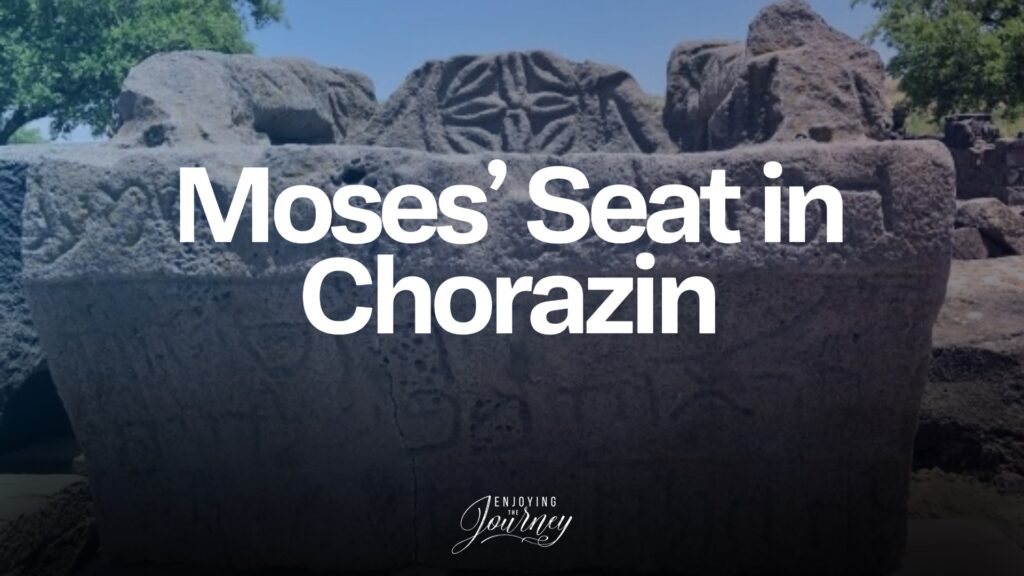
Among other finds, the researchers found a synagogue built from the local volcanic basalt stones. Inside the synagogue, beside the ark where the biblical scrolls were stored, was a seat. It has been identified by many scholars as Moses’ Seat. Although it dates to after the time of Christ, this find is a remarkable fusion of biblical text and archeology. It illuminates the words of Matthew and shows us the custom He referenced.
The Difference between the Takanot and the Law
In ancient times, synagogues were divided by a hierarchy that was based on learning and authority. Whoever was deemed worthy to sit in Moses’ Seat would have been the most esteemed and learned man of the community. Rather than being humbled by this elevation, we learn from Matthew that those who merited this seat in the synagogues instead took the chance to impose their own views on the congregation. They added layers of “heavy burdens and grievous to be borne” on top of the clear meanings of Scripture.
Even in Jesus’ day, the religious authorities were performing takanot to the text of Scripture. Takanot literally means “improvement” and are changes made to biblical law which are considered to be binding on subsequent generations. Some of them are fairly benign, but some of them are enacted to intentionally skirt biblical commands. Many of these changes made in antiquity are still practised by Jews today.
The Hypocrisy of the Scribes and Pharisees
Jesus pointed out the hypocrisy of the scribes and Pharisees for sitting in Moses’ seat, but undermining what he wrote. Jesus condemned this group for sitting in Moses’ seat, praising Moses, but not doing what was in Scripture. In Matthew 23, Christ gave several examples of takanot, of changes that the scribes and Pharisees made to the text of the books of Moses.
For example, instead of their oaths being binding, they created semantic loopholes that gave them a way out, if so desired. If you wanted to wiggle out of an oath, you could claim that your vow was not actually on the gold of the Temple, but merely on the Temple itself, so you would be free. (23:16) For instance, this could be devastating to someone who was trying to recoup a loan. Jesus seems to be calling attention to their lack of respect for the Temple, the altar, and even Moses. We can assume that this carried over into many other areas as well.
The Danger of Human Addition to Divine Revelation
Christ was careful to draw a distinction between observing what is written in the books of Moses, which Jesus commended, and the manmade additions to the text that were already accumulating in His day. However, God did not include in the text the frequent disagreements between His living Son and the long-dead scribes and Pharisees for us to point our fingers at them in judgment. Instead, we are given their example so we know to watch for this natural human tendency in ourselves. We all have the urge to amend, change, or otherwise neutralize parts of Scripture to suit our flesh. It is easy to criticize the ancient Pharisees, while at the same time being like them in practice.
Christian, what takanot have you imposed on the text? What changes have you made, either mentally or in practice, that negate and undermine the clear teaching of the Word of God? What grievous burdens are you laying on others, or even yourself? In Jesus’ day, the religious authorities taught that the takanot were binding on all subsequent generations. I urge you to examine your own beliefs for these practices. Pray for wisdom, and for the Holy Spirit to help you. They are not binding, but rather a choice.
Often, believers do not institute these beliefs themselves, but rather learn them from others. The words of preachers, teachers, and authors should be carefully compared with the words of the Bible. Just as in Jesus’ day, the best safeguard against this error is an intimate knowledge of the Scriptures.
“Ye shall not add unto the word which I command you, neither shall ye diminish ought from it, that ye may keep the commandments of theLordyour God which I command you” (Deuteronomy 4:2).
Listen to Scott Pauley’s Broadcast: Dealing With the Pharisee in Me
RELATED RESOURCE: Study Matthew Page
Discover more from Enjoying the Journey
Subscribe to get the latest posts sent to your email.