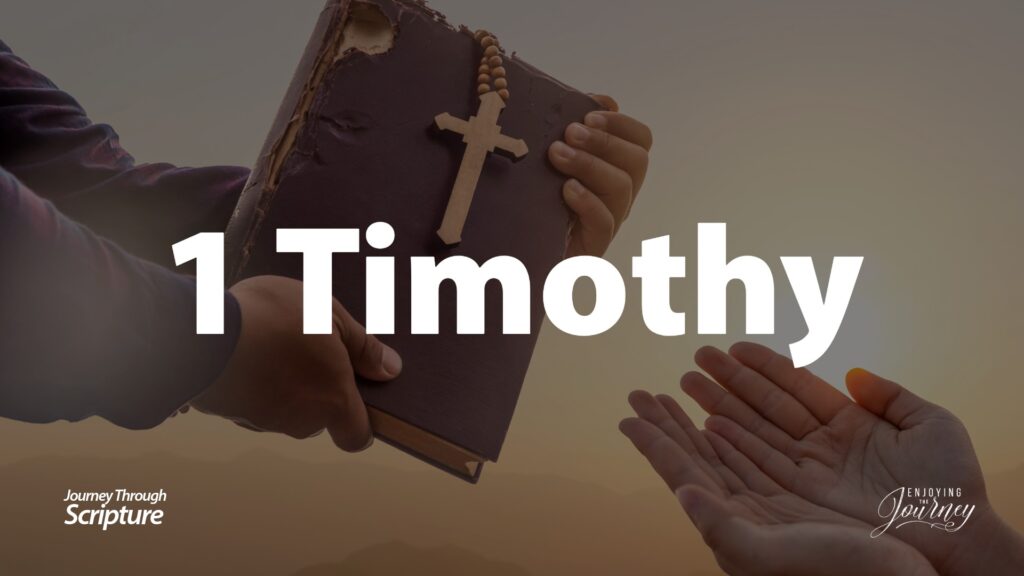
Journey Through 1 Timothy
I had the privilege of growing up in a pastor’s home. Not only that, but I also served under the same pastor for nearly two decades of my life. Now, every week of my life, I am with different pastors. I love preachers. If you have a faithful pastor, you ought to thank God for him! A shepherd who feeds you the Word of God and points you to the chief Shepherd makes a huge difference. Praise God for pastors. Do everything you can to pray for them and to encourage them. There is much we can learn about this matter in 1 Timothy.
Listen: Journeying through 1 Timothy
Pastoral Epistles
In our journey through Scripture, 1 Timothy opens a section known as the Pastoral Epistles or the Pastoral Letters. They were written to young pastors to give them instruction. This section includes 1 Timothy, 2 Timothy, and Titus. The word ‘pastor’ itself is only used once in the New Testament, in Ephesians 4:11, but its equivalent, this idea of a shepherd, is used throughout. It is the same office that is referred to as the bishop or the elder. These words describe various roles of the office of pastor.
1 Timothy explains for us the heart of a pastor, the qualifications of a pastor, the duties of a pastor, and the goals of a pastor. For that reason, these are referred to as Pastoral Epistles. Significantly, these are some of Paul’s final writings before his martyrdom. They give us lasting instructions on how to do the work of God in the last days.
Pastoral Epistles are for Everyone
Do not get the idea that these books are only for pastors. This is for you as well. Remember that it is this very portion of the Bible that says, “All scripture is given by inspiration of God, and is profitable for doctrine, for reproof, for correction, for instruction in righteousness:” (2 Timothy 3:16).
The Word of God meets all of our needs. It is all-sufficient. And so, when you approach the pastoral epistles, first, it makes us think about pastors and our relationship to them. The way we should honor, the way we should submit to God-ordained leadership, spiritual leadership in the local assembly, but also the responsibility that we have in a local assembly.
The church is not made up of just the pastor. A church is made up of many people in that body. The pastor is one member among many members. But we all have the privilege and opportunity of serving the Lord and being a part of the wonderful work of God. The Pastoral Epistles have something very definite to say to every one of us.
Overview of 1 Timothy
Paul is writing to his son in the ministry, a son of the faith, Timothy. We know that Timothy was raised in a Christian home. 2 Timothy 1:5 even refers to his mother and his grandmother by name and their heritage. He was part of the church at Lystra. Paul had invested time in developing Timothy, and God desires mature believers to keep investing.
His name means “honoring God.” I love that. He is mentioned about 24 times in the New Testament, as best we can tell, and he became one of Paul’s closest friends and most faithful fellow laborers. When Paul writes to him in these letters, he is pastoring a local church in a place called Ephesus. So we have journeyed through the book of Ephesians, and we know something about the church at Ephesus. That is where Timothy is serving the Lord at this particular time.
There are so many key things in 1 Timothy. There are words that are used repeatedly; words like ‘godliness.’ That is a word we need to get back to. May God give us a generation of people who understand godliness. The word ‘doctrine’ is used repeatedly, and we need to return to real Bible doctrine in our day. Words like ‘teach‘ and ‘charge’ are used repeatedly. The word ‘faithful’ is used often. These are all great Bible words.
Key Verse of 1 Timothy
But I want to bring you to one verse that I believe is the key that opens up first Timothy to us. It is 1 Timothy 3:15. The apostle Paul writes and says, “But if I tarry long, that thou mayest know how thou oughtest to behave thyself in the house of God, which is the church of the living God, the pillar and ground of the truth.”
We learn something about Christ’s institution of the church in this verse, but we also learn something individually about our place in it. Institutionally, we know that the church is the church of the living God. It is not our church, it is His church. (Click HERE for more on this.) It is the pillar and ground of the truth.
What is the church’s work in this world? It is literally to hold up the message of Jesus, to hold up the truth in a world of error. But the first part of the verse says that we are to know how we are to behave in the house of God.
This does not simply mean “listen in church,” or “be a good person in the meetings,” though I think we should teach people how to listen to preaching. That is not what this verse is about. The issue here is how to live as a member of a local church in a way that brings glory and honor to the Head of the church–Jesus Christ. It is a matter of personal conduct. It is a matter of our godliness–living in a way that honors the Lord Jesus Christ.
A Faithful Saying
One of the phrases that is used three times in this book is the phrase, “this is a faithful saying.” I love that phrase. It is used in 1 Timothy 1:15 in reference to salvation, it is used in 1 Timothy 3:1 in reference to service, and it is used in 1 Timothy 4:9 in reference to spiritual living.
Paul says, “Look, I want to give you the truth. I want to put it down on the bottom line, right down on the lower shelf so you can get it.” This is a faithful saying, this is the way God wants you to live your life. This is what ought to characterize the life of a believer. And that is not just true of Timothy, that’s true of every person in the local assembly. Let me prove it to you.
Examples and Exhortations
Paul begins the book of 1 Timothy with an explanation, a summary of what Paul has in mind for Timothy and for the church. Then he gives some examples throughout the rest of chapter one. He gives an example of how not to behave, by addressing specific men (Hymenæus and Alexander) who did not behave themselves correctly. The Apostle also gives an example of how to behave. Paul uses himself as a pattern for young Timothy (1 Timothy 1:12-16).
The rest of the book is a list of exhortations to all different groups of people about their place in the local church. He addressed everyone about their prayer life. Paul then addresses women, he addresses pastors, he addresses deacons, he addresses church members, and he addresses the wealthy. He exhorts Timothy to press on in faith. Whoever you are, whatever your role in the local church, God has a word for you.
The word is that you should know how to “behave thyself in the house of God, which is the church of the living God, the pillar and ground of the truth.”
Strong Members Make Strong Churches
It is easy for us to spot somebody else’s sin and weakness. We can spot their sin at 100 yards and tell someone all about it. However, the truth of the matter is, in the words of the old spiritual, “It’s not my brother, not my sister, but it’s me, oh, Lord, standing in the need of prayer.”
Do you know how to have a great church? Great churches are made up of believers who are seeking to be the best possible Christians they can be. They are made up of strong church members. They are made up of strong Christian families. And if you want your church to be everything it ought to be, then you work, not just to get from your church what you can get from your church, but to give back to it.
Be a Part and Do your Part
Do your part. You may never be the Apostle Paul, and you may not be the pastor of the church. But my friend, you can say, “By the grace of God, I am going to pray, work, love, and live in a way that honors Christ and strengthens the local assembly.” Make the church’s mission your mission. (Click HERE to go study through our Bible App plan on The Great Commission | Our Mission.)
You and I are simply pieces of something much greater than ourselves. But if you will do your part, God will do the rest. If ever there was a generation that needs stronger churches, not weaker, it is our generation. It is the generation that is about to meet Jesus.
[Download this FREE handout with eight reasons why the church assembles by clicking HERE]
Related: Visit Our Resource Page for Preachers
Discover more from Enjoying the Journey
Subscribe to get the latest posts sent to your email.