Paul’s Farewell Address
In 2 Timothy chapter 1, we come to Paul’s farewell address—his final letter written to his son in the faith. Sitting in a cold Roman prison cell, taking pen in hand, he writes under the inspiration of the Holy Spirit. In this final epistle, he introduces us to a man who appears at both the beginning and the end of the letter, like bookends on Paul’s final thoughts.
Unfaithful: Phygellus and Hermogene
“Thou knowest, that all they which are in Asia be turned away from me; of whom are Phygellus and Hermogenes.” (2 Timothy 1:15)
Can you imagine when this letter was read aloud in a church for the first time? How awful it would have been to hear Paul, under the inspiration of the Holy Spirit, call your name as a deserter. The only reason Phygellus and Hermogenes made the biblical record was because they were unfaithful. By this point, Paul records that the believers in Asia had deserted him. How quickly human hearts turn.
Faithful: The Household of Onesiphorus
Yet in the very next verse, Paul tenderly writes:
“The Lord give mercy unto the house of Onesiphorus; for he oft refreshed me, and was not ashamed of my chain: But, when he was in Rome, he sought me out very diligently, and found me. The Lord grant unto him that he may find mercy of the Lord in that day: and in how many things he ministered unto me at Ephesus, thou knowest very well.” (2 Timothy 1:16-18)
Turning to the final chapter of Paul’s last letter, we find this faithful man mentioned once again alongside Prisca and Aquila:
“Salute Prisca and Aquila, and the household of Onesiphorus.” (2 Timothy 4:19)
Notice that both times Paul references Onesiphorus, he speaks of his house and household, as though the man himself was already gone. Most scholars believe that by this time, Onesiphorus had fallen during the intense persecution of believers, having been imprisoned or put to death for his faithful following of the Lord Jesus Christ.
Some religious groups have taken this passage out of context, imagining that Paul was praying for a dead man’s soul to enter Heaven. But that is entirely inconsistent with what Paul taught and with the whole of Scripture. Once a person takes their last breath, their eternal destiny is settled forever. Nobody’s prayers after death can alter that reality. You must trust Christ for your own salvation before you cross the threshold of death.
The Apostle Paul was not praying for Onesiphorus’s salvation; rather, he was praying that this man’s godly influence would live on, and that the family he left behind would be abundantly blessed because of his faithfulness.
Onesiphorus: The Gospel Christian
What do we learn from Onesiphorus? I call him a Gospel Christian. To be a Gospel Christian means more than simply having believed the gospel years ago. You cannot be a Christian apart from the gospel—you must believe in the death, burial, and resurrection of the Lord Jesus Christ, trusting entirely in His finished work. But many who received the gospel long ago are not living today as Gospel Christians, because their daily lives and labor are no longer defined by the gospel.
“Gospel Christians aren’t just glad they are going to heaven; Gospel Christians want to take other people to heaven with them. They are not content to sit comfortably in a church building; they are willing to step out of their comfort zone to further the glorious message of Jesus Christ.”
Onesiphorus was a Gospel Christian because he gave his life to the very end for the greatest cause in all the world: the cause of the Lord Jesus Christ. He likely traveled to Rome on business, but along the route, he moved from his own business to the Father’s business. From our text, we discover four clear measurements of a Gospel Christian.
The Depth of His Commitment
The commitment Onesiphorus displayed was heart-deep, not merely head-deep. Many people possess head knowledge—they can recite facts and give a nod to God—but when Christ captures a man’s heart, the love of Christ constrains him. He serves not out of external pressure, but out of a deep internal desire born of what Christ has done for him.
Onesiphorus lived in Ephesus, where Timothy pastored, yet he made his way to Rome to find and encourage the imprisoned Apostle Paul. Two striking phrases reveal the depth of his heart:
He Was a Refresher
Paul writes in 2 Timothy 1:16 that Onesiphorus ‘oft refreshed me.’ There are two kinds of Christians in this world: refreshers and drainers. Drainers are faithless, negative, and critical, sapping spiritual life out of everyone around them. But refreshers live so consciously in the presence of God that every time you are around them, your soul is revived and encouraged.
The word ‘refresh’ literally means to cool off—like a cup of cool water in the heat of battle. The New Testament connects true refreshing to the presence of the Lord:
“Repent ye therefore, and be converted, that your sins may be blotted out, when the times of refreshing shall come from the presence of the Lord;” (Acts 3:19)
Preachers do not refresh you; singers do not refresh you; human efforts cannot refresh you. The thing that revives the inner man is the presence of Almighty God. When you walk closely with Jesus, His presence flows unhindered through your life, and you become a breath of fresh air to weary saints.
He Was Not Ashamed
Alexander Maclaren commented regarding those who helped the Apostle Paul:
“Paul had his helpers, on whose names he lovingly lingers and has made immortal, a ‘Gaius, mine host, and of the whole church,’ an ‘Epaphroditus, my fellow soldier, who ministered to my wants,’ and therefore was a soldier, though he did not fight, and ‘Onesiphorus, who oft refreshed me, and was not ashamed of my chain.’
But let us remember that these two forms of service which are equally necessary are equally binding on us all, in the measure of our opportunity and capacity. Our performing the indirect is no excuse for our neglecting the direct. The conversion of the world is our business and not to be handed over to any society or missionary. No Christian can be only and always a non-combatant, without sin and loss. He is bound to take some share in the actual conflict in one or other of its many parts.”
Paul notes that Onesiphorus ‘was not ashamed of my chain‘ (2 Timothy 1:16). An unashamed, bold testimony is a running theme throughout 2 Timothy chapter 1:
- Exhortation to Timothy: Timothy is urged not to be ashamed: “Be not thou therefore ashamed of the testimony of our Lord, nor of me his prisoner:” (2 Timothy 1:8)
- Paul’s Testimony: Paul describes his own boldness: “For the which cause I also suffer these things: nevertheless I am not ashamed:” (2 Timothy 1:12)
- Onesiphorus’s Example: Onesiphorus exemplifies unashamed loyalty: “He oft refreshed me, and was not ashamed of my chain:” (2 Timothy 1:16)
When Jesus hung on the cross in naked shame, He was not ashamed to be identified with us. The very least we can do is stand up unashamed to be identified with Him. Scripture promises that ‘whosoever believeth on him shall not be ashamed’ (Romans 10:11). This is not the time for God’s children to cower in a corner; it is the time for the righteous to be bold as a lion.
The Breadth of His Service
Notice where Onesiphorus served:
“In how many things he ministered unto me at Ephesus, thou knowest very well. But, when he was in Rome, he sought me out very diligently, and found me.” (2 Timothy 1:17-18)
He served God at Ephesus, his hometown, and he served God in Rome, hundreds of miles away in hostile territory. He did not merely serve where it was convenient; he served everywhere he went.
- At Ephesus: He started right at home, ministering to the saints and supporting his local pastor, Timothy, in a wicked, worldly city.
- In Rome: When persecution under Emperor Nero turned hot and other believers were fleeing Rome, Onesiphorus rushed directly into Rome to find Paul. He sought him out diligently despite the personal danger.
True Gospel Christians do not go incognito when they leave home or travel away from their local church. Whether alone or with others, at home or far away, they remain active witnesses for the Lord Jesus Christ, alert to the divine appointments God places in their path.
The Length of His Reward
Everything done for this world perishes, but what is done for Christ lasts for eternity. Paul twice mentions the reward of divine mercy: “The Lord give mercy unto the house of Onesiphorus… The Lord grant unto him that he may find mercy of the Lord in that day:” (2 Timothy 1:16, 18)
Notice the two dimensions of this eternal reward:
Mercy for His Family
Paul prays for mercy upon the house of Onesiphorus. Jesus taught in the Beatitudes, ‘Blessed are the merciful: for they shall obtain mercy’ (Matthew 5:7). When you live in God’s mercy and extend mercy to others, you sow seeds of mercy that bless your home and family long after you are gone.
Mercy at the Judgment Seat
Paul prays that Onesiphorus will find mercy ‘in that day’—referring to the day we stand before the Judgment Seat of Christ. Every believer will give an account of his life to God. Living with that day in view changes how we speak, how we serve, and how we labor for the gospel.
The Height of His Influence
What is the greatest thing a person can leave behind? It is not financial wealth, organizational status, or earthly fame; it is a spiritual legacy. Scripture records nothing about Onesiphorus’s earthly net worth, vocal talents, or public prominence. But twice Paul highlights his household (2 Timothy 1:16, 4:19). He left behind a family of faith following in his footsteps.
Paul closes chapter 1 with these striking words to Timothy: “Thou knowest very well” (2 Timothy 1:18). Timothy knew very well what kind of man Onesiphorus was. His life left no doubt about his character or his convictions.
What will people know about you when your life on earth is finished? Let them know very well that you belonged to Jesus Christ. And let them know very well that you were not merely a passive church member, but a faithful Gospel Christian who lived and died for the cause of Jesus Christ.
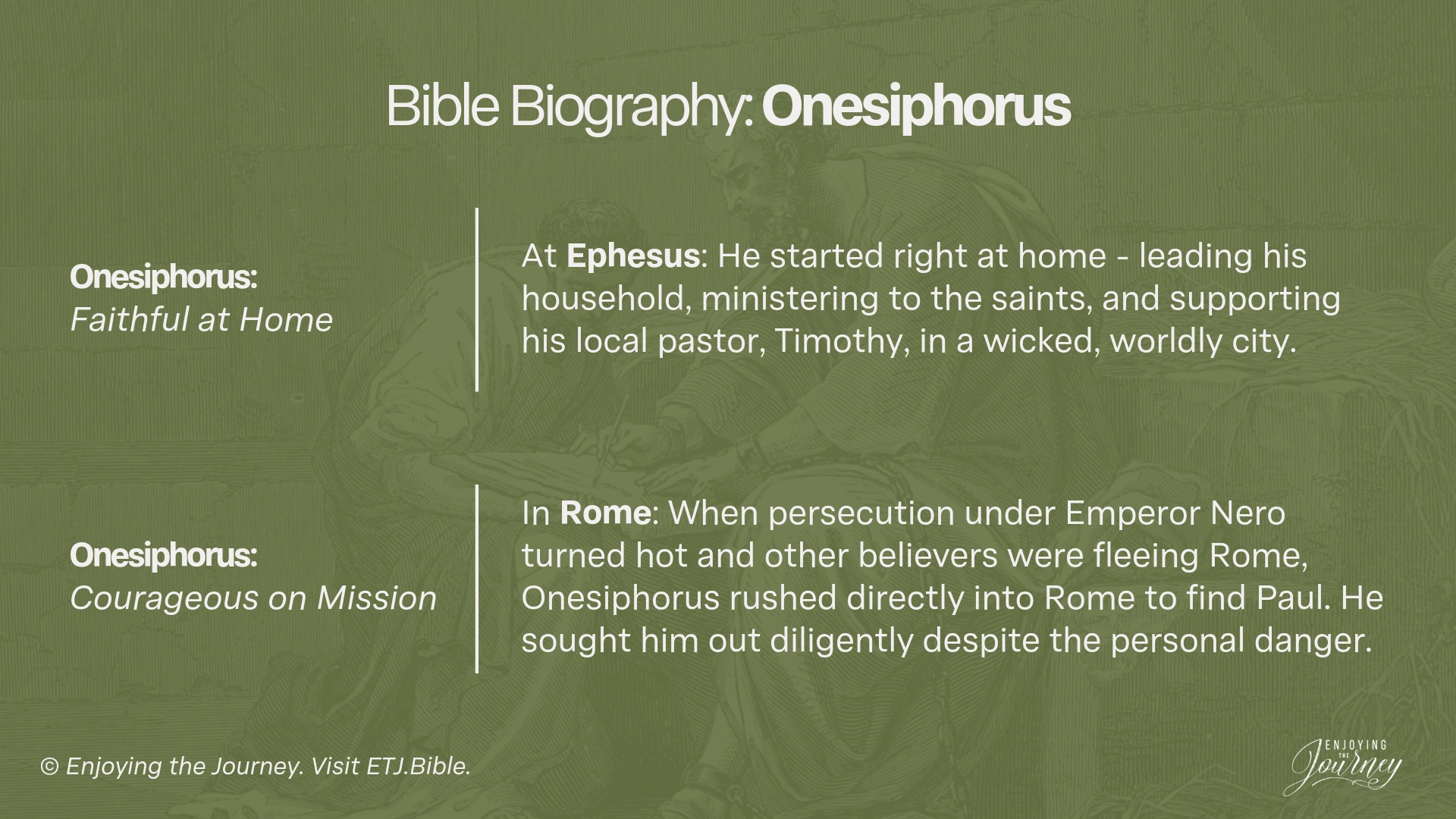
This slide provides a brief look at the private life of Onesiphorus at home in Ephesus and on mission for the Lord in Rome. Share it online, save it for later, or use it as a tool to teach these truths to others. © Enjoying the Journey 2026
Resource Page: Study 2 Timothy
Discover more from Enjoying the Journey
Subscribe to get the latest posts sent to your email.