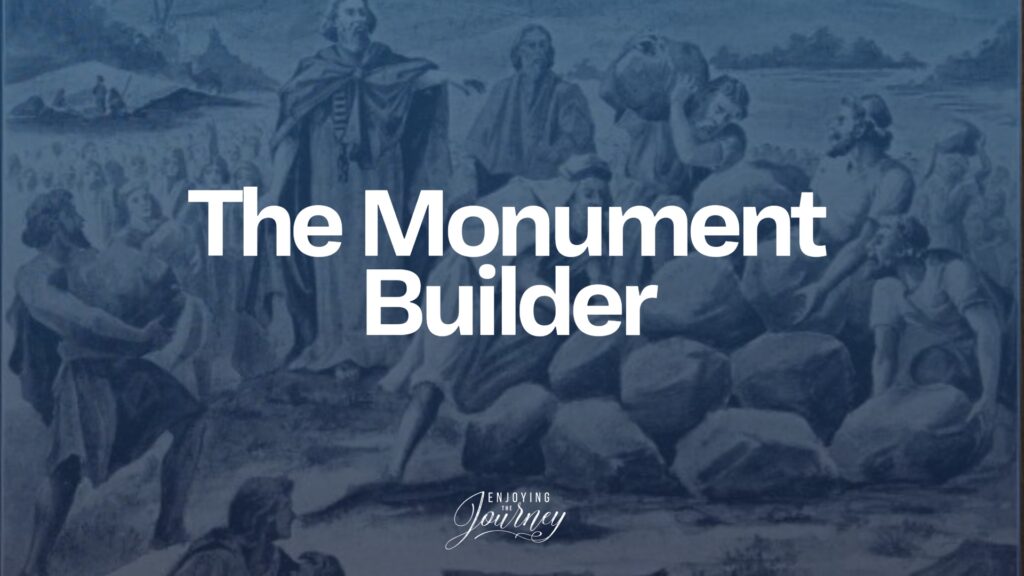
“And command ye them, saying, Take you hence out of the midst of Jordan, out of the place where the priests’ feet stood firm, twelve stones, and ye shall carry them over with you, and leave them in the lodging place, where ye shall lodge this night.
Then Joshua called the twelve men, whom he had prepared of the children of Israel, out of every tribe a man:
And Joshua said unto them, Pass over before the ark of the LORD your God into the midst of Jordan, and take you up every man of you a stone upon his shoulder, according unto the number of the tribes of the children of Israel:
That this may be a sign among you, that when your children ask their fathers in time to come, saying, What mean ye by these stones?
Then ye shall answer them, That the waters of Jordan were cut off before the ark of the covenant of the LORD; when it passed over Jordan, the waters of Jordan were cut off: and these stones shall be for a memorial unto the children of Israel for ever.” (Joshua 4:3-7)
The idea of building a monument was not that of Joshua, but of God. God instructed Joshua to have twelve men remove a stone from a prescribed place, place it on their shoulders and bear it up out of Jordan. It was to be taken to their place of lodging. What purpose could possibly be served in carrying twelve large river rocks approximately six or seven miles to Gilgal? God said,
“That this may be a sign” (verse 6).
The word “sign” means, in the sense of appearing, a signal as a flag, beacon, monument, or evidence. Verse 20 tells us that Joshua was to pitch the stones in Gilgal. The idea of pitch here is to cause to stand or raise up. God wanted a monument to be raised up in Gilgal, and the stones were formed in an orderly manner to produce that monument. May we remind ourselves that we are God’s monuments in this world. Psalm 40:2, “He brought me up also out of an horrible pit, out of the miry clay, and set my feet upon a rock, and established my goings.” It is God who has removed me from the deplorable condition of my sinfulness, and placed me upon the Rock of Ages as a monument of His grace. Hallelujah! What a Saviour! When the believer understands what a monument does, then our service for Christ will be enhanced because we know our purpose!
(I) The Calling of Attention
Upon their arrival in Gilgal, the men did not throw the stones down in a haphazard manner. The placement of these stones was not to appear as an act of nature but the work of another force, thus calling one’s attention to the arrangement of stones or monument. Some time ago, my wife Glenda and I were in the upper part of Maine. The area was one of massive rock formations and sheer cliffs. Posted throughout the area were signs with the names of certain hiking trails. Investigating one of the trails, I had cause to ask myself: how was one to navigate across those large rock flats, avoiding the cliffs and places of danger? It was then that my attention was diverted to a mound of small rocks differing from the formations around them. These were trail markers placed there by previous pioneers. These rock monuments were placed there to call the traveler’s attention to the proper path.
The children of God have been left in this world for the purpose of calling attention. When I speak of calling attention, I do not mean that the people of God are to appear as some freak monstrosity that belongs in the midway of some carnival. But we are to be different!
The Monument of Good Works
II Corinthians 6:17, “Wherefore come out from among them, and be ye separate, saith the Lord, and touch not the unclean thing; and I will receive you.” Four times in the Word of God, His people are referred to as peculiar. Deuteronomy 14:2, “For thou art an holy people unto the Lord thy God, and the Lord hath chosen thee to be a peculiar people unto himself, above all the nations that are upon the earth.” Then in Titus 2:14, “Who gave himself for us, that he might redeem us from all iniquity, and purify unto himself a peculiar people, zealous of good works.” The word “peculiar” in Deuteronomy means peculiar treasure or jewel. While in Titus, it refers to being beyond the usual, special or one’s own.
It is not the people personally that call attention, but their holiness and good works. There is to be such a radical difference between the children of God and the world that it becomes evident to all. Listen to the words of Jesus in Matthew 5:16, “Let your light so shine before men, that they may see your good works.” A monument is to stand out, to be seen by all, or to call attention to. J.C. Massee points out that the monument is not in itself an end but a reminder of the presence of God, who Himself must be worshipped in spirit and in truth. To whom or what are you causing attention to be called?
(II) The Causing of Inquiry
Once the stones were erected in a column and had attracted the attention of the people, the next thing that occurred was an inquiry. “When your children ask their fathers in time to come, saying, What mean ye by these stones?” (verse 6). The first time one of the stacks of stones in Maine caught my attention, I asked Glenda what they were. We later found out that they were known as cairns or rock cairns. They aid the hiker in remaining on the trail and averting danger in foggy conditions. When I saw the first one, I knew they were the result of another power other than nature. Nature had not left such a formation; it was the hand of another that had so ordered these stones. This is the second purpose of God’s people, the causing of inquiry.
When holiness and good works are projected from us, it is apparent to all that it is contrary to our nature. Thus, the question, “How can these things be?” Ruth Stewart, in her book, Our Heavenly Inheritance, speaks of the difference an indwelling Christ makes in the life of the believer. This difference will provoke such questions as, “What happened to your bad temper?” “How can you have such patience and love?” “Whence comes the peace and joy your life portrays?” “By what power do you accomplish your work?” When the disciples returned to the well of Sychar and found Jesus’ physical appetite satisfied with spiritual things, it provoked the question, “Hath any man brought him ought to eat?” (John 4:30-34).
When Jesus arose from the hinder part of the ship and rebuked the winds and the sea, the Bible said, “there was a great calm. But the men marvelled, saying, What manner of man is this, that even the winds and the sea obey him?” (Matthew 8:26-27). Their attention was attracted to the monument so that their hearts might inquire. Listen to the words of our Lord, “Verily, verily, I say unto you, He that believeth on me, the works that I do shall he do also; and greater works than these shall he do; because I go unto my Father” (John 14:12). What kind of questions are they asking about your life?
(III) The Casting of Testimony
The whole purpose of calling attention, and causing inquiry, is culminated in the supreme purpose of casting a testimony, “Then ye shall answer them” (verse 7). The supreme purpose of the monument is that it might testify of Him! J.C. Massee said, “The memorial is vain unless it bears the living testimony of the presence of the living God.” The monument is not to be worshipped but is to serve as a witness. Yet, this is the prevalent danger of today. We have exalted the creature over the Creator. “Who changed the truth of God into a lie, and worshipped and served the creature more than the Creator, who is blessed for ever. Amen.” (Romans 1:25) The picture is not to be exalted over the painter, the pottery over the potter, sculpture over the sculptor, the architecture over the architect nor the saint over the Saviour! “For we are his workmanship, created in Christ Jesus unto good works, which God hath before ordained that we should walk in them.” (Ephesians 2:10)
We are the created object, the product of His hand. God is to be glorified by the saints, “For ye are bought with a price: therefore glorify God in your body, and in your spirit, which are God’s” (I Corinthians 6:10). God is to be glorified before the sinner, “Having your conversation honest among the Gentiles: that, whereas they speak against you as evildoers, they may by your good works, which they shall behold, glorify God in the day of visitation” (I Peter 2:12).
When I think of casting a testimony, my mind goes to Acts 3&4. In the text, God has healed a lame man who immediately begins leaping and praising in the temple. The people begin to question within themselves who or what had wrought this great miracle. This produces an opportunity for Peter to cast a testimony. “And when Peter saw it, he answered unto the people, ye men of Israel, why marvel ye at this? or why look ye so earnestly on us, as though by our own power or holiness we had made this man to walk?” (3:12) Rather than calling attention to themselves, they point men to the Saviour. To whom or what are you casting a testimony?
We are God’s monuments on this earth. Just as the stone cairn is to point the way to safety and keep the traveler on the way, we are to point to Him and be an example in the way. Our stand is to call attention, our life is to cause inquiry, and our lips are to cast a witness! God is a monument builder.
*This material is an excerpt from guest author Dr. Bob Sanders’ commentary on JOSHUA. Find your copy HERE.
RELATED ETJ RESOURCE: STUDY JOSHUA
Discover more from Enjoying the Journey
Subscribe to get the latest posts sent to your email.
Post Author
More from similar topics
Deuteronomy | Israel | Joshua | Titus | Witness | children | fathers | generations | promises of God | questions | remember | reminders