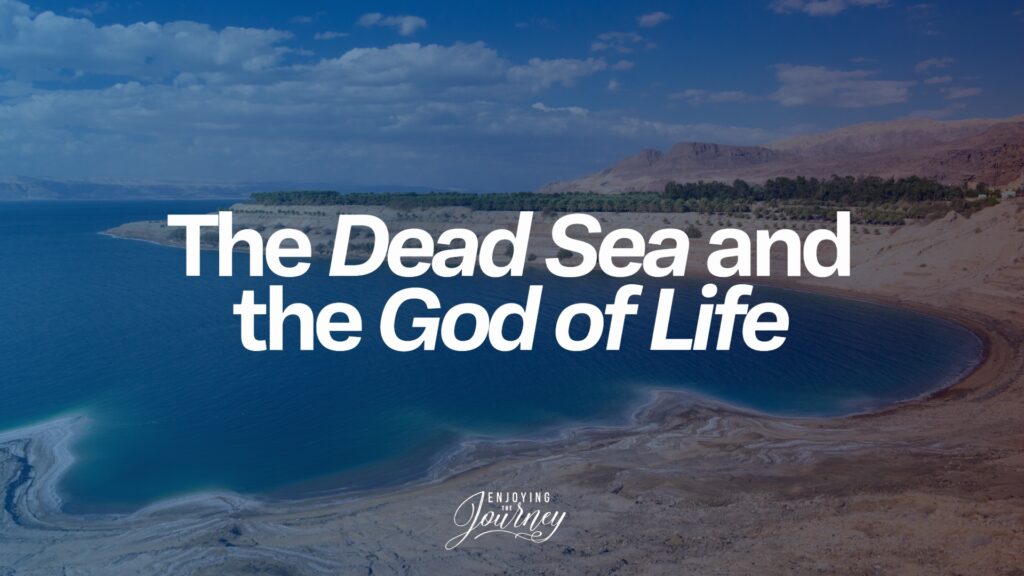
“Then said he unto me, These waters issue out toward the east country, and go down into the desert, and go into the sea: which being brought forth into the sea, the waters shall be healed. And it shall come to pass, that every thing that liveth, which moveth, whithersoever the rivers shall come, shall live: and there shall be a very great multitude of fish, because these waters shall come thither: for they shall be healed; and every thing shall live whither the river cometh.” (Ezekiel 47:8-9)
What is the Dead Sea?
The Dead Sea is the lowest point on earth and is usually called the Salt Sea in the Bible because of its most salient characteristic: the water’s high salt content. It is also sometimes called the eastern sea, or the sea of Arabah. Despite the salinity of the water, the area around the Dead Sea has been fought over for millennia. Fissures deep under the surface leak bitumen, what we call tar. This gave rise to the Greek name for the sea, Asphaltites. The ancient historian Josephus wrote of workers extracting blobs of tar the size of oxen from the surface of the sea. In the centuries before the Israelite conquest, the local Canaanite tribes traded bitumen from the Dead Sea with Egypt where it was used in everything from medicine to mummification.
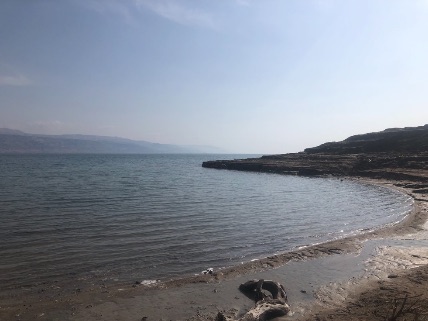
The international border between Israel and Jordan is in the middle of the Dead Sea. Both countries have a small naval contingent that patrols here. Occasionally you can find balls of tar that have washed up on the shore. The largest one I have found was about the size of a house cat. Photo by John Buckner
It was for this reason that the notorious Queen Cleopatra of Egypt quarreled over ownership of the sea with the equally infamous King Herod the Great. Beyond the bitumen, which can still be found washing up on the shore, the sea produced salt and potash, which are valuable for glassmaking, soap and fertilizer. The valley around the sea has been used throughout history up to today for the growth of date palms.
The Salt Sea: From Death To Life
One thing that the Salt Sea, or the Dead Sea, does not have is life in it. The salt content of the water is over eight times greater than the ocean, rendering life impossible. Yet, in the Messianic Age, living water will flow out from God’s house in Jerusalem and heal the waters of the Salt Sea. The now barren banks of the sea will be covered with plants, and the dead waters will teem with life. The trees on the banks will bear fruit every month, and the leaves will be for medicine (47:12). They will not fade because the water issues forth from the sanctuary of God.
As is so often the case in the New Testament, the writer John dipped his pen into the ink of the Old Testament when he described the tree of life that he saw in heaven. “In the midst of the street of it, and on either side of the river, was there the tree of life, which bare twelve manner of fruits, and yielded her fruit every month: and the leaves of the tree were for the healing of the nations.” (Revelation 22:2)
When you sit alone on the shore and read Ezekiel, it is so dry, desolate, and lonely that it can be hard to imagine the glorious day when God will resurrect the Dead Sea. While there, I meditate on the various stories that connect the area to Scripture. For instance, when word came to Jesus that Lazarus had died, He tarried for a while where He was on the east side of the Jordan River. Then He and His disciples started toward Jerusalem. The ancient road would have taken them within sight of the northern shore of the Dead Sea. I like to go there and imagine the embodied resurrection and life pausing for a break during the heat of the day. I imagine Him looking out at the dead water in the distance and quietly smiling as He thought about Ezekiel’s prophecy and His own future kingdom.
Reader, the man who raised Lazarus from the dead will one day raise the Dead Sea to life. It seems impossible, but He showed that He is capable of so much more when He conquered death for all of us. He rose from the grave on the third day, and He has raised all of us who know Him to new life. If you do not know Him as your Savior, He stands eager to give you eternal life. Have you drunk from the living water that is Christ? If you have not, I urge you to come to Him today.
“Jesus answered and said unto her, If thou knewest the gift of God, and who it is that saith to thee, Give me to drink; thou wouldest have asked of him, and he would have given thee living water.” (John 4:10)
Discover more from Enjoying the Journey
Subscribe to get the latest posts sent to your email.