Alabastron
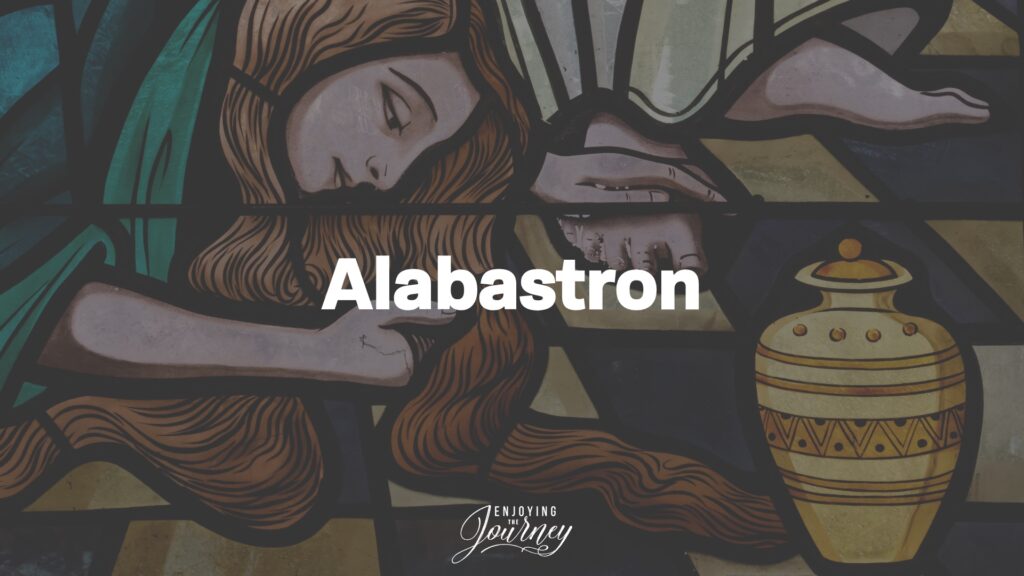
“And being in Bethany in the house of Simon the leper, as he sat at meat, there came a woman having an alabaster box of ointment of spikenard very precious; and she brake the box, and poured it on his head. And there were some that had indignation within themselves, and said, Why was this waste of the ointment made?” Mark 14:3-4
History of Alabastron
The Greek word for the box mentioned by Mark is alabastron, with alabastra being the plural. The English word box has changed meaning over the centuries. In modern times we think of it as being square, with a flat bottom, but the word originally meant a container, whether a bottle or a modern box.
Alabastra were at first formed using alabaster stone, hence the name. The shape is believed to have been inspired by the date palm. They were originally produced on lathes in Egypt in the 11th century BC and exported around the Mediterranean. Later they began to be produced at various ancient using glass, but they retained the original name and shape. They range in size, but most are between four and eight inches tall (10-20 cm).
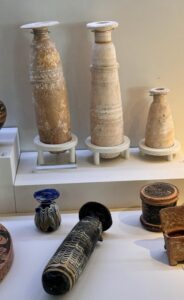
The three alabastra in the back are made of alabaster, and possibly of Egyptian origin, while the ones in the foreground to the lower left are made of glass. As you can see, the ones made from glass still retained the traditional shape. They are all from Pella in Macedonia, Greece. They are all from the third century BC. Photo by John Buckner
Types of Alabastron
Egyptian, and Greek alabastra were often hand-painted with scenes of daily life, or they could be coated in a precious metal. In contrast, Roman alabastra were frequently made of multicolored glass. They were prized as perfume containers since wood or pottery would chemically react with the perfumes they contained and cause unwanted changes in the fragrances, but stone and glass do this much less. The ancient world produced a seemingly infinite variety of fanciful perfume containers. Some are in the form of kittens playing, and some look like wild animals.
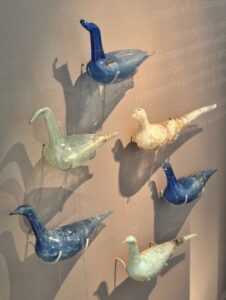
Glass perfume bottles in the form of birds. They were designed to be used only once. The perfume would be bottled, then permanently sealed. The only way to extract the perfume was to break the bottle. These are from the first century AD and were found near Thessaloniki, Greece. Photo by John Buckner
Broken to Be Used
Jesus says that the woman came to prepare His body for burial. Interestingly, alabastra are common finds from ancient graves. In the Near East, alabastra are usually found intentionally broken. They would be broken, and the perfume poured onto the deceased. Then the broken alabastron would be carefully positioned inside the grave. Scholars are unsure why this is, but one theory is that the broken alabastron represented the broken hearts of the living. In other words, the woman was pouring out her broken heart to Jesus and telling Him that she mourned His death.
The alabastra would often be works of art in their own right and were most often designed to contain expensive perfumes. In studying perfume customs from the ancient world, it is striking how often alabastra, and other fragrance containers, were intended to be broken. The woman broke the alabastron, and poured pure spikenard onto Jesus’ head. Spikenard is a plant that only grows in the Himalayas on the far side of the world from ancient Judea, and was imported during Bible times at great expense.
Christ, our Alabastron
It is as if Mark wants us to see Jesus as our alabastron. In life He was altogether lovely, but He was destined to be broken for us. He did not pour out an expensive, imported perfume. Instead, on the cross, His broken body poured out the blood that brought Heaven’s salvation to man. The woman’s gift to Christ filled the whole house where they were gathered. Christ’s gift to us fills our souls with His love for us. Some saw the use of the ointment in this way, but it is never a waste to give our best to Jesus.
Often, you will see a broken alabastron in a museum that has been carefully pieced back together by archaeologists, but upon close inspection the break is always still visible. Christ’s broken body was placed in a grave, but it did not stay there! However, even in His resurrected state, we know that He still bears in His hands and side the marks where He was broken for us.
Christian, I urge you to meditate on the gift that Jesus poured out for you from His broken body. If we were to speak to this heartbroken woman in our story, we might be tempted to remark on the amazing gift she gave the Savior. I am sure she would respond, “No. He is who gave me the great gift.” If you are not saved, I plead with you to accept His precious gift that He poured out for you.
“While the king sitteth at his table, my spikenard sendeth forth the smell thereof.” Song of Solomon 1:12
Discover more from Enjoying the Journey
Subscribe to get the latest posts sent to your email.