
Who was Sosthenes?
Sosthenes never speaks a single recorded word in Scripture. The name Sosthenes appears exactly twice in the Word of God — once naming the man being beaten in public, once naming the man co-signing one of the books included in God’s Word. We know very little about Sosthenes; we cannot even be certain that these two references describe the same person. However, it is possible that between those two mentions lies one of the quietest conversion stories in the New Testament.
The Ruler of the Synagogue (Corinth, AD 51–52)
As we read Acts 18, Paul had just arrived in Corinth, and he would end up spending eighteen months here as part of his second missionary journey (Acts 18:11). Paul began making tents with Aquila and Priscilla, and he also went to the synagogue every week, seeking to persuade the Jews and the Greeks about the truth of the Gospel of Jesus Christ. When Silas and Timothy arrived, Paul was led of the Holy Spirit to confront the Jews in Corinth that Jesus Christ was the promised Messiah and Son of God. Those he spoke with did not accept the truth of his message, and instead opposed themselves and blasphemed. This led Paul to begin sharing the truth of the Gospel with the Gentiles.
However, Paul did see some fruit from his efforts. After his confrontation with the Jews, he entered into the house of a man named Justus, a believer whose house was either attached to or adjacent to the synagogue. We read in Acts 18:8 the following conversion account:
“And Crispus, the chief ruler of the synagogue, believed on the Lord with all his house; and many of the Corinthians hearing believed, and were baptized.”
The Confrontation of Paul Before Gallio
A man named Sosthenes succeeded Crispus in the office of chief ruler of the synagogue. He was now responsible for the synagogue that had just lost its leader to the Paul’s message of Christ.
At some point during Paul’s ministry in Corinth, Paul’s opponents dragged him before Gallio, the Roman proconsul of Achaia. They brought him before the judgement seat and charging that he, “persuadeth men to worship God contrary to the law” (Acts 18:13). The irony is that this accusation was one of which Paul was guilty (recall in verse 4 that “he reasoned in the synagogue every sabbath, and persuaded the Jews and the Greeks.” However, before Paul could even answer, Gallio threw the case out. In his view, this was not a dispute about breaking Roman law, such as “wrong or wicked lewdness.” Instead, because it was, “a question of words and names, and of your law,” he directed the accusers to, “look ye to it; for I will be no judge of such matters,” and drove them from the judgment seat.
The Beating of Sosthenes
Then came the verse that made Sosthenes famous:
“Then all the Greeks took Sosthenes, the chief ruler of the synagogue, and beat him before the judgment seat. And Gallio cared for none of those things.” (Acts 18:17)
Why did the Greeks beat Sosthenes? We cannot be sure, but perhaps he led the group who brought Paul before Gallio, and the Greeks saw his effort as wasting the time of the Roman government. Not only did he fail to secure a conviction against Paul before Rome, he is the one who ends up being punished. Another possibility is that the Greeks saw that Gallio was indifferent to the plight of the Jews, and simply took advantage of the situation to act upon their persistent contempt of a group viewed as troublemakers.
Sosthenes Our Brother (Corinth, AD 54)
About three years later, Paul opens his first letter to Corinth with two names: “Paul, called to be an apostle of Jesus Christ through the will of God, and Sosthenes our brother“ (1 Corinthians 1:1). Could this be the same Sosthenes that was mentioned in Acts 18:17? It is probable. If so, note the drastic difference that takes place behind the scenes. The beaten synagogue ruler is now “our brother,” standing beside the apostle as co-sender of the letter — quite possibly as its scribe, as Tertius was for Romans (Romans 16:22). Sosthenes was likely well known to the Corinthians, giving the letter local weight — no small thing for a letter Paul wrote to a divided church (1 Corinthians 1:10–12).
Are the two Sosthenes from Acts 18 and 1 Corinthians 1 the same man? The case for it is strong: the same name, the same city, and a timeline that fits. The case against it is that Sosthenes was a common Greek name, and some scholars describe the identification pure conjecture.
The great Bible teacher, Matthew Henry observed:
It seems most probable that Sosthenes was a Christian, and Paul’s particular friend, that appeared for him on this occasion, and probably had taken care of his safety, and conveyed him away, when Gallio dismissed the cause; so that, when they could not light on Paul, they fell foul on him who protected him. It is certain that there was one Sosthenes that was a friend of Paul, and well known at Corinth; it is likely he was a minister, for Paul calls him his brother, and joins him with himself in his first epistle to the church at Corinth (1 Cor 1:1), as he does Timothy in his second, and it is probable that this was he; he is said to be a ruler of the synagogue, either joint-ruler with Crispus (v. 8), or a ruler of one synagogue, as Crispus was of another.
If they are the same man, his conversion came after the beating — the public humiliation perhaps became the path that led him to Christ. If they are two men, we can appreciate the beauty that God put an otherwise unknown believer’s name on the first line of Scripture.
What We Can Learn from Sosthenes
Sosthenes teaches us many things:
- God can use anyone to serve Him.
- Your past does not determine your future.
- Our identity in Christ is more important than any earthly position. I would rather be a “brother” than a “chief ruler”.
- God values faithful service, even if it receives little recognition from others
- Christian fellowship and being part of the family of God is a precious gift.
We do not know much about Sosthenes, but his story is a useful reminder that we do not need to know every detail of a person’s story to recognize that God is at work in their life.
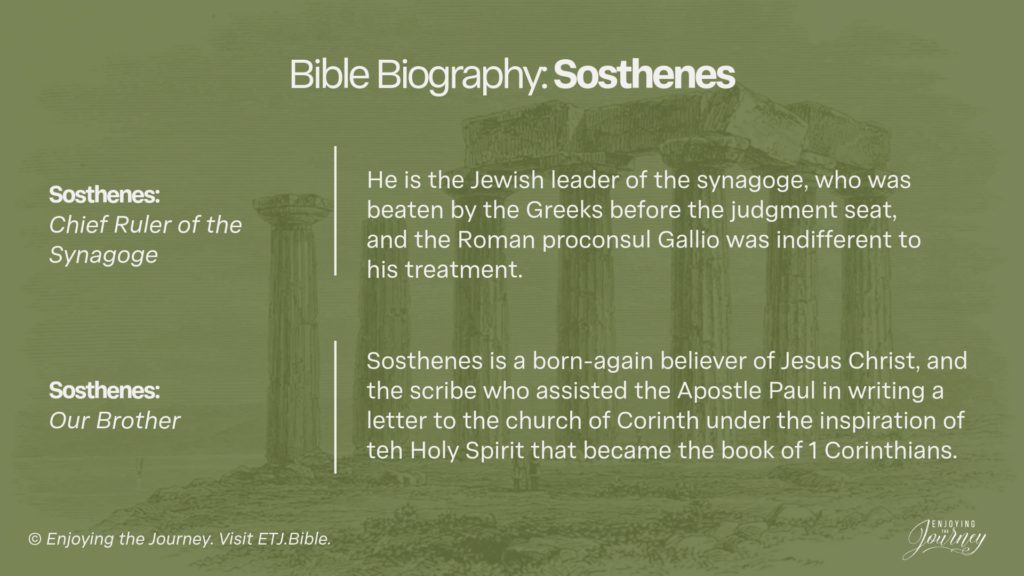
This slide provides a brief look at Sosthenes, his past as chief ruler of the synagogue in Corinth, and how later he was used by God as a scribe for the Apostle Paul when writing the book of 1 Corinthians. Share it online, save it for later, or use it as a tool to teach these truths to others. © Enjoying the Journey 2026
Resource Page: Study Acts
Discover more from Enjoying the Journey
Subscribe to get the latest posts sent to your email.