Paul in Corinth
“And when Gallio was the deputy of Achaia, the Jews made insurrection with one accord against Paul, and brought him to the judgment seat, Saying, This fellow persuadeth men to worship God contrary to the law. And when Paul was now about to open his mouth, Gallio said unto the Jews, If it were a matter of wrong or wicked lewdness, O ye Jews, reason would that I should bear with you: But if it be a question of words and names, and of your law, look ye to it; for I will be no judge of such matters. And he drave them from the judgment seat. Then all the Greeks took Sosthenes, the chief ruler of the synagogue, and beat him before the judgment seat. And Gallio cared for none of those things” (Acts 18:12-17).
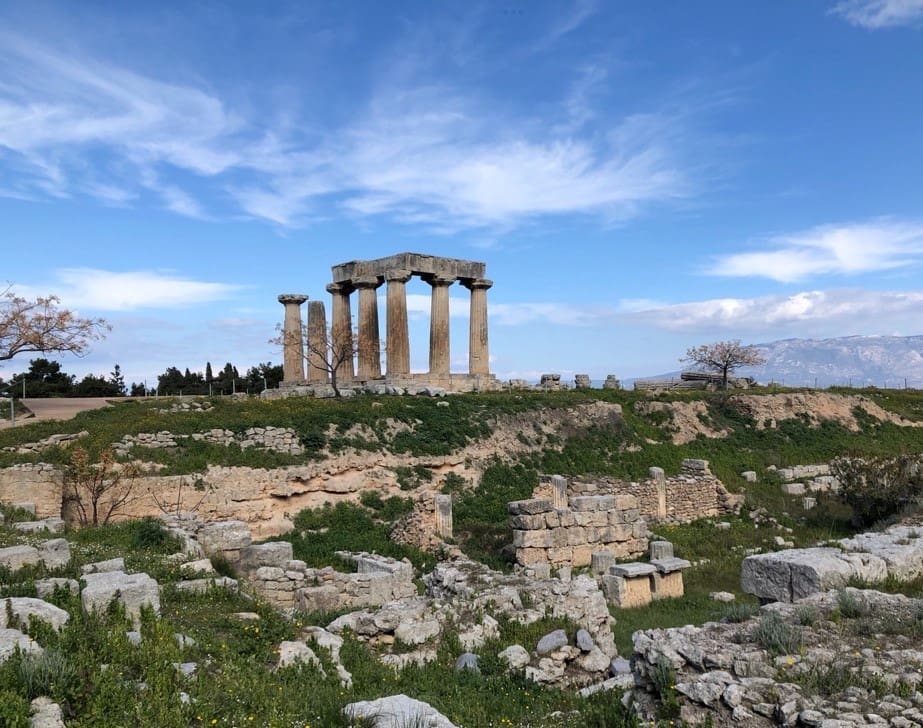
The Apostle Paul contended with the Stoic and Epicurean philosophers of Athens at the Areopagus. After this, he traveled down the Sacred Way to Corinth, which was one of Greece’s largest cities. Once in Corinth, God came to him in a vision and told him to not be afraid. God told him that when he preached, He would protect him. Paul stayed a year and a half in Corinth and saw many people come to Christ.
The new deputy of Achaia, Lucius Junius Gallio Annaeanus, was politically connected back in Rome. Gallio’s younger brother was the well-known Stoic philosopher and author Seneca, who was a mentor and advisor to Emperor Nero. When Gallio took command of the region, the enemies of Paul leaped at the chance to bring him to judgment before this powerful, connected man. However, as a Roman, Gallio cared nothing for the nuances of Jewish law, nor for disputes between Jews and Christians. His dismissal of their charges seems to have precipitated a riot, since the Greek residents of Corinth grabbed Sosthenes, the chief ruler of the synagogue, and beat him up in front of the judgment seat.
WATCH: A Lesson From Corinth
Even after experiencing this, the Book of Acts tells us that Paul continued on in Corinth preaching and teaching. Sometime before he was dragged before Gallio, Paul had led Crispus, the chief ruler of the synagogue, to the Lord, and then personally baptized him. (Acts 18:8, I Corinthians 1:14) We can surmise from the text that Sosthenes replaced Crispus as chief of the synagogue. Sosthenes was the man whom the Greeks beat up in front of the judgment seat for unknown reasons. In addition, we can guess that someone, probably Paul, led Sosthenes to the Lord as well. He is listed alongside Paul as one of the human authors of the First Epistle to the Corinthians. “Paul called to be an apostle of Jesus Christ through the will of God, and Sosthenes our brother, to the church of God which is at Corinth…” (I Corinthians 1:1-2a)
Through his actions in Corinth, the Apostle Paul teaches us to persist in our witnessing. God told Paul in a vision “Be not afraid, but speak, and hold not thy peace: For I am with thee, and no man shall set on thee to hurt thee: for I have much people in this city.” (Acts 18:9b,10) One of the people whom God had in the city of Corinth was Sosthenes, the ruler of the synagogue. In his position as a Jewish community leader, he contributed in the attempt to imprison Paul. Later, he became a brother in Christ who helped the Apostle to write a major book of the New Testament.
Just like Paul, we should not let persecution deter us from witnessing, even to our persecutors. We do not know the plans of God. Our fiercest enemies may become our dearest brothers and fellow laborers in Christ. Whoever your Sosthenes might be, keep witnessing!
Related Content:
Discover more from Enjoying the Journey
Subscribe to get the latest posts sent to your email.